A customer enters a UK VAT number during checkout, the payment session is waiting, and your tax logic sends the identifier to the wrong service. VIES returns no match, the buyer sees “invalid VAT number,” and a legitimate B2B order is abandoned before anyone checks whether the government database was the problem.
That failure is common because checking a VAT number in the UK is now a routing and reliability problem, not just a form validation task. GB numbers belong on the HMRC path, EU numbers generally belong on VIES, and a temporary outage or newly issued registration can produce an inconclusive result rather than a meaningful rejection.
For SaaS and B2B billing teams, the practical design target is clear: normalize input, route it correctly, preserve evidence, and distinguish invalid from unavailable. The following approach is built for checkout systems that have to keep working when an upstream tax service doesn't.
Table of Contents
- The Post-Brexit Reality of UK and EU VAT Routing
- Manual Validation and Official HMRC Tools
- Why Direct Government API Integrations Fail in Production
- Building a Resilient Validation Flow with TaxID
- Designing Checkout Forms for Compliance and Conversion
- Scaling B2B Billing Without Maintaining Tax Wrappers
The Post-Brexit Reality of UK and EU VAT Routing
The first architectural decision is the authority you call. On 1 January 2021, the European Commission stated that VIES stopped validating standard UK, or GB, VAT numbers after Brexit. Traders validating UK GB numbers must use the UK tax administration, while VIES continues to support EU member states and Northern Ireland under the Protocol on Ireland and Northern Ireland. See the European Commission's VIES guidance for the official distinction.
That means a single “European VAT validator” endpoint can't blindly send every identifier to VIES. A GB number routed there may appear invalid even when HMRC would confirm it. Northern Ireland requires separate handling, because its protocol status means it remains available through the VIES route.
Route by jurisdiction, not by geography
Your backend should identify the prefix before selecting a validator. In practical terms:
- GB identifiers: Send the request to HMRC's UK VAT service.
- XI identifiers: Use the VIES route for Northern Ireland where applicable.
- EU member-state identifiers: Send the request to VIES.
- Unknown or malformed identifiers: Return an input error before making a remote call.
Don't treat the country selected in a form as sufficient evidence. A buyer can choose the wrong country, paste a prefixed number into a field that expects digits only, or submit a value containing spaces and punctuation. Store the raw value for audit purposes, then normalize a separate value for validation.
Practical rule: A VIES “not found” result for a GB number is a routing failure until HMRC has been queried.
The post-Brexit split also affects exemption decisions and invoice workflows. A result from the wrong authority shouldn't be allowed to trigger reverse-charge or tax-exempt treatment, and it shouldn't automatically label the customer fraudulent. Teams working through the detailed UK and EU distinction can use this guide to intra-community VAT numbers and the UK as a complementary implementation reference.
Manual Validation and Official HMRC Tools
For a finance operator, supplier review, or developer testing a difficult case, the official GOV.UK checker remains the practical source of truth for UK validation. The official UK VAT checker has been available on GOV.UK since at least 1 December 2020, was last updated on 22 September 2026, and lets users confirm whether a UK VAT registration number is valid while returning the registered business name and address.
The manual process is simple, but the evidence you retain matters.
Use the checker deliberately
- Collect the identifier exactly as supplied. Keep the original entry in your internal record, including any prefix or spaces.
- Normalize the value for the HMRC request. HMRC's design guidance recommends a single text field and normalization to 9 digits, with optional spaces or a GB prefix accepted at the input boundary. Your frontend can be forgiving, while your backend sends a predictable representation.
- Review the returned identity. A valid response isn't only a Boolean. Compare the returned registered business name and address with the customer or supplier details.
- Choose the evidence level. An ordinary lookup can answer whether the number is recognized. A verified HMRC check can generate an acknowledgement or reference number, giving your workflow auditable proof of validation.
A useful normalization policy removes spaces around the value, handles an optional GB prefix consistently, and rejects unexpected letters or punctuation before the remote request. Do not strip arbitrary characters without warning, because turning a mistyped identifier into a different identifier makes later investigation difficult.
Keep validation separate from tax treatment
A successful HMRC lookup confirms the registration record returned by the service. It doesn't, by itself, decide every question about place of supply, customer establishment, or the tax treatment of a particular product. Your billing system should store the validation response, the lookup time, the authority used, and any reference returned by a verified check.
The same distinction applies to failed checks. A malformed value is an input problem. A validly formatted value with no match may need investigation. A service failure is an availability problem. Treating all three as “invalid” creates bad customer support trails and poor billing decisions. For a developer-focused walkthrough of the UK path, see this VAT validation guide for the UK.
Why Direct Government API Integrations Fail in Production
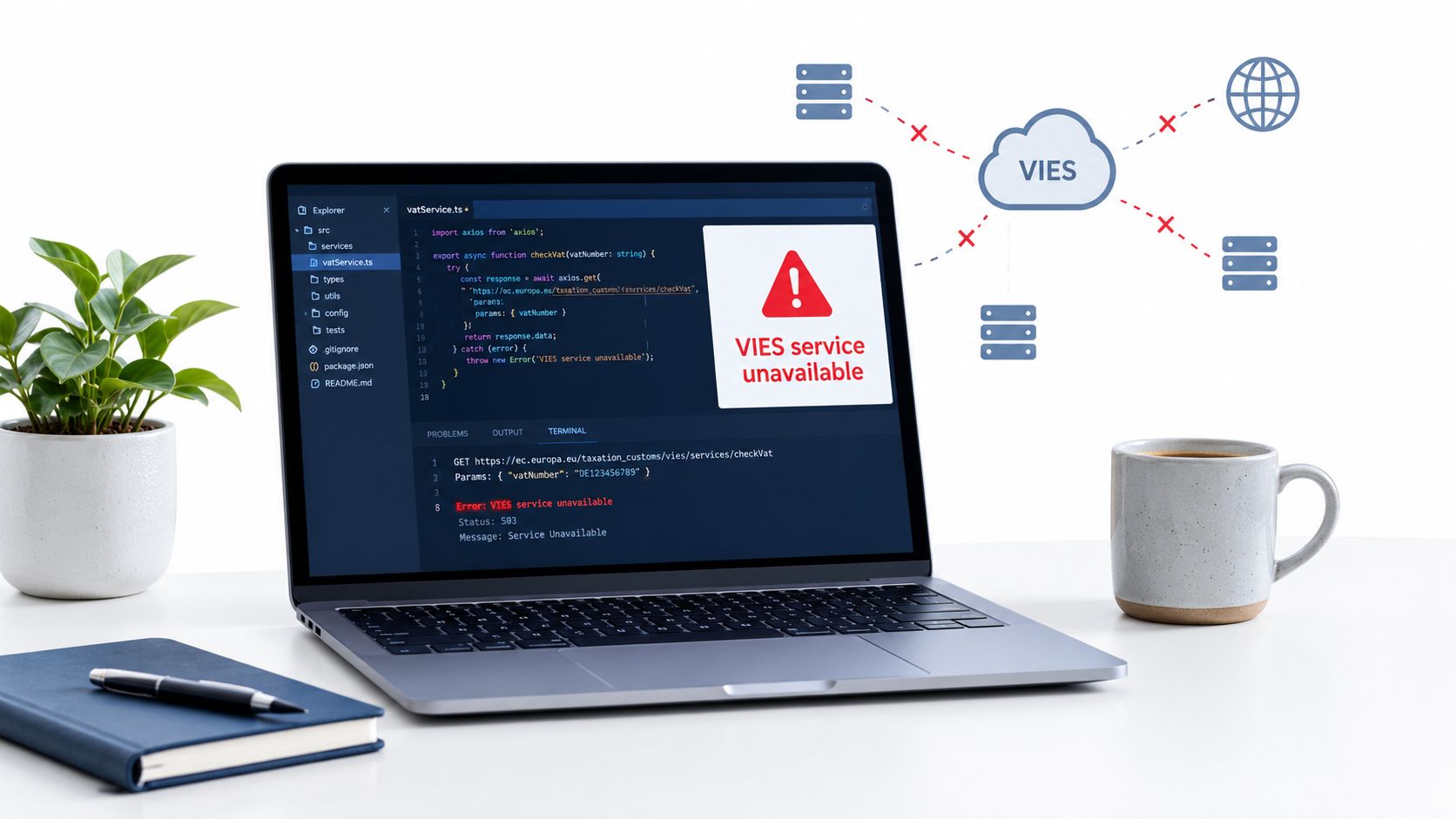
A direct government integration often works perfectly in a local test and still causes checkout incidents later. The reason isn't that the validation rule is complicated. The problem is that your application has to depend on an external authority whose availability, response format, and data freshness are outside your release cycle.
Official HMRC guidance says the service can miss new VAT registrations during maintenance windows, and its databases may lag by 48 hours after registration. A newly registered business can therefore be valid while remaining absent from the lookup result. The same service availability and issues guidance documents the operational conditions behind that gap.
“Not found” isn't one state
Your application needs more than a true or false result. At minimum, distinguish these outcomes:
| Outcome | Meaning | Checkout response |
|---|---|---|
| Valid | The authority returned a matching registration | Apply your configured billing workflow |
| Invalid | The authority completed the check and found no valid match | Ask the buyer to review the identifier |
| Unavailable | The authority timed out, failed, or entered maintenance | Preserve the order and route for later review |
| Delayed visibility | The registration may be too new to appear | Ask for supporting details or retry later |
This distinction is especially important for B2B SaaS. Blocking a buyer because HMRC or VIES timed out turns an infrastructure incident into lost revenue and a support ticket. Accepting every failed check as proof of validity creates a different risk, because your invoice record no longer explains what was verified.
Build for failure before adding retries
Retries can help with transient network faults, but they can't fix a maintenance window or registration lag. Set bounded timeouts, use controlled retry behavior, and return a machine-readable state to the checkout layer. Log the authority, normalized identifier, request time, response class, and correlation identifier without exposing more customer data than your retention policy requires.
Cache successful validations according to your compliance policy, and retain the timestamp rather than pretending that a past result is a permanent fact. When an upstream service is unavailable, show a review path instead of an accusation. The VIES downtime resilience reference is useful when designing that failure model.
Building a Resilient Validation Flow with TaxID
A practical abstraction should hide routing differences without hiding the result's meaning. TaxID provides a single REST endpoint for VAT and company identification checks, routing UK and EU requests to the relevant authority and returning structured validation data. It can be used as one option when you don't want checkout code to manage separate HMRC and VIES integrations.
Start with a narrow backend boundary. The browser submits the customer's country and raw VAT input to your server. Your server normalizes the value, calls the validation service, maps the response into your own domain model, and sends the checkout only the state it needs.
Keep the response useful to downstream systems
A clean internal result might contain:
- Authority: HMRC or VIES.
- Status: valid, invalid, unavailable, or pending review.
- Identity: registered name and address when returned.
- Evidence: lookup timestamp and any verification reference.
- Input record: raw and normalized values.
TaxID documents machine-readable errors such as vat_invalid and service_unavailable, which is preferable to matching brittle human-readable error text. Your application can map vat_invalid to an inline correction message while mapping service_unavailable to a non-blocking review state.
Caching is another important boundary. Successful responses can be cached according to your legal and operational policy, while failures should have shorter handling windows because an outage or registration delay can change the result. Never cache an unavailable response as though it were a confirmed invalid registration.
A typical request lifecycle looks like this:
- Accept one flexible text field.
- Normalize the identifier and determine the jurisdiction.
- Check an approved cache entry.
- Call the selected validation route when necessary.
- Persist the result and timestamp.
- Let the billing system decide whether to apply the relevant tax treatment.
The key is that validation and checkout authorization remain separate. A service outage should produce a controlled review state, not an exception that crashes the payment session.
Test the unhappy paths explicitly. Include a GB number sent through the UK route, an EU number sent through VIES, malformed input, a valid-looking value with no match, a timeout, and a newly issued registration that isn't visible yet. Observability should tell your team which authority failed and whether the customer was blocked, allowed to continue, or sent to manual review.
Designing Checkout Forms for Compliance and Conversion
The form is where tax logic becomes a customer experience. A legitimate buyer doesn't know whether “VAT number invalid” means a typo, a routing error, a newly registered business, or a government outage. Your interface should expose the next useful action instead of forcing the buyer to diagnose your integration.
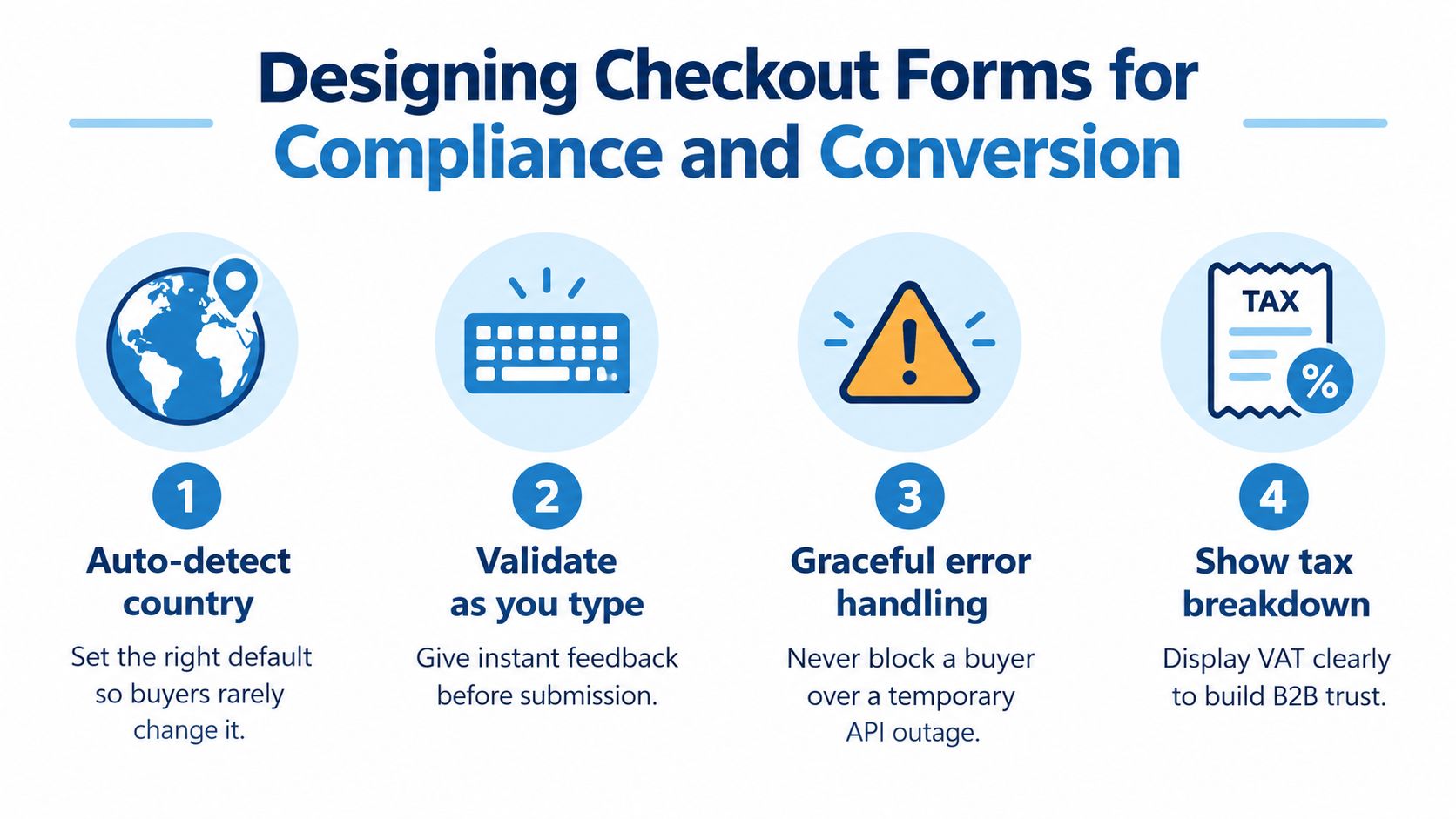
HMRC recommends a single text field and normalization to 9 digits, with optional spaces or a GB prefix accepted at the boundary. That pattern keeps the form simple while letting the backend enforce a stable representation. Explain the expected format beside the field, but don't make customers manually remove every space before submission.
Give each failure a different message
A malformed value deserves a correction prompt. A completed negative lookup can ask the buyer to verify the number and legal entity. An unavailable service should say that validation couldn't be completed and offer a route to continue with review.
Inline validation can run after the user pauses typing or leaves the field, but it shouldn't make a remote call on every keystroke. Debounce requests, avoid displaying a success state before the authority responds, and keep the entered value intact when a call fails. This prevents the frustrating loop where a temporary outage wipes the buyer's work.
Tax evidence belongs in the order record, not only in the UI. Store the normalized identifier, authority, timestamp, returned company identity, and reference number when the verification mode provides one. Show a clear VAT breakdown on the invoice and checkout summary, so the buyer can see what the system applied and your finance team can reconstruct the decision later.
A resilient checkout doesn't hide uncertainty. It labels uncertainty and gives the customer a safe next step.
The tax field also has to coexist with the rest of the payment architecture. If you're deciding between hosted and customizable payment experiences, this comparison of Plus vs standard checkout APIs can help frame the trade-off between implementation control and platform-managed behavior. Whatever your choice, don't let a tax-service timeout turn into an irreversible payment failure.
Scaling B2B Billing Without Maintaining Tax Wrappers
The build-versus-buy decision changes as soon as VAT validation becomes part of every invoice, supplier workflow, and checkout. An in-house wrapper may begin as a small HTTP client, then grow into routing rules, normalization, retries, caching, response parsing, audit storage, alerting, and operational runbooks for two different authorities.
That maintenance burden competes with product work. A small SaaS team might reasonably build a narrow HMRC integration for an internal workflow, especially when it controls the entire process and can tolerate manual review. A billing platform serving multiple countries has a different problem. It needs consistent responses, clear failure states, and an upgrade path when an authority changes its service behavior.
Use a simple decision test
Build internally when all of these are true:
- Scope is narrow: You serve one jurisdiction and one controlled workflow.
- Review is available: Finance staff can resolve uncertain results manually.
- Operations are owned: Someone monitors failures and maintains the integration.
- Evidence is sufficient: Your system records the lookup context needed for audits.
Use an infrastructure layer when the opposite is true. A service such as TaxID can provide one integration surface for UK and EU validation, structured company identity data, and machine-readable availability failures. The value isn't removing your tax responsibility. It's keeping external-service plumbing out of every checkout and billing component.
Before shipping, review broader common B2B billing mistakes alongside VAT-specific failure modes. Teams often focus on the tax formula and overlook duplicate invoices, missing evidence, incorrect customer identity, and outage behavior. Those are engineering problems, but they become finance problems when the system reaches production.
The durable approach is to treat validation as an observable dependency. Store what you checked, where you checked it, when you checked it, and whether the authority answered. That model scales better than a Boolean field named vat_valid, because it preserves the difference between a confirmed result and an unresolved operational event.
TaxID provides a developer-first API for UK and EU VAT validation, including authority routing, structured company details, and machine-readable unavailable states. Use TaxID to test a resilient validation flow, keep checkout logic defensive, and give your finance team evidence they can use.