A customer enters a French VAT number during SaaS checkout. Your Node.js backend sends it to the European Commission's VIES service, waits on a SOAP response, and receives an unhelpful fault. The customer sees a generic validation error, the invoice can't apply the intended tax treatment, and finance starts a manual email exchange.
That's the practical reason teams use a company data API. The value isn't just returning a company name or an address. It's turning fragmented registry lookups, inconsistent errors, slow upstream services, caching, and audit requirements into a predictable integration for billing, invoicing, checkout, and compliance. VIES has operated since the EU single market began in 1993, but its SOAP interface still leaves application teams responsible for much of the reliability work (PlainVAT's explanation of VIES validation).
Table of Contents
- What Happens When a VAT Number Fails at Checkout
- How Company Data APIs Are Structured for Reliability
- TaxID vs General Company Data Providers
- Caching, Consistency, and Audit Timestamps
- GDPR, Lawful Basis, and Legal Usability
- Building vs Buying for Checkout and Invoicing
What Happens When a VAT Number Fails at Checkout
The failure usually starts innocently. A developer adds a VAT field, submits the value to VIES, and treats a successful response as a green light for reverse-charge invoicing. That approach works in a happy-path test. Production adds malformed input, unavailable registries, ambiguous results, slow SOAP calls, retries, duplicate submissions, and customers who enter a number belonging to a different legal entity.
A raw VIES integration also exposes an awkward boundary between technical and financial responsibility. The developer sees a SOAP fault or timeout. The billing system sees no authoritative validation. Finance sees an invoice that may have the wrong customer identity or tax treatment. The customer sees “VAT number invalid” without knowing whether the number is invalid or the registry did not answer.
Practical rule: A failed upstream request isn't the same thing as an invalid company identifier.
A company data API abstracts that distinction into a response your application can handle deliberately. It can return a normalized status, registered company name, address, country, validation timestamp, and a machine-readable error such as an invalid identifier or unavailable service. The checkout can then decide whether to block tax exemption, allow the customer to continue with standard tax handling, or place the invoice in a review queue.
The fields matter because billing needs more than a Boolean result. A valid status helps determine whether a number exists. The registered name and address help compare the registry record with the legal customer details entered in the account. The timestamp and consultation reference help explain what the system knew when the transaction occurred. For practical guidance on the wider problem, the discussion of cross-border VAT compliance for e-commerce is useful because a lookup is only one part of a compliant sales flow.
Why naive integrations break
The common first implementation places a synchronous registry call directly in the checkout request. That couples conversion to an external service whose availability and response format you don't control. A timeout becomes a checkout error, while an upstream outage can look identical to a bad VAT number unless your wrapper preserves the distinction.
The other mistake is to parse human-oriented SOAP text inside business logic. Error strings change, contain limited context, and force every consuming service to interpret the same brittle response independently. A stable company data API should instead expose consistent statuses and error codes, while retaining the raw upstream response for investigation and audit.
Your own data model should also separate the customer's submitted identifier from the normalized identifier and the registry response. The lookup record should include the country, normalized value, result status, returned legal identity, source, validation time, and any review decision. A practical implementation guide for business registration number lookup can help when the workflow needs to support more than VAT validation.
The shift is important. Company data isn't a decorative enrichment step added after signup. In a B2B checkout, it sits between customer input and the legal identity printed on an invoice. Treat it as a compliance dependency with explicit failure states, not as a convenience field.
How Company Data APIs Are Structured for Reliability
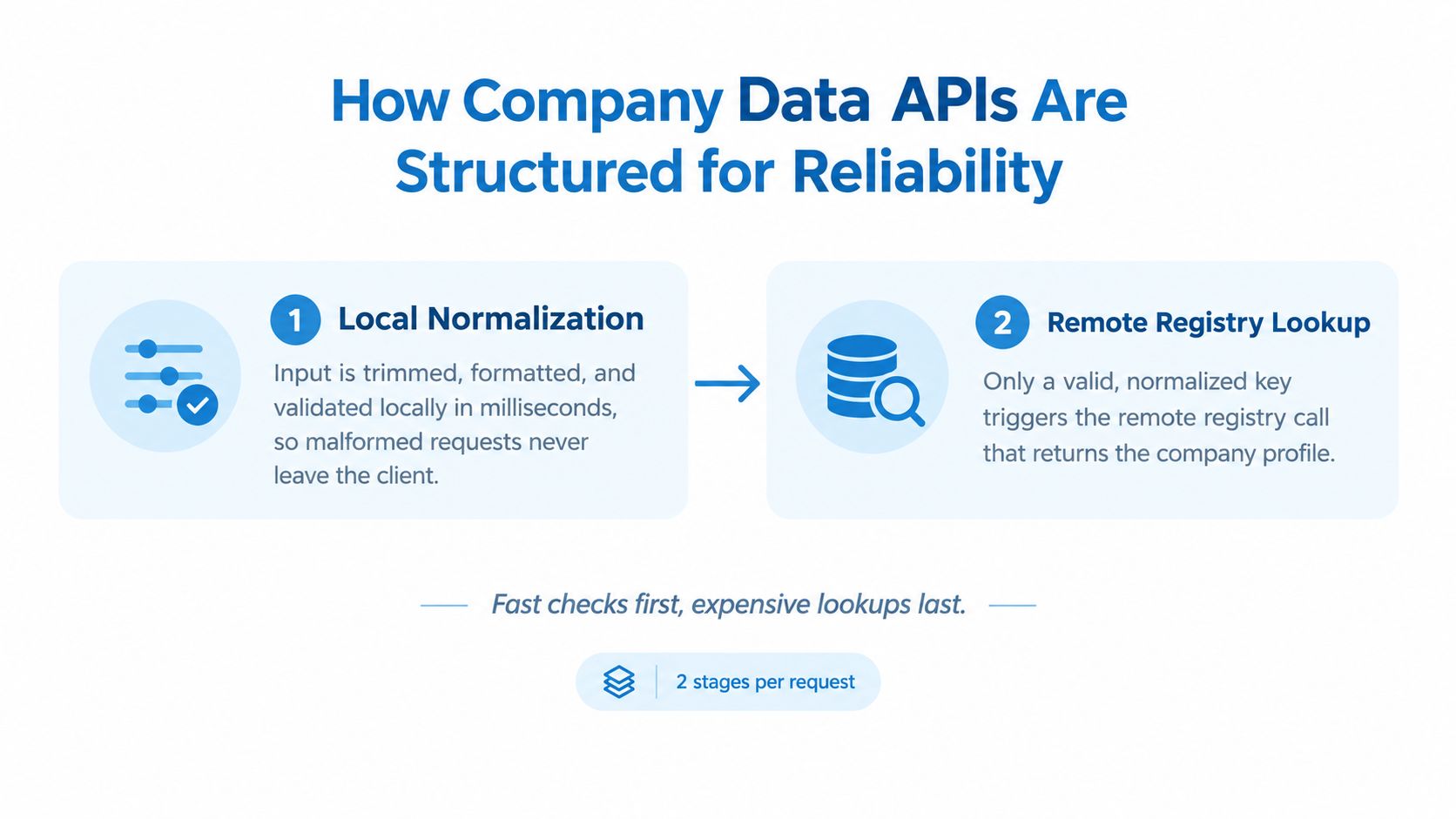
A reliable integration rejects cheap failures locally and reserves remote calls for inputs worth checking. Most production designs use two stages:
- Local normalization and format validation. Trim whitespace, normalize separators and casing, identify the country, and apply country-specific structural rules.
- Remote registry lookup. Send only a normalized identifier that passes local checks to the relevant registry or provider.
That sequence reduces unnecessary upstream requests and limits the number of cases exposed to network latency. The pattern is described in EuroValidate's implementation guidance, which also discusses caching successful results for 24 hours as a way to absorb repeated lookups.
A request flow that survives real traffic
The request path should be explicit:
- Receive: Accept the country and submitted identifier.
- Normalize: Remove presentation-only spacing and punctuation without changing the legal identifier.
- Validate locally: Reject values that fail the country's known format rules.
- Read the cache: Return a recent, successful result when policy allows.
- Call the registry: Query the remote source only on a cache miss.
- Persist evidence: Store the result, source, response metadata, and original validation time.
- Map the outcome: Return a stable application status such as valid, invalid, unavailable, or needs review.
The local stage should be deterministic and fast. It must not claim that a company exists. It only answers whether the input is plausible enough to justify a registry lookup. A format-valid number can still be unregistered, inactive, mistyped, or associated with different company details.
The remote stage needs its own timeout, retry, and circuit-breaker policy. Retrying every failure immediately can multiply load during an outage and make the checkout slower. A better design distinguishes invalid responses, temporary unavailability, authentication failures, rate limits, and malformed provider responses. The application can then choose a customer-facing response for each class instead of showing one generic error.
API and webhook decisions
A synchronous API call fits a checkout when the customer needs an immediate validation decision. A webhook or queue works better for supplier onboarding, back-office review, and periodic reconciliation, where the user doesn't need to wait for the upstream registry. The practical choice depends on whether the caller needs a response now or an event later. The comparison of webhook and API patterns is a useful reference when designing that boundary.
Caching introduces another important distinction. A cache-hit response can be immediate, but its speed doesn't make the data newly validated. Keep the original registry validation timestamp separate from the time your application served the cached response. That separation becomes essential when billing asks why a later registry change didn't alter an earlier invoice.
For teams integrating media into developer documentation or onboarding, the following walkthrough can sit after the request-flow explanation:
TaxID vs General Company Data Providers
A broad company enrichment platform and a specialized VAT validation service solve different problems. The broad platform may aggregate corporate profiles, officers, industry information, ownership data, and registration records. A focused VAT provider concentrates on the narrower question that billing systems need: does this identifier validate, which legal entity does it represent, and can the result be used consistently inside a revenue workflow?
Coverage is the first distinction, but it shouldn't be the last. CompanyData's public API documentation describes an aggregation model covering 400M+ companies, 605M+ officers, 200+ countries, and 1,200+ official registers (CompanyData API documentation). Those figures illustrate the appeal of a general provider. They also show why a large database does not automatically answer a VAT compliance question. More fields can mean more sources, more licensing terms, and more variation in freshness and permitted use.
Compare the operational fit
| Provider Type | Coverage Focus | Best For | Limitations |
|---|---|---|---|
| Specialized VAT and company-ID API | Tax identifiers, registry validity, legal name, address, country-specific validation | SaaS billing, B2B invoicing, VAT exemption, marketplace checkout | Narrower enrichment depth outside legal identity and tax validation |
| General company enrichment API | Broad company profiles, officers, business attributes, and multi-register aggregation | Sales intelligence, account research, onboarding enrichment | May require extra logic for VAT semantics, provenance, and billing-specific failures |
| Direct national registry integration | One jurisdiction or registry with direct source access | Teams with a narrow country footprint and strong internal compliance expertise | Multiple integrations, inconsistent interfaces, and higher maintenance burden |
| Internal wrapper around VIES or registries | Custom response model over selected upstream services | Organizations with unusual workflows and existing registry operations | The team owns SOAP behavior, outages, retries, monitoring, and evidence retention |
A specialized API earns its place when the failure mode is financial rather than merely informational. Checkout needs a clear answer quickly. Invoice creation needs a stable legal identity. A compliance queue needs to distinguish “invalid” from “service unavailable.” Those requirements favor normalized responses and explicit error codes over a large, loosely structured record.
Where broad enrichment is enough
A general provider can be appropriate when VAT validation is only one small part of a research workflow. If a sales team wants to identify companies, enrich accounts, or inspect officer relationships, a specialized tax endpoint won't replace the wider dataset. The right question is whether the API's source rights, update behavior, and fields match the decision being made.
For a billing flow, evaluate the provider with a test harness rather than a feature checklist. Submit valid and invalid identifiers, malformed values, countries with different formatting rules, duplicate requests, unavailable responses, and records whose returned legal name doesn't match the customer's typed name. Inspect the raw and normalized responses, error stability, cache behavior, and audit metadata.
TaxID is one example of the specialized route. Its public product description states that it wraps VIES and other country routes behind a REST endpoint, returns structured company details, performs country-specific checks before remote calls, and uses Redis-backed caching. Those features address the integration burden directly, but they don't remove your responsibility to define how a mismatch or unavailable lookup affects an invoice.
The choice comes down to decision risk. Use broad enrichment when you need a broad company picture. Use a focused VAT and company-data service when a legal identity decision must be repeatable, explainable, and safe to embed in the payment path.
Caching, Consistency, and Audit Timestamps
Registry data changes more slowly than most application teams assume, but “slowly” doesn't mean “never.” A company can update its registered address, change status, or correct an identifier after your system has already issued an invoice. Treating every lookup as perfectly real-time creates unnecessary latency. Treating every cached result as permanent creates audit and compliance problems.
A practical reliability model treats registry responses as eventually consistent. Guidance on EU tax-number validation describes reusing a positive result for 24 to 48 hours, while preserving the original validation timestamp and response hash for audit purposes (Cleverence's validation guidance). The cache window should be a policy decision based on the workflow, not a hidden implementation detail.
Store two different times
The first time is the evidence time, when the remote registry or validation service produced the result. The second is the served time, when your application returned that result from cache. They answer different questions.
Evidence time answers, “What did the source say when we checked?” Served time answers, “When did this customer or internal service receive the result?” If a billing analyst sees only the cache-hit timestamp, they may incorrectly conclude that the registry confirmed the company after a later status change.
A useful validation record contains:
- Submitted value: Exactly what the user or source system provided.
- Normalized value: The canonical value used for validation.
- Source and route: The registry or provider path used.
- Result: Valid, invalid, unavailable, or another explicitly defined state.
- Legal identity: Returned name and address where available.
- Evidence timestamp: When the source response was generated.
- Served timestamp: When your system returned the result.
- Response hash: A stable fingerprint of the raw response.
- Cache metadata: Whether the response was a hit, miss, refresh, or stale fallback.
- Decision record: How billing or compliance used the result.
Raw-response storage needs access controls and a retention policy. Don't log sensitive payloads indiscriminately into application logs where they can spread across development and monitoring systems. Store the evidence in a controlled audit store, redact fields that aren't needed, and make the retention period match the legal and operational purpose.
A checkout cache also needs a failure policy. A successful cached result may let the customer continue during a temporary upstream outage. A stale or missing result shouldn't become a fresh validation on its own. If the business permits a manual review path, mark the invoice clearly and preserve the unresolved state rather than forcing an operator to infer it later.
For teams optimizing a store checkout, the principles behind a fast WooCommerce checkout with caching are relevant, but VAT caching still needs evidence semantics on top of response speed. The implementation details for VAT API rate limiting and caching are also useful when repeated customer submissions and automated retries hit the same validation endpoint.
GDPR, Lawful Basis, and Legal Usability
The most important provider question may not be “How many fields do you return?” It may be “Can we explain why we have this data, where it came from, how long we keep it, and whether we're allowed to share it with the next system?”
A company record can look public and still carry obligations. The provider may aggregate national registries under different access terms. A contract may restrict redistribution. A downstream CRM, billing platform, or support tool may retain the returned name and address longer than the original workflow requires. In EU and UK operations, those details can outweigh a richer enrichment profile.

Build a provenance record
A provider should be able to tell you which official register or source supports the response, what the service is permitted to do with that data, and how it handles corrections. VIES itself is a federated search service that queries national VAT registries rather than a single standalone database, which makes source routing and response context worth recording (PlainVAT's VIES overview).
Before production, document:
- Purpose: Is the lookup for tax treatment, invoice accuracy, fraud prevention, supplier verification, or another defined business need?
- Lawful basis: Which legal basis supports collecting and processing the submitted identifier and returned company details?
- Source provenance: Which registry or provider supplied the result, and can the path be reproduced?
- Retention: How long will the raw response, normalized value, and audit record remain available?
- Access: Which services and staff can view the returned identity data?
- Sharing: Can the response be sent to payment, CRM, analytics, or support systems?
- Correction process: What happens when the customer disputes a mismatch or the registry is wrong?
A positive lookup doesn't automatically authorize every downstream use. Validation for an invoice is a narrower purpose than building a prospecting database. Keep those purposes separate in system design and provider evaluation.
Reproducibility beats field count
A regulated billing workflow needs to reproduce its decision later. That means storing the response context, source, timestamp, and decision rules, not merely copying a company name into a customer table. If a provider can't explain its provenance or contract terms, a large response payload may increase risk rather than reduce it.
Legal usability becomes a selection criterion. Ask whether the provider supports audit exports, documents data sources, explains retention, and states restrictions on onward transfer. Ask the same questions of your own systems. A compliant provider can't compensate for an application that logs every response forever or exposes registry data to every internal user.
The right design minimizes data while preserving evidence. Store what the invoice and audit process needs, restrict the rest, and make every use of company data traceable to a documented business purpose.
Building vs Buying for Checkout and Invoicing
Building a thin wrapper around VIES looks easy until it becomes a revenue dependency. The first version may handle a successful SOAP response. The production version needs country-specific normalization, timeouts, retries, circuit breaking, cache invalidation, structured errors, monitoring, incident handling, raw-response evidence, and a policy for ambiguous matches.
That work is not difficult because the code is mysterious. It's difficult because every edge case lands in a customer-facing flow. A registry outage can block checkout. A parser change can misclassify an error. A retry storm can worsen an upstream incident. A missing audit timestamp can leave finance unable to explain why an invoice received its tax treatment.
When an in-house wrapper makes sense
Build internally when your organization already operates registry integrations, needs a restricted country scope, has a compliance team that owns source and retention decisions, and can support the service after launch. Direct integration can be reasonable when the custom behavior is genuinely valuable and the team accepts the continuing maintenance burden.
Buy a specialized API when VAT validation is important but not strategic, especially if your main product is SaaS billing, B2B checkout, or invoicing. A service such as TaxID provides a REST endpoint, structured JSON responses, country-specific validation routing, caching, and machine-readable failures. Those abstractions let your team spend time on billing rules and customer experience instead of maintaining a SOAP adapter.
Use tax compliance automation as a broader design lens, but keep the boundary clear. An API can validate identity and provide evidence. Your application still decides whether to apply exemption, request manual review, issue an invoice, or stop the transaction.
Ask these questions before choosing:
- Does the service fit your Node.js, Python, Stripe, WooCommerce, or custom checkout stack?
- Can it distinguish invalid identifiers from unavailable registries?
- Does it preserve validation evidence separately from cache-hit time?
- Can your team test and monitor outage behavior?
- Are the source rights, lawful basis, retention, and downstream sharing terms documented?
- Does the cost of maintaining an internal wrapper justify the control it provides?
A company data API is worth buying when it removes operational uncertainty from a regulated path. It isn't a shortcut around tax policy, but it can give your application a stable validation layer instead of making checkout depend directly on a fragile upstream interface.
TaxID provides a REST API for validating VAT and company identification numbers, returning structured validation results and registered company details while handling country-specific checks, caching, and machine-readable failures. Visit TaxID to evaluate the integration for your checkout, invoicing, or compliance workflow.