Table of Contents
- Protect Checkout Revenue With EU VAT Validation
- Build Reliability Into the Checkout
- From Input to Billing Decision
- Map Each Failure to a Billing Decision
- Log Failures You Can Actually Investigate
- Build Cache Keys the Right Way
- Plan for Cache Misses and API Failures
- Can an EU VAT Code Checker Validate Non-EU IDs
- What to Do When VIES Goes Down
- How to Handle High Validation Volumes
Protect Checkout Revenue With EU VAT Validation
Treating VAT validation as a final compliance checkbox creates avoidable friction. A B2B customer might enter a perfectly valid German VAT number, yet your checkout still slaps on 19% German VAT, forcing your support team to issue a refund later. On the flip side, accepting an invalid exemption leaves your business holding the bag for tax you never collected.

A solid checker turns that guesswork into a predictable API response. Take TaxID, for instance. You pass it a country code and VAT number, and it hands back validation status, the registered company name, and the address in clean JSON.
That data lets your billing logic react on the spot:
- Valid number: apply the reverse-charge treatment for an eligible B2B sale.
- Invalid number: keep the normal local VAT rate and ask the buyer to fix their entry.
- Unavailable service: resist the urge to treat the customer as exempt, and route the order for manual review or a retry.
Key takeaway: Distinguish between an invalid tax ID and a temporary validation outage. They demand fundamentally different billing decisions.
Build Reliability Into the Checkout
EU VAT rates vary wildly. As of January 2026, standard rates span from 17% in Luxembourg all the way up to 27% in Hungary, according to the Tax Foundation's European VAT rate overview. Getting the status wrong doesn't just annoy customers — it eats directly into your margin.
Before you accept any exemption, normalize the country prefix, verify the expected format, and log the response alongside the invoice. Then cache successful checks for a short window, but keep enough audit detail on hand to explain exactly why VAT was or wasn't charged. Your future self (or your accountant) will thank you.
A EU VAT code checker doesn't query a single central database. The European Commission's VIES system routes requests to individual national tax administrations. This creates a reliable source for compliance but also means you're dependent on the uptime and behavior of multiple government systems.
VIES reportedly handles up to 17 million consultations daily, so occasional timeouts, instability, and unclear responses are just part of normal operations. Its legacy SOAP interface can throw technical errors that are tough for a checkout or billing service to interpret gracefully.
Key takeaway: A number that passes format validation and a number that passes remote verification are two different things. Your application needs to handle both outcomes independently.
From Input to Billing Decision
In a production environment, a VAT validation flow should look something like this:
- Normalize the input. Strip spaces, punctuation, and extract the country prefix.
- Run a country-specific format check before you ever touch a remote API. This catches obvious typos instantly and saves you unnecessary VIES calls.
- Check a cache layer. Redis or a similar key-value store works well here. If you've validated this ID recently, pull the stored result.
- Call VIES only when you need to. Specifically after the format check passes and you get a cache miss.
- Translate the response. Convert whatever SOAP envelope comes back into a simple status, company name, and address that your billing logic can work with.
This upstream layer does two things: it shields your application from raw government-service failures, and it gives your customers faster feedback. That speed really matters when the same B2B account runs repeated checks during onboarding or procurement workflows.
TaxID offers 24-hour Redis-backed caching, with cached responses returning in under 10 milliseconds. That's a meaningful difference when VAT validation runs inside a checkout flow rather than a back-office batch job.
For a deeper technical breakdown, check out this guide to VIES VAT number validation.
One thing worth calling out: cache successful results with a reasonable expiry, but treat service-unavailable responses differently from confirmed invalid IDs. A temporary VIES outage should trigger retry or manual review logic, not permanently block a legitimate customer from completing their order.
How a Production EU VAT Code Checker Should Work
Keep checkout logic separate from the verification mechanics — that's the core principle. Once you've set up a TaxID account and pulled your API key, send the buyer's country code and a normalized VAT number in a POST request.
const response = await fetch("https://api.taxid.dev/v1/validate", {
method: "POST",
headers: {
Authorization: Bearer ${process.env.TAXID_API_KEY},
"Content-Type": "application/json"
},
body: JSON.stringify({ country: "DE", vat_number: "123456789" })
});
const result = await response.json();
The API hands back a clean JSON payload with validation status, company name, and address when available. Map that status straight to your Stripe tax logic at the server level — don't leave the decision about whether an exemption applies to frontend code.
valid— proceed with reverse-charge treatment in your B2B workflow.invalid— apply the local VAT rate and ask for corrected details.unavailable— pause, retry, or flag the transaction for manual review.
The TaxID Node.js VAT API quickstart walks through the setup in more detail if you're wiring this up for the first time.
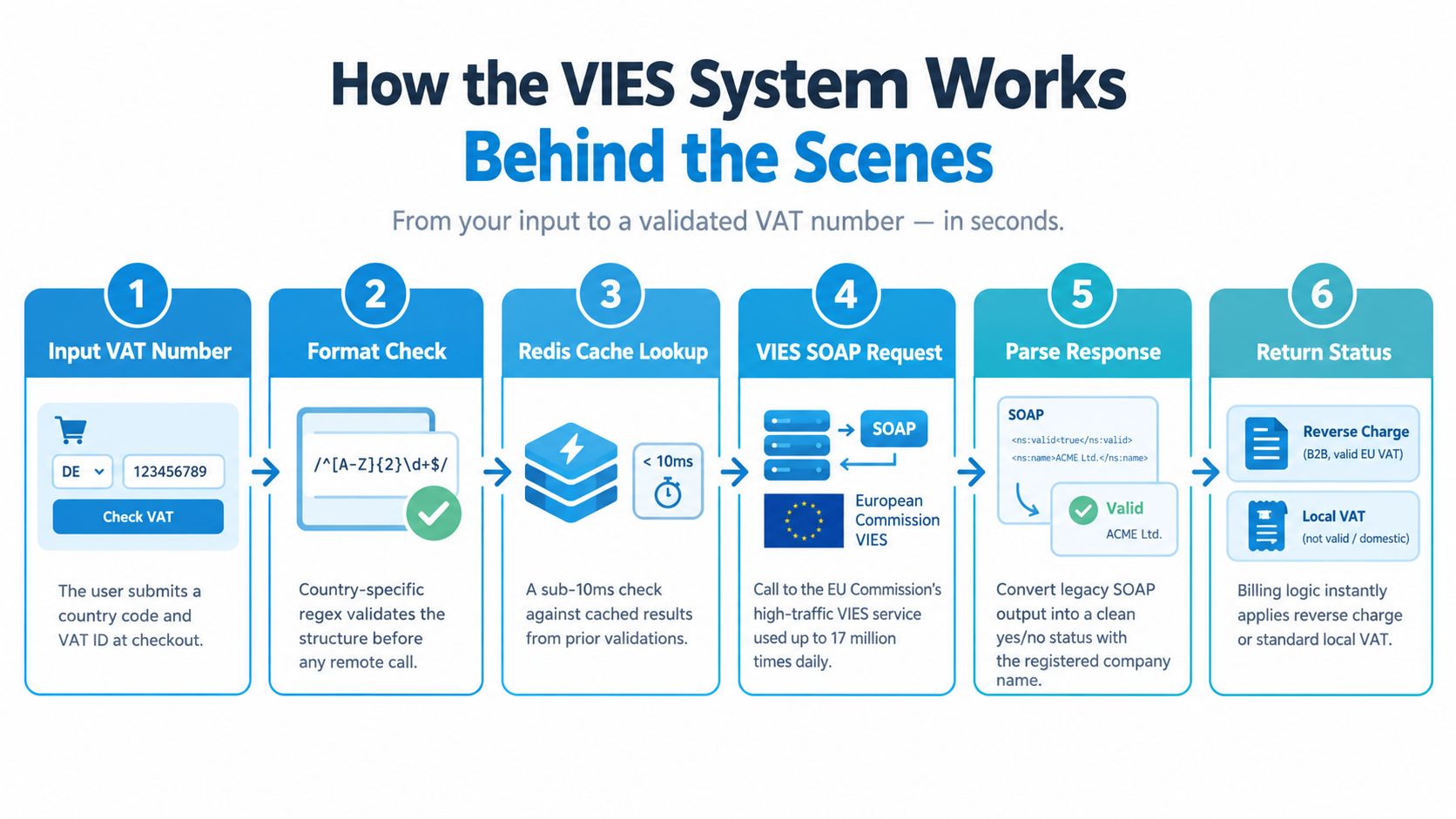
The infographic above traces the full path: checkout input, format checks, cache lookup, VIES verification, response parsing, and the final billing decision.
What it really drives home is that format validation and remote verification are distinct stages. A cache lookup can return a recent answer in milliseconds, while TaxID keeps your application from having to deal with raw SOAP responses when you need a fresh check against VIES.
Practical rule: Never treat a timeout as if the VAT number is invalid. Keep those outcomes separate in your logs, invoices, and retry logic.
For recurring customers, cache successful results for a set window and record the verification timestamp alongside each invoice. If you're running a Stripe-based SaaS, that audit trail saves a lot of headache during reconciliation. A few other things worth getting right from the start:
- Store your API key in environment variables — never in client-side code.
- Validate inputs server-side before hitting the API.
- Never expose credentials in browser requests.
Run through the full flow with valid, invalid, and temporarily unavailable responses before you turn on reverse charge in production. It's a small test matrix, but it catches billing mistakes before they reach real customers.
A failed API call doesn't mean the VAT number is actually invalid. Timeouts, rate limits, and VIES outages happen all the time, and your EU VAT checker needs to draw a clear line between those temporary hiccups and a genuine validation failure — especially before you change how you tax a customer.
TaxID makes this easier by returning machine-readable status codes, like vat_invalid and service_unavailable, in a format similar to what Stripe uses. That lets your checkout flow decide whether to reject the exemption, retry the lookup, or complete the order with a flag for manual review.
Map Each Failure to a Billing Decision
Don't wrap everything in a generic catch block and treat every exception as "invalid." Sort responses by what actually happened:
vat_invalidmeans the number didn't pass validation. Prompt the buyer to double-check their country prefix and digits, then apply the correct local VAT rate.service_unavailablepoints to a temporary problem on the provider or VIES side. Retry with exponential backoff, fall back to a recent cached result if you have one, or queue the order for review.- Authentication or malformed request errors are almost always your own integration issue. Route those to engineering — don't show a cryptic tax error to your customer.
Practical rule: Never turn a timeout into a permanent rejection. A real business shouldn't lose an order just because a government service was down for a minute.
Here's a compact Node.js example that keeps these cases separate:
try {
const result = await validateVat(country, vatNumber);
if (result.status === "valid") {
return applyReverseCharge();
}
return chargeLocalVat();
} catch (error) {
if (error.code === "service_unavailable") {
await flagForReview();
return chargeLocalVat();
}
throw error;
}
Log Failures You Can Actually Investigate
Capture the error code, country code, request timestamp, correlation ID, and the decision your system made — but resist the urge to log personal data you don't need. Set up dashboard alerts for spikes in service failures, particularly when error rates climb across multiple EU member states at once.
When the service is flaky, cap your retries so checkout requests don't spiral out of control. A brief exponential backoff followed by a manual review protects both the customer experience and your revenue, while giving finance a clean audit trail to work with.
Your EU VAT code checker doesn't need to hit the validation API on every single order. When B2B customers place back-to-back orders or register multiple accounts, repeated checks create real friction at checkout — and real latency.
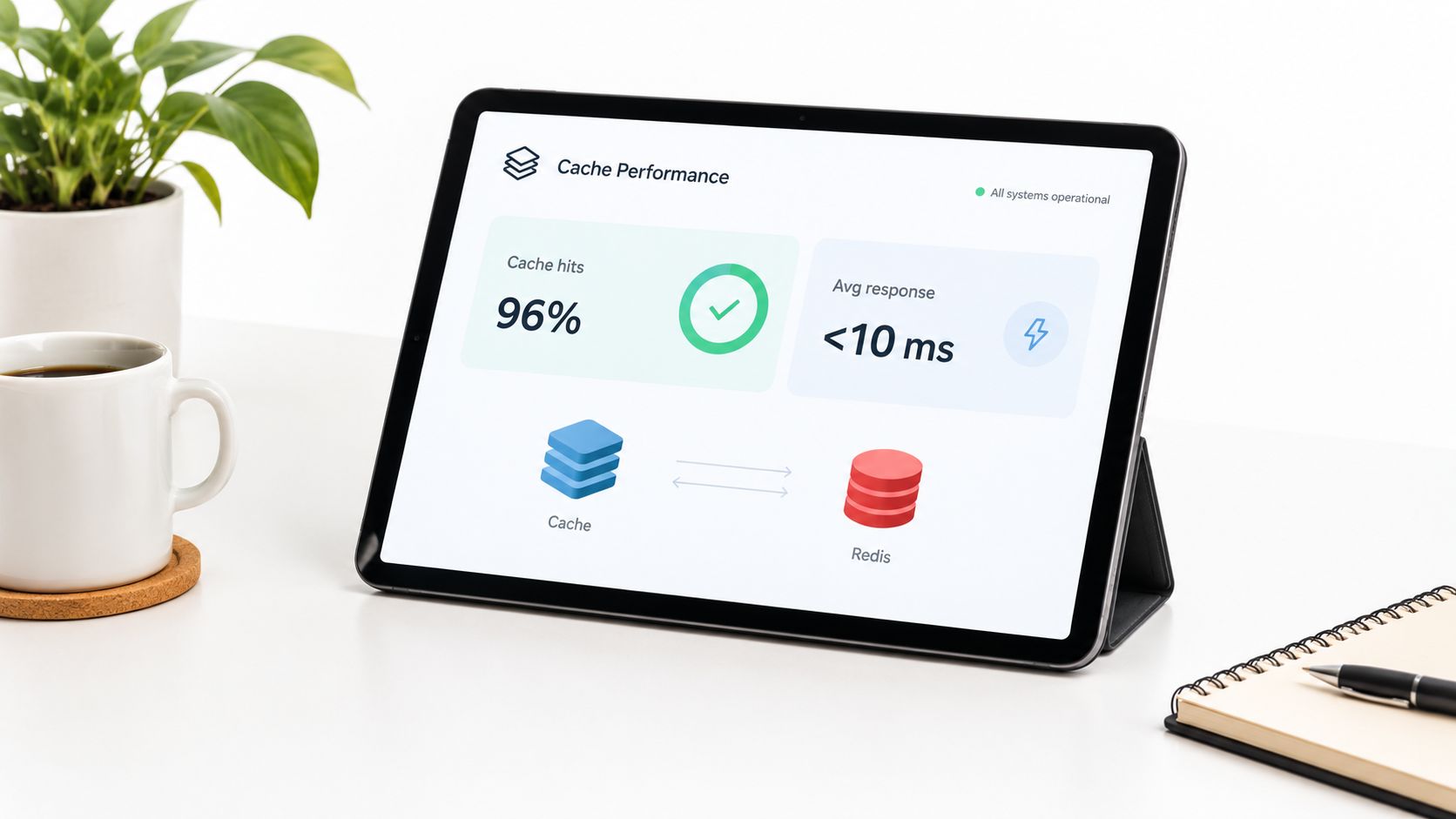
Storing successful responses in Redis or an in-memory cache with a 24-hour TTL is standard practice here. TaxID's cached lookups return in under 10 milliseconds, which means the customer barely registers the validation step while your server avoids the round-trip delay of an external API call.
Build Cache Keys the Right Way
Normalize before you hash. Strip spaces, punctuation, and inconsistent country-code prefixes from the VAT number first. Otherwise "DE 123456789", "DE123456789", and "123456789" all create separate entries for the same company, and your cache efficiency drops fast.
A well-structured cached record should store:
- Validation status (valid or invalid)
- Registered company details returned by the authority
- Verification timestamp for audit purposes
- Expiration time so downstream logic knows when to refresh
- Provider reference to tie the result back to a specific API response
Cache confirmed valid results with confidence. But don't hold onto failed responses forever — a company might fix a typo, receive a new VAT registration, or transition from inactive to active status after an earlier lookup came back negative.
For invalid numbers, a shorter expiration of a few minutes makes sense. It gives the customer a window to correct their entry without letting a stale failure block legitimate orders that would now validate successfully.
Plan for Cache Misses and API Failures
A cache miss should mean "call the API," not "reject the order." If TaxID returns service_unavailable, implement exponential backoff on the retry. If your compliance policy allows it, a recent stale-but-valid result is almost always better than a checkout timeout.
Don't conflate a network error with an invalid VAT number. Treat timeouts as indeterminate — charge local VAT or flag the order for manual review, log the decision, and move on. Reconcile later when the service is back up.
Read also: Redis caching strategies for VAT validation
Keep an eye on your cache-hit rate, API latency, expiration patterns, and error rates. A sudden drop in hit rate usually points to a normalization bug or an overly aggressive TTL — both worth investigating before your customers start noticing slower checkouts.
Can an EU VAT Code Checker Validate Non-EU IDs
VIES only covers EU member states. That's the reality. But plenty of validation APIs have expanded well beyond that scope, supporting the United Kingdom, Switzerland, Norway, Australia, and others.
This distinction matters more than you might think. If you're running a SaaS platform with international B2B customers, you'll hit edge cases fast. Brexit alone complicated how UK businesses are treated for EU transactions, and that's just one example.
The smart approach combines remote verification with country-specific format checks. A good format layer catches missing prefixes, wrong lengths, or misplaced characters before your app fires off a request to an external service. It's a cheap filter that saves money and reduces latency.
Picture this: a checkout normalizes GB 123 4567 89 into a clean, consistent value, then sends it to the same REST endpoint you use for EU VAT numbers. The response comes back with a status and, when available, the registered company name and address. Same flow, same code path — just broader coverage.
VIES stops at the EU border. If your customers span beyond that, pick an API that goes further.
What to Do When VIES Goes Down
Here's a rule worth tattooing on your architecture: never treat a VIES outage as proof that a VAT number is invalid. The two situations are completely different, and your system needs to know that.
A well-built wrapper returns a machine-readable service_unavailable error. This lets your billing system separate an infrastructure failure from an actual failed tax ID without guesswork.
Once you have that signal, you can pick a policy that fits your risk tolerance:
- Retry briefly with exponential backoff.
- Fall back to a recent valid cached result.
- Charge local VAT and flag the invoice for manual review.
- Queue the validation and update the record after things stabilize.
The one thing you don't want to do is block every order during a brief outage. A legitimate customer shouldn't lose access to checkout because a government endpoint hiccupped for a few minutes. Design for resilience, not rigidity.
How to Handle High Validation Volumes
If you're validating thousands of IDs, you're sending redundant requests unless you've built in caching. Normalize your inputs, cache successful results, stamp them with a verification timestamp, and refresh according to whatever your compliance policy demands.
For heavier workloads, pull validation out of the synchronous checkout flow entirely. Batch processing handles supplier imports efficiently, while webhooks or queued jobs can update customer records after an order lands — no blocking, no delays.
| Scenario | Recommended Approach |
|---|---|
| Occasional checkout checks | Synchronous API request |
| Repeat B2B customers | 24-hour cache |
| Large supplier lists | Batch processing |
| Temporary provider outage | Retry queue and manual review |
TaxID reports sub-10ms responses for cached lookups, which keeps frequent validations snappy while cutting down on unnecessary API calls. If your volume starts pushing past the free tier, review paid plans before surprise bills show up.
A few operational habits pay off quickly: keep API credentials server-side, log status codes without storing unnecessary personal data, and track cache-hit rates, latency, and outage frequency. Those three metrics will tell you whether your setup is actually working — or quietly creating problems.
TaxID gives developers one REST endpoint for VAT and company ID validation across 31 countries, with a free tier of 100 monthly validations and no credit card required. Start building with TaxID.