You do everything right in checkout, then a VAT validation call stalls. The customer has already typed the company name, the address is correct, and the cart is ready, but a slow upstream response turns a clean transaction into a support ticket. That's where Redis cache benefits stop being abstract infrastructure talk and become a practical way to keep billing flows moving.
A cache changes the shape of the request path. Instead of forcing every lookup through a slower database or remote service, Redis keeps frequently used data in memory, so repeat reads can be served locally while the origin handles fewer requests. For SaaS billing, that's the difference between treating every tax-ID lookup like a fresh dependency chain and turning repeated validations into a fast, bounded read path. CloudOrbis server design services is one useful reference point if you're designing the surrounding server layout and want to keep the cache close to the app tier.
Table of Contents
- Understanding the Core Mechanics of In-Memory Caching
- Measuring Latency and Throughput Improvements
- Offloading Databases and External Dependencies
- Managing Cache Freshness and Memory Limits
- Applying Redis to SaaS Billing and Checkout Flows
- Evaluating Redis for Your Specific Workload
- Planning Your Caching Implementation Strategy
Understanding the Core Mechanics of In-Memory Caching
A checkout timeout often starts one layer away from the database. A validation endpoint, tax service, or account lookup adds another network hop to an already busy request, and the customer waits while the page spins. If the same identifier appears again, a cache can answer from memory instead of repeating the slow path, which keeps the transaction moving.
Memory changes the shape of the request
Redis keeps frequently accessed data in RAM, so the app does not keep walking back to a slower origin for the same answer. That is the core of redis cache benefits. Repeated reads move to a dedicated memory layer, while the primary database or upstream service does less work. The Redis docs describe this as a measurable performance model, and they provide an official redis-benchmark utility for repeatable throughput and latency testing under configurable load Redis benchmark documentation.
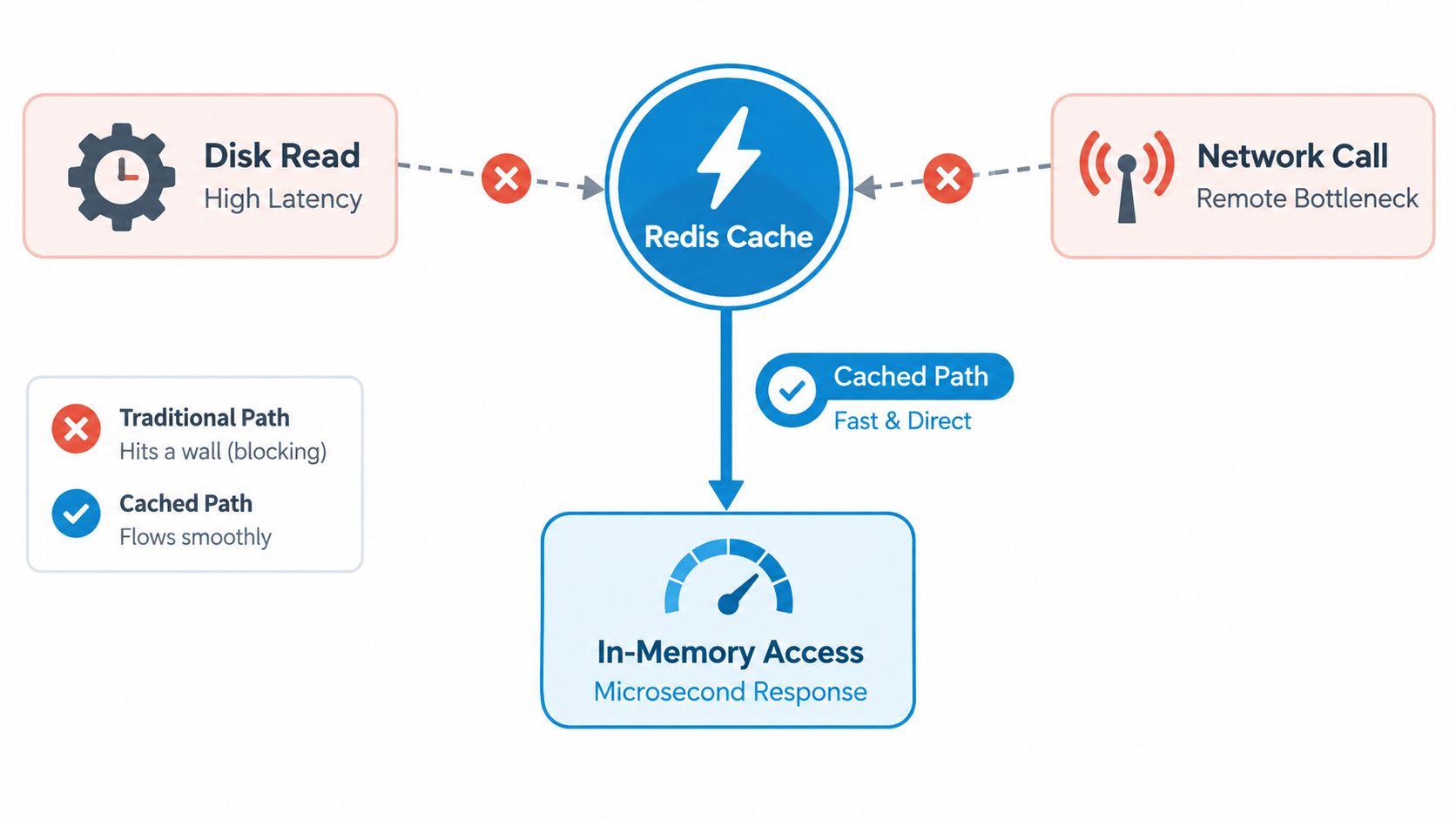
The practical value shows up in systems where the same identifier gets checked again and again. A VAT number, supplier ID, or customer billing profile is a good cache candidate when the response changes slowly or is expensive to regenerate. A cache hit returns the already validated result, which avoids another database query or external API call.
Why the cache sits beside the database
A primary database remains the source of truth. Treat the cache as a bounded read layer that absorbs repeat traffic, so the origin stays available for writes, fresh reads, and recovery after misses.
Practical rule: cache the result, not the whole problem. If the upstream service owns correctness, store the validated response and its metadata, then decide when that answer is too old to trust.
That separation matters in high-volume billing systems because the slowest dependency often is not the code you control. It is the remote authority, SOAP service, or serialization layer in the middle of the request. If your app keeps the client and Redis instance geographically close, and you measure realistic hit/miss patterns, you get the value of in-memory caching without pretending the network disappeared.
For teams designing the server side around this pattern, the surrounding architecture still needs bounded memory, TTLs, and a clear fallback path when the upstream service is down. Those choices keep checkout and billing flows from stalling when external validation becomes the bottleneck.
Measuring Latency and Throughput Improvements
A cache only earns its place when it changes the shape of real traffic. Redis's benchmark tooling is useful for a controlled check of throughput and latency under configurable client and request loads, and its example uses 100,000 requests. That kind of test gives you a repeatable baseline, but the number still moves with network round-trip time, payload size, concurrency, serialization cost, and cache-hit ratio.
Synthetic tests are a starting point, not a promise
Synthetic runs help confirm that the cache layer is healthy and that the key design behaves as expected. They do not show what happens when a checkout request crosses regions, waits on TLS, or serializes a large JSON object.
In production, the useful question is narrower. Does a cache hit remove enough work to matter for the business flow? In SaaS billing, the answer is often yes, because the hit avoids computation and reduces pressure on the upstream dependency. If a validation endpoint spends most of its time waiting on a remote authority, the cache keeps that request out of the queue again.
What to measure in a real system
Founders need the right dashboard, not marketing copy. Measure hit rate, p95 latency, upstream-call reduction, and eviction counts. Then test a realistic mix of repeated identifiers and misses, because a cache that only works in perfect demos will not protect a live checkout.
For a closer look at response-time instrumentation, measuring query latency for SaaS is a useful companion read. It helps separate real cache savings from a result that only looks better on paper.
The mistake I see most often is testing the cache in isolation and then shipping it into a noisy service mesh. Redis performs best when the client and cache are close to each other, the keyspace matches the workload, and the payload stays small enough that serialization does not dominate. If those conditions do not hold, the benchmark still tells you something, but it may not be the thing you care about in production.
For teams moving from theory to implementation, this REST API cache walkthrough shows how the pattern maps to a concrete billing flow.
Offloading Databases and External Dependencies
Caching pays off when repeated reads stop hammering the same dependency. A relational database can usually handle a single checkout flow, but not when every page refresh, retry, and validation lookup asks it to do the same work again. External services with rate limits or uneven uptime behave the same way. The cache absorbs that traffic before it reaches the origin.
In a study of a web-based platform, testing at 250 concurrent users found that web caching reduced latency by 9.9%, increased throughput by approximately 4.5 times, reduced server response time by 96.6%, and lowered the failure rate by 80.2% compared with load balancing alone JESSI study. Those numbers describe web caching generally, not Redis specifically, but the mechanism maps cleanly to transactional SaaS. If the same VAT number or supplier ID is requested repeatedly, serving it from cache preserves capacity and reduces the odds that one slow dependency turns into a visible outage.
The hidden value is resilience
Many teams frame caching as a speed feature. That leaves out the bigger operational gain. In billing and checkout flows, cached responses keep the interface responsive when an upstream authority is slow or unavailable. The cache does not repair that authority, but it gives your application room to keep moving while the dependency recovers.
Cached data becomes a buffer against failure only if your fallback rules are explicit.
Your app should know when to trust the cached answer, when to revalidate, and when to fail closed. If a VAT validation is a repeat request and the cached result is still inside its policy window, the app can continue without another remote call. If the upstream is down, checkout can stay functional instead of turning every retry into another timeout.
Where the offload happens
Redis reduces repeated reads from the database or upstream service, and it cuts the number of simultaneous requests those systems need to answer during spikes. That lowers pressure on CPU, network, and connection pools, which is often the bottleneck in small SaaS stacks.
Redis is a layer with a specific job, and origin health still matters independently of it. If your cache key design is sloppy, or you cache values that should not be reused, you just move the failure somewhere else. Used correctly, it keeps the core app responsive while the expensive dependency does less work.
Managing Cache Freshness and Memory Limits
A cache without expiration is just a second database with worse correctness. Redis makes freshness explicit through per-key TTLs and memory limits, which means you can decide how long a value stays trusted and what happens when memory fills up. That design is what turns caching from a risky shortcut into a bounded operational tool.
TTLs define how long you're willing to trust the answer
A TTL forces every cached item to age out on purpose. Once the TTL expires, the next request has to consult the origin again, which keeps stale data from living forever. For billing lookups, that's often exactly what you want, because repeated validations can be served quickly while still being rechecked on a schedule that matches your policy.
The trade-off is straightforward. Longer TTLs improve resilience and reduce remote calls, but they also preserve old answers longer. Shorter TTLs improve freshness, but they send more traffic back upstream. For anything tied to compliance or customer-facing pricing, the TTL should reflect business risk, not just developer convenience.
Memory pressure needs an eviction plan
When memory reaches the configured maxmemory limit, Redis can evict keys using policies such as allkeys-lru, which removes least-recently-used entries, or volatile-lru, which restricts eviction to keys carrying an expiration AWS Redis caching whitepaper. That gives you bounded memory growth instead of a surprise failure when the dataset expands.
A practical cache for APIs should usually include TTLs on entries so stale or low-value data can be removed predictably. Policies like volatile-ttl can also help when you want Redis to prioritize entries with the shortest remaining lifetime. Monitor eviction counts and hit rate, because cleanup under pressure can increase write latency while Redis makes room.
| Decision point | What it protects | What it costs |
|---|---|---|
| Short TTL | Freshness | More upstream revalidation |
| Long TTL | Resilience | Higher stale-result risk |
| LRU eviction | Hot keys stay resident | Cold keys disappear sooner |
Operational note: bounded memory is better than heroic memory growth. A cache that fails gracefully is easier to reason about than one that slowly consumes the box and surprises you during a busy checkout window.
The implementation pattern in this cache strategy guide is useful if you want to turn those rules into a production setup without improvising under load.
Applying Redis to SaaS Billing and Checkout Flows
A European checkout often has one annoying moment, the user enters a VAT number, and the app needs to validate it before applying reverse charge or deciding which invoice path to use. If that validation hits an upstream service every time, the page becomes fragile. A Redis-backed cache changes that by storing the authoritative result, along with metadata that tells your app how to treat the answer next time.
A VAT lookup that doesn't punish repeat requests
The cleanest version is simple. The first request checks the remote authority, the app stores the validation result, and later requests for the same identifier read the cached response until the TTL expires. The payload should carry the validation status, the registered company name, the address if the upstream provides it, and metadata like cached_at and source status so the app can tell whether the value is still acceptable.
That's especially useful during a VIES outage or a slow upstream response. The checkout can stay responsive, the user keeps moving, and the billing system avoids turning a temporary external failure into cart abandonment. You're not guessing, you're reusing an already verified result inside a policy window.
Caching should carry enough context to be safe
A cached VAT result is only useful if the application can make a sane decision from it. That means the stored object should include the original lookup time, the source system, and a clear stale-versus-fail policy. If the upstream says the ID is valid, the cache can serve that answer until the TTL expires, but the app still needs to know when to force a fresh check.
That's why a shared cache should be policy-driven, not just key-driven. A 24-hour window can be appropriate for repeated billing lookups, but the right duration depends on the regulatory and business context. If the data is more volatile, the TTL should shrink. If the result is stable and expensive to fetch, a longer window can make the checkout much smoother.
For teams building usage-sensitive flows, usage based billing for SaaS is a useful adjacent read because it shows how often billing logic depends on repeat lookups and metering decisions.
A cache helps most when the fallback path is boring. If the app knows exactly what happens on hit, miss, stale, and upstream error, the checkout stays predictable.
TaxID is one option in this space. It provides VAT and company ID validation through a single REST endpoint, with Redis-backed caching for repeated lookups, which is the kind of architecture that fits this checkout pattern without forcing the team to build the wrapper themselves.
Evaluating Redis for Your Specific Workload
Redis is a good fit when a small subset of data gets most of the requests. That's the shape where client-side and application caching usually pay off, because hot entries stay in memory and repeated reads don't keep touching the origin Redis client-side caching docs. It's a weaker fit when memory is tight, cache misses are frequent, and invalidation chatter starts to outweigh the benefit.
When Redis helps, and when it just adds plumbing
A validation endpoint that mostly waits on a remote authority benefits from caching if the same identifiers show up again. A basic key-value cache is enough there. New Redis features like JSON, time series, probabilistic structures, or vector sets don't automatically improve that flow, and they shouldn't distract from the actual work, which is key design, TTL selection, connection pooling, and protection against stampedes.
Redis 8 became generally available in May 2025 with more than 30 improvements, and Redis reports vendor benchmarks such as up to 87% lower command latency, up to 2x higher operations-per-second throughput, up to 18% faster replication, and up to 16x more query processing capacity for its Query Engine Redis 8 GA announcement. Those numbers are useful context, but they're vendor benchmarks, not universal application results. For a small SaaS, the decision to add Redis usually depends less on release notes and more on whether the cache hit rate is high enough to justify the added operational layer.
Use the metrics that match your product
Don't evaluate the cache by saying it's fast. Evaluate it by asking whether it changes the business flow. If the p95 latency drops, the number of upstream calls falls, and the failure rate during retries stays under control, the cache is doing real work. If not, it may just be hiding complexity behind a small amount of speed.
The easiest mistake is overengineering a simple endpoint because Redis can do more than you need. A billing validation cache doesn't need to become a multi-model data platform before it solves the actual problem. Keep the scope narrow, keep the keys obvious, and let the evidence decide whether more complexity is worth it.
Planning Your Caching Implementation Strategy
Start with observability, or the cache will become folklore. Track hit rate, eviction count, upstream-call reduction, and the error paths for stale or missing entries. If you can't see those numbers, you can't tell whether Redis is protecting checkout or just making the stack harder to debug.
Production rules that keep the cache honest
Use a cache-aside pattern for validation results, and make the fallback path explicit. The app should know what to do on hit, miss, stale read, and upstream failure, with no guessing in the request path. Add stampede protection so one cold key doesn't trigger a thundering herd of identical remote calls.
A practical rollout checklist looks like this:
- Define cacheable keys carefully: use normalized identifiers so the same VAT number doesn't create duplicate entries.
- Set TTLs by data class: slower-changing validation results can live longer than volatile operational data.
- Watch eviction behavior: rising eviction counts usually mean the keyspace or memory budget needs attention.
- Protect the origin: use locks, request coalescing, or single-flight behavior so misses don't multiply under load.
- Log stale decisions: store enough metadata to explain why the app trusted or rejected a cached value.
The architecture guide at this Redis caching strategy resource is a practical companion if you're turning those rules into implementation work.
Final check before launch: every cached answer should have an expiration, every miss should have a fallback, and every fallback should be observable.
If you're building VAT validation, invoice flows, or checkout logic for European customers, TaxID gives you a developer-first API that wraps VAT and company ID checks with Redis-backed caching and clean JSON responses. It's a practical way to keep billing flows resilient while you focus on your core product, and the docs make it straightforward to fit into a SaaS stack that needs fast, repeatable validation.