A German business customer pastes a VAT number into your checkout. Your Node.js backend is ready to finish the Stripe flow, but the EU validation service hasn't answered. The buyer is waiting, and your billing code needs to decide whether to proceed, collect VAT, or pause the invoice.
Table of Contents
- Why a Tax API Matters at Checkout
- What VAT Number Validation Actually Confirms
- Core Capabilities of a Production Tax API
- Handling VIES Outages and Ambiguous Results
- Where Tax APIs Fit in Billing and Marketplaces
- Building In-House or Using a Tax API
- Your Next Step Before the Next Invoice
Why a Tax API Matters at Checkout
That waiting request is where a tax integration stops being a background utility and becomes a checkout decision. A timeout doesn't tell you whether the customer's number is valid. It tells you that your application hasn't obtained the evidence it needs.
For this workflow, a tax API is the layer between your billing application and the official validation infrastructure. Your application submits an identifier and receives a structured result, potentially including registered company details. A modern wrapper can translate the underlying SOAP responses into JSON without replacing the authority of the national registries and EU validation network.
Keep transport code out of tax decisions
Calling a legacy SOAP service directly from a checkout handler puts several responsibilities in the same place. That handler must understand the remote protocol, interpret the response, and decide what the customer can do next.
I'd separate those responsibilities:
- Validation adapter: Submit the identifier and translate the upstream response into an internal result.
- Billing policy: Decide whether that result supports the proposed tax treatment.
- Checkout presentation: Explain what the customer needs to do without exposing technical failures.
- Invoice finalization: Record the decision and the evidence used to make it.
This separation is an engineering recommendation, not a claim that adding an API automatically makes billing compliant. You still own the policy.
Practical rule: Your payment flow should consume a tax decision, not try to interpret a SOAP failure.
In a Node.js or Python service, that could mean keeping validation behind a dedicated application function rather than scattering remote calls across cart updates, customer creation, and invoice generation. The function should return something billing code can reason about, not just an upstream payload.
There's also an important scope distinction. Checking a VAT number isn't the same as calculating VAT. In this article's checkout scenario, the API supplies evidence about the customer's tax identifier. Your billing rules still need to determine the treatment of the actual supply.
The useful design question is therefore broader than whether the request succeeds. Can your application finish checkout, explain uncertainty, and produce a defensible invoice without making every decision depend on a fragile remote call?
What VAT Number Validation Actually Confirms
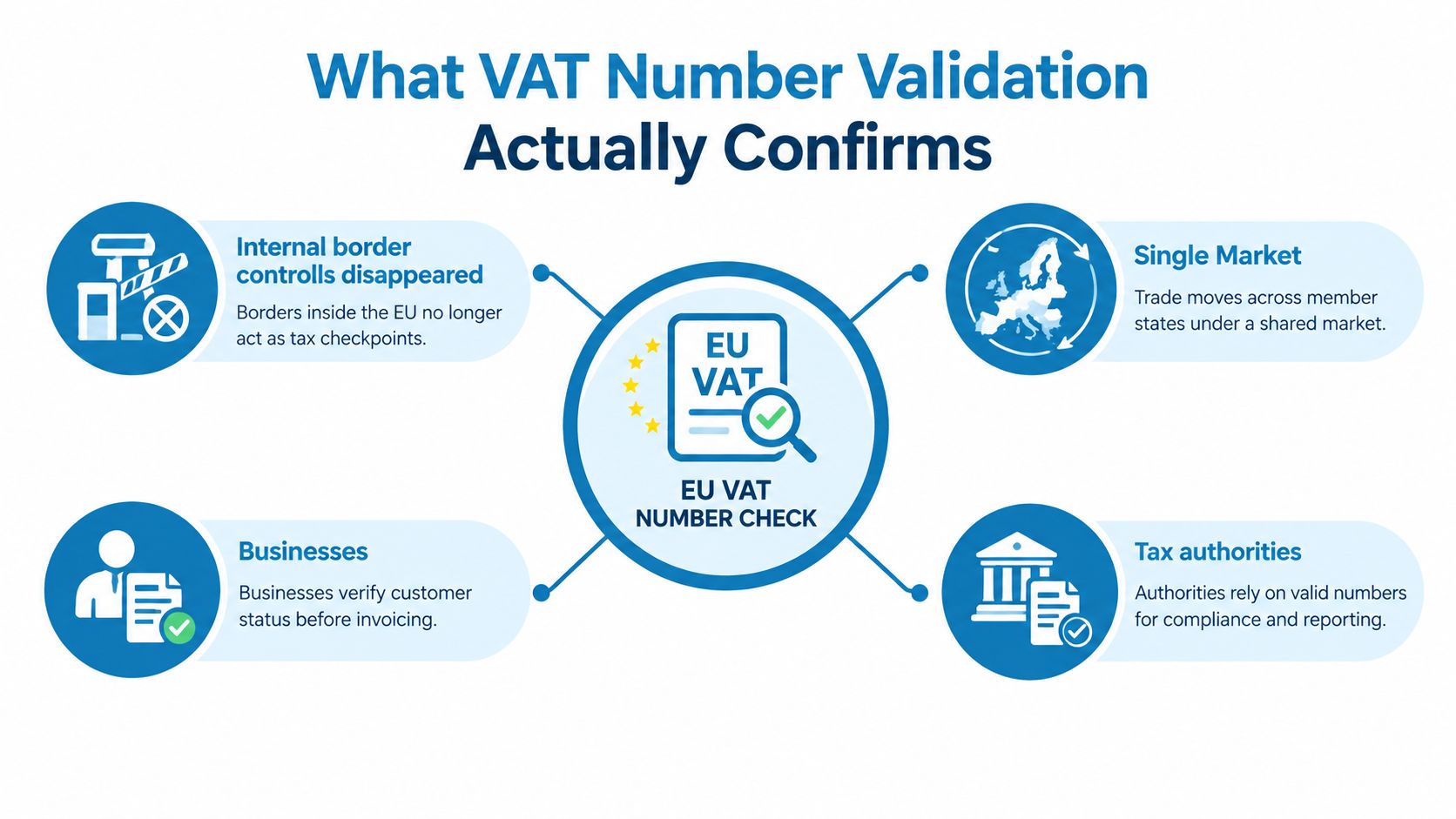
The reason for EU VAT validation starts with a change in how cross-border trade was controlled. VIES was established within the VAT-control framework introduced when the European Single Market began on 1 January 1993. With fiscal customs controls removed at internal borders, businesses and tax administrations needed a shared way to check registrations across what is now a market of 27 EU Member States, as described in the European data portal's VIES overview.
Think of a positive check as closer to a passport check than a phone-book search. It confirms that the identifier is recognized for intra-Community transactions at the time of the query. It isn't merely finding a company with a similar name.
Separate structure from registration
A number can look right without being recognized by the issuing authority. A country prefix and plausible character pattern answer a structural question, not a registration question.
Use the VAT number format reference when designing input handling, but keep the distinction visible in code. Passing a local format check should mean ready for authoritative validation, not approved for an exemption.
The result supports a tax decision, rather than completing it:
- What it confirms: The identifier's recognized status in the relevant cross-border validation context at query time.
- What it can support: Decisions about reverse charge or zero-rating when the transaction otherwise qualifies.
- What it doesn't establish: Whether the buyer will pay, whether the business is solvent, or whether the particular transaction is commercially legitimate.
Suppose the checkout receives a positive result and registration details for the customer's VAT number. That's useful evidence. If the buyer's supplied identity doesn't match those details, however, your application shouldn't discard the mismatch just because a boolean says true.
Interpret the result narrowly
The engineering mistake is turning recognized identifier into trusted transaction. Those are different assertions, with different evidence requirements.
Model the validation result as an observation about a tax identity. Model the invoice decision separately, using the transaction context your finance team requires. That distinction keeps a registry response from becoming an accidental authorization mechanism.
You're connecting billing logic to a cross-border tax-control system, not adding an ordinary company-directory lookup. The narrower interpretation is also the more useful one: it tells your application exactly which question has been answered and which questions remain open.
Core Capabilities of a Production Tax API
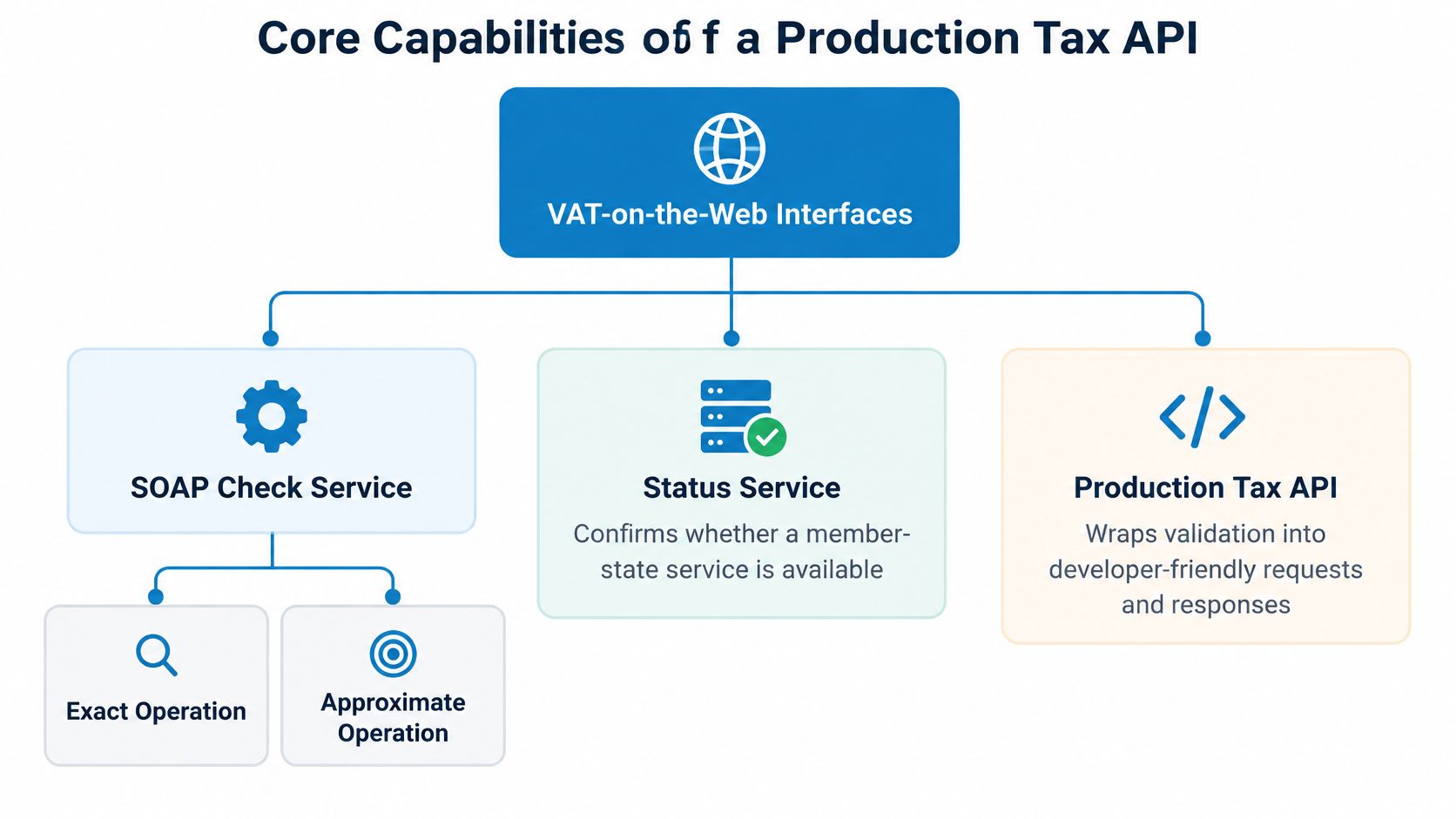
The European Commission's VAT-on-the-Web interfaces expose a SOAP CheckVatService with checkVat and checkVatApprox, plus a CheckStatusService for application and member-state availability. The Commission's public interface specification describes exact and approximate matching and a request identifier that can be returned when requester member-state details are supplied.
For a billing engineer, those interfaces imply a pipeline rather than a thin protocol converter. A production tax API should make the evidence easier to consume while preserving its meaning.
Process the input before calling upstream
Start with conservative normalization and country-specific syntax checks. Preserve the submitted value for troubleshooting, and maintain a normalized value for validation and comparison.
Don't repair an identifier into something that could belong to another business. Removing harmless presentation differences is a different operation from guessing missing characters.
The application-facing response should contain enough information to support the next decision:
| Field | Why billing needs it |
|---|---|
| Normalized number and country | Identify exactly what was checked |
| Validation status | Select the appropriate policy branch |
| Registered name and address, when returned | Compare registration details with customer identity |
| Consultation timestamp | Establish when the observation was made |
| Request identifier, when available | Connect the evidence to the authoritative request |
Treat absent registration fields as absent, not as permission to substitute customer-entered values into the authoritative response. Otherwise, a later reviewer can't distinguish what the registry returned from what the buyer supplied.
Give application code a stable contract
Machine-readable errors let your code branch on a defined category instead of parsing human-readable messages. In TypeScript, I'd use a discriminated result type; in Python, a typed result model or explicit status enumeration serves the same purpose.
Keep the raw provider response available for diagnosis, but don't make every billing caller understand it. Also document whether matching was exact or approximate so finance doesn't have to infer what happened.
If you're choosing the surrounding storefront as well as the validation integration, AmaJova's digital selling platform comparison is a separate resource to review during platform evaluation. Your tax integration checklist should still ask where customer identity, validation evidence, and invoice decisions will live.
For requirements beyond EU VAT, evaluate additional company-ID coverage separately. Don't assume that another country's registry check has the same meaning or response fields as VIES.
Handling VIES Outages and Ambiguous Results
A failed request is not an invalid VAT number. Collapsing those outcomes creates a billing bug: an infrastructure problem becomes a claim about the customer.
VIES is used up to 17 million times per day, and the European Parliament document notes that traders can retain proof of validation for possible audits. That scale and evidence requirement make reliability part of the workflow, not an optional enhancement, as outlined in the Commission's VIES reporting document hosted by Parliament.
How Billing Code Should Treat Each Validation Outcome
The following is a recommended application policy model. Have finance approve the specific actions before deploying it.
| Outcome | What it means | Safe billing action |
|---|---|---|
| Valid | An authoritative response recognizes the identifier | Evaluate the remaining transaction requirements |
| Invalid | The identifier fails local structure checks or receives a negative authoritative response | Request correction and retain the reason |
| Unavailable | The service couldn't provide an answer | Apply the documented outage policy without claiming invalidity |
| Indeterminate | The response doesn't support a clear decision | Queue review or revalidation before granting unsupported treatment |
Keep local format failures distinguishable from authoritative negative responses, even if both prevent the current submission from proceeding.
Fail-open and fail-closed need an object. Are you allowing account creation, payment, fulfillment, or an exemption? You can permit one action while holding another, rather than treating the entire checkout as a single switch.
Bound uncertainty instead of hiding it
My recommended default is to require a fresh authoritative check before the first exemption. A timeout alone should never create eligibility.
For subsequent checks, define a cache policy with finance. A shorter cache reduces reliance on stale observations; a longer cache improves latency and tolerance of upstream disruption. Always retain the original consultation timestamp, rather than making a cached answer look newly verified.
- Bound retries: Use backoff and stop within the checkout's time budget.
- Open the circuit: Stop repeatedly calling a dependency that's failing, then probe for recovery.
- Limit stale use: Specify which decisions may use older evidence and when that permission expires.
- Expose uncertainty: Give finance a pending reason, last successful check, and next action.
An outage is an operational fact. Invalidity is a tax-identity finding. Don't store them as the same thing.
Log the normalized input, country, response, provider status, and decision rule. For implementation planning, use the VIES downtime resilience guide to turn these choices into explicit checkout branches rather than exception-handler defaults.
Where Tax APIs Fit in Billing and Marketplaces
Consider a SaaS developer preparing a subscription invoice. The customer has entered company details, and the developer needs to know whether the proposed business tax treatment has supporting evidence before finalization.
That's a different job from supplier onboarding, even when both use the same validation endpoint. The right integration point depends on which decision your team is trying to control.
Customer-facing billing
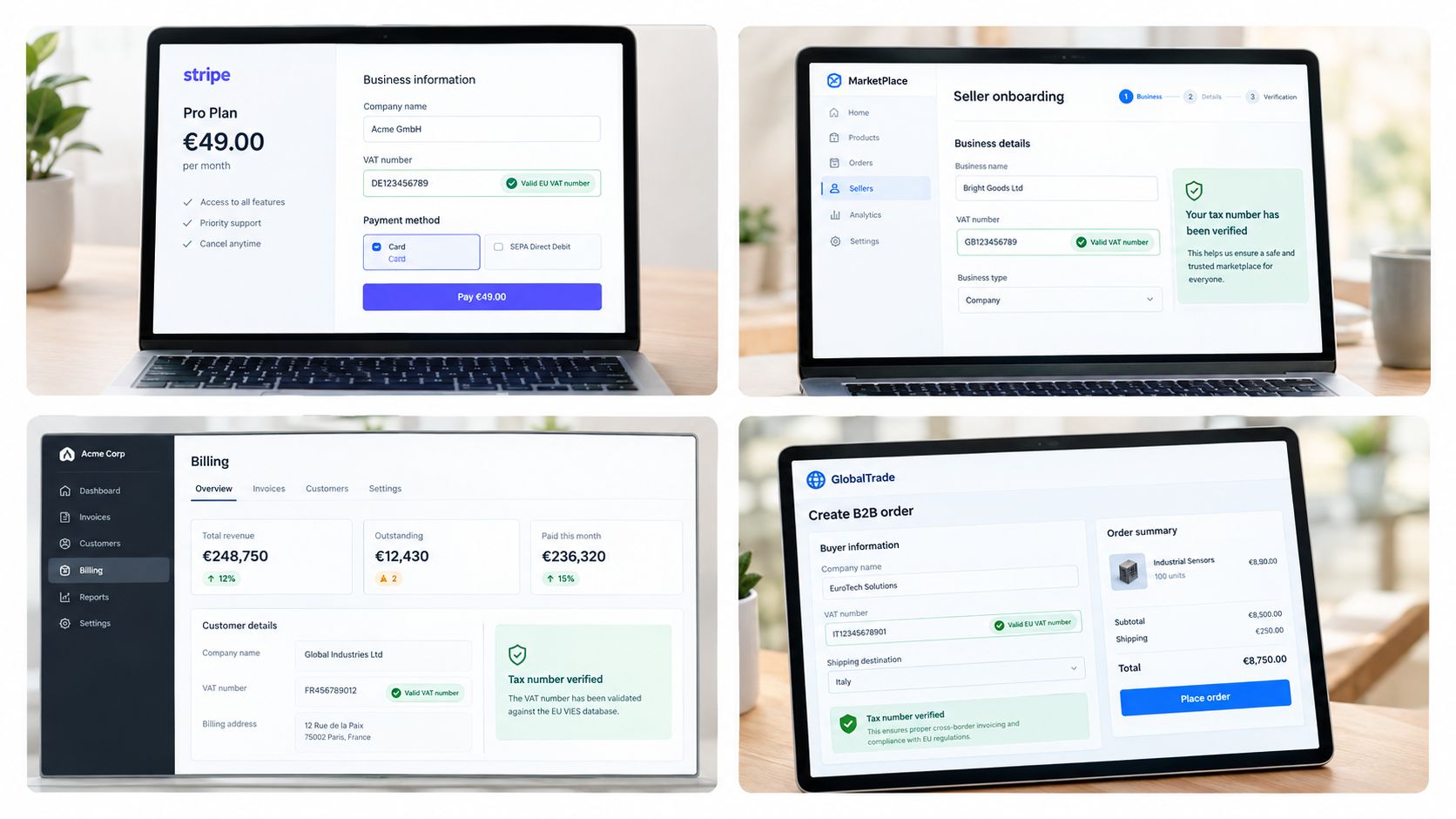
SaaS subscriptions on Stripe. Put the check before the application commits the relevant invoice treatment. Store the observation against the customer, then associate the evidence used with the invoice decision rather than relying only on the customer's latest profile.
The reverse-charge VAT explainer is useful when developers and finance need shared terminology. The implementation discussion should identify which transaction conditions finance expects the application to evaluate.
Marketplace and cart flows. In a custom checkout, or a WooCommerce or Shopify Plus implementation, the VAT field influences the buyer's displayed total. Design the cart so an unchecked identifier can't authorize an exemption, and make pending verification understandable before payment.
Here, the tax API sits on an interactive path. Coordinate cart recalculation and invoice finalization so they don't apply different versions of the customer's tax decision.
Operational and embedded workflows
Finance teams have a different trigger: a supplier invoice awaiting approval. An internal Python script or automation workflow can request validation and route discrepancies for review before payment approval, without pretending that registration proves the supplier fulfilled the contract.
Billing and accounting product teams have another responsibility. They embed validation for their customers, so they need to expose understandable evidence and decision states rather than burying everything inside an internal log.
- Supplier operations: Tie the result to the supplier record and the invoice under review.
- Embedded infrastructure: Give downstream users enough context to understand and investigate their own billing decisions.
The business case is material, but it needs careful interpretation. The EU's VAT compliance gap was estimated at €89.3 billion, or 7% of total VAT liability, in 2022, covering multiple forms of non-compliance rather than losses recoverable through identifier checks alone, according to the VAT gap report.
Treat validation as a documented control. Pair it with customer identity, billing-address comparison, and transaction-risk checks, with review paths appropriate to the buyer job.
Building In-House or Using a Tax API
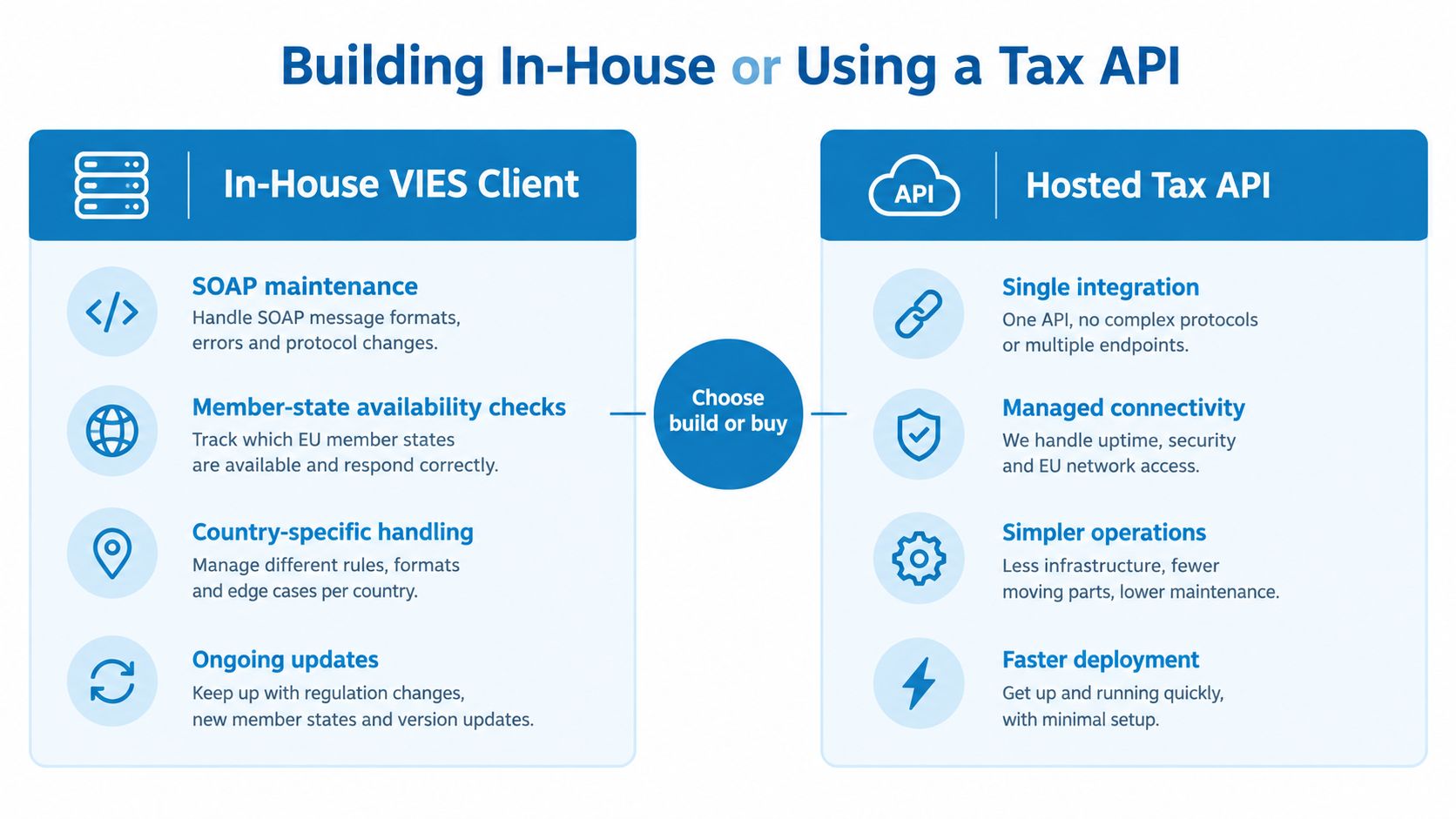
The build-or-buy decision isn't really SOAP versus REST. It's whether your team wants to own the operational adapter between billing and the authoritative services.
An in-house client can be reasonable when you need unusual control over data handling or already maintain similar infrastructure. A hosted tax API can be reasonable when validation is necessary supporting work rather than a feature your customers buy from you.
Compare ownership rather than request syntax
With an in-house integration, your team owns protocol handling, country rules, availability checks, error translation, and ongoing testing. Someone also needs to answer when finance asks why a particular invoice received its tax treatment.
A hosted service can simplify the application-facing interface. It doesn't remove the need to understand its cache behavior, upstream dependencies, or evidence fields.
| Decision area | In-house client | Hosted tax API |
|---|---|---|
| Connectivity | Your team maintains the upstream adapter | Evaluate the provider's managed adapter |
| Response contract | You design and version it | Confirm the supplied schema meets billing needs |
| Operations | You monitor and investigate failures | Establish what the provider monitors and exposes |
| Evidence | You construct and retain the record | Verify what's returned, then retain what you need |
| Billing policy | Your organization owns it | Your organization still owns it |
The stakes aren't limited to malformed inputs. The Commission estimated annual Missing Trader Intra-Community fraud losses at EUR 13 billion to EUR 33 billion during 2010–2023, providing context for careful counterparty controls without making identifier validation a complete fraud solution, in its VAT compliance progress announcement.
Test the contract before choosing
I'd evaluate either approach against recorded scenarios, not just a successful demo request. Include an unavailable member-state service, a name discrepancy, missing registration details, and a previously checked customer whose identifier changes.
- Inspect provenance: Can you distinguish an authoritative consultation from a cached response?
- Exercise failures: Can your application identify retryable conditions without parsing text?
- Review evidence: Can finance reconstruct the invoice decision from stored records?
- Check portability: Can you replace the adapter without rewriting invoice policy?
For a hosted option, prefer documentation that makes these behaviors explicit. For an internal build, make them acceptance criteria.
Buying connectivity can reduce maintenance work. It cannot transfer responsibility for the decision your application makes with the result.
Your Next Step Before the Next Invoice
A customer updates their VAT number after an invoice has been issued. If the customer profile stores only a mutable vat_valid flag, you cannot tell which number was checked or what supported the earlier invoice decision.
Keep a historical record tied to each invoice. Store the relevant tax identity, consultation time, jurisdiction, decision rationale, and invoice reference together. Updating a customer profile should not change the evidence for an invoice already finalized.
Preserve a decision record
Separate the current customer profile from past validation observations. A practical record can include:
- Identity snapshot: The identifier and customer details used for the decision.
- Validation observation: The result, returned registration details, timestamp, and available request reference.
- Decision context: The jurisdiction and policy applied to the transaction.
- Invoice association: A reference to the invoice supported by that evidence.
This record does not replace legal advice about reporting or retention. It gives finance and engineering a way to review an invoice without piecing together events from scattered logs.
Implementation checkpoint: Can a teammate explain the invoice decision using its stored record, without relying on your memory or today's customer profile?
Run a real workflow before expanding it
Trace a real EU customer from VAT number entry through invoice finalization. Store the validation result and consultation timestamp with the billing records, and keep any returned name or address as an observation rather than overwriting customer details.
Then simulate an unavailable validation service. Decide whether checkout pauses, payment proceeds with a pending review, or another finance-approved policy applies. Confirm that the invoice records the outcome and the reason for that treatment.
Before issuing the next invoice, ask a teammate to reconstruct the decision from the stored evidence. If they have to search unrelated logs, improve the record before automating more decisions.
TaxID offers a REST layer for VAT and company-ID validation, with structured responses and machine-readable errors for billing integrations. Review the TaxID documentation, free-tier terms, and status page, then test a customer lookup against your service_unavailable checkout policy.