A customer enters GB123456789 at checkout, your billing service accepts the pattern, and the invoice applies the expected B2B treatment. Two weeks later, finance checks the transaction and discovers that the number doesn't resolve against HMRC. The invoice is now a reconciliation problem, not a successful validation.
That failure captures the central challenge with UK VAT numbers. A plausible string isn't proof that a business is currently registered, and a successful format check doesn't tell you which authority should validate the number. Post-Brexit billing adds another routing decision, because GB and XI can lead to different validation services and different VAT treatment.
Table of Contents
- What a UK VAT Number Actually Identifies
- Anatomy of a UK VAT Number
- GB vs XI Prefixes After Brexit
- How to Read and Validate a UK VAT Number
- HMRC vs VIES for UK VAT Validation
- Why a Valid Number Can Still Fail in Production
- Choosing a Validation Approach for Your Stack
What a UK VAT Number Actually Identifies
A UK VAT number identifies a VAT-registered business or organisation in HMRC's tax administration system. For most businesses, it has a 9-digit core, commonly displayed with the GB prefix for international use. HMRC's official checker can confirm whether a number is valid and, where available, return the registered business name and address. HMRC's UK VAT checker therefore acts as more than a syntax tool. It queries a live registration record.
That distinction matters in a billing pipeline. The number can be well formed but not active, newly issued but not yet visible, or entered with the wrong prefix. Your application should separate these states instead of treating every non-successful response as “invalid.”
A VAT registration record can connect the identifier with registration information, the registered business name and address, and the entity's place in the VAT system. It doesn't replace your broader tax assessment. The number alone doesn't establish whether a particular supply qualifies for zero-rating, reverse charge, or another treatment. Your invoicing rules still need the customer's location, the nature of the supply, and the applicable transaction rules.
Don't confuse a VAT number with other identifiers
Several UK business identifiers appear together in onboarding and invoicing data, but they serve different purposes:
- VAT registration number: Identifies a business for VAT administration and invoicing.
- Unique Taxpayer Reference, or UTR: Relates to wider tax administration, not VAT registration.
- Companies House company number: Identifies a company in the corporate register.
- EORI number: Supports customs and international trade processes.
A company can have all of these identifiers, and none should be used as a substitute for another. If your invoice template asks for a VAT number, inserting a company number or UTR creates a compliance and reconciliation defect. For a broader checklist of invoice fields, see this guide to UK invoice legal requirements.
Practical rule: Treat the VAT number as a claim that must be verified against an appropriate authority, not as customer-entered text you can automatically trust.
The post-Brexit lesson is straightforward. UK VAT validation is a routing problem, not a regular-expression problem. You need to normalize the value, understand whether it belongs to Great Britain or Northern Ireland for the relevant transaction, select the right service, and record the result with enough context for finance to audit later.
Anatomy of a UK VAT Number
Read a UK VAT number in layers rather than as one uninterrupted string. The first layer is the country or jurisdiction prefix, the second is the identifier issued by HMRC, and the third consists of special formats used by certain public-sector bodies or registration structures.
For a normal Great Britain registration, the common international representation is GB followed by nine digits. HMRC's guidance describes the underlying input as nine numbers, with optional spaces and an optional GB prefix. GB123456789 is therefore a useful canonical example, but GB 123 4567 89 is still a presentation variant that your input layer should normalize.
Northern Ireland creates a separate prefix for EU-facing goods transactions. The XI prefix uses the same 9-digit core, but its meaning is tied to the post-Brexit trade framework rather than merely to a different spelling of the same country code. The routing implications belong in your tax decision logic, not only in your parser.
Standard and special formats
The standard pattern isn't the whole universe. UK VAT systems also include formats associated with VAT groups, government departments, and health authorities. The comparison below is a practical map, not a license to accept every string that resembles an example.
| Format | Example | Identifies |
|---|---|---|
| Standard Great Britain registration | GB123456789 |
A standard VAT registration with a 9-digit core |
| Northern Ireland EU-facing registration | XI123456789 |
An HMRC registration used for relevant Northern Ireland goods transactions |
| VAT group format | A 12-digit VAT number | A VAT group registration |
| Government department series | A number containing a government marker such as GD |
A government department registration |
| Health authority series | A number containing a health-body marker such as HA |
A health authority registration |
Spaces, punctuation, and prefixes are formatting concerns. Your storage model should preserve the original value for audit purposes, while a normalized field should remove whitespace, standardize letters, and isolate the identifier used for validation. Don't silently mutate the customer's original input and then lose the value they supplied.
Some UK VAT numbers also use branch logic. Branch identifiers can distinguish a registered branch from a parent record, while public-sector series require their own handling. That means a validator designed only for GB plus nine ordinary digits can reject legitimate registrations or, worse, classify a special number incorrectly.
The safest design keeps three separate fields: raw input, normalized input, and validation result. That lets you explain why a value failed without confusing an input-format problem with an HMRC lookup result.
GB vs XI Prefixes After Brexit
The GB versus XI distinction is about jurisdiction and transaction rules, not just character matching. Great Britain registrations use GB, while Northern Ireland registrations can use `XI for relevant EU-facing goods activity under the post-Brexit framework. The same business may need to consider different registration details depending on the transaction and the movement of goods.
Many implementations go wrong. A developer sees a country prefix, sends it to a generic EU VAT service, and assumes the response determines the tax treatment. But a GB number isn't an EU number with a different prefix. Great Britain VAT registrations aren't covered by the EU VIES network, so EU-facing validation for GB and XI must follow different paths. The UK and EU intra-community VAT guidance provides useful context for that distinction.
A practical routing decision
Use the transaction, not just the customer address, to decide what happens next:
- The customer supplies a GB number. Route the registration check through HMRC's UK service. Don't expect VIES to validate it as an EU VAT number.
- The customer supplies an XI number. Consider whether the transaction involves goods covered by the Northern Ireland arrangements, then use VIES for the EU-facing validation path.
- The customer supplies an EU prefix other than GB or XI. Route it to VIES and apply the relevant EU-country rules.
- The prefix doesn't match the transaction or customer evidence. Hold the transaction for review rather than automatically applying an exemption.
A GB number can be valid in the UK and still be unsuitable for an EU VIES check. Conversely, an XI result can confirm VAT registration for the relevant EU-facing framework without answering every question about the customer's broader UK tax position.
Routing rule: Prefix selection determines which authority can answer the registration question. It doesn't, by itself, decide whether you should charge VAT.
Your system should also handle migration and registration-history ambiguity carefully. A legal entity may have related GB and XI records, so matching solely on the prefix can create duplicate customer accounts or an incorrect exemption decision. Store the returned business identity and address when the service provides them, then compare those details with the customer record and transaction context.
How to Read and Validate a UK VAT Number
A production validator should perform local checks before making a remote request. Start by trimming whitespace, converting letters to uppercase, and removing a leading GB or XI only when your validation routine expects the numeric core. Preserve the original value separately, because audit teams may need to see exactly what the customer submitted.
For a standard UK VAT number, the core contains nine digits. HMRC-linked guidance describes a long-standing check-digit algorithm for the standard format, but a checksum can only establish that the number is mathematically plausible. It can't confirm that HMRC currently recognizes the registration.
The standard checksum
For the ordinary 9-digit pattern, multiply the first seven digits by the weights 8, 7, 6, 5, 4, 3, and 2. Add the final two digits as a number, then check whether the total is divisible by 97. For the worked example GB123456789, the calculation is:
1 × 8 = 82 × 7 = 143 × 6 = 184 × 5 = 205 × 4 = 206 × 3 = 187 × 2 = 14- Final two digits:
89 - Total:
8 + 14 + 18 + 20 + 20 + 18 + 14 + 89 = 201 201isn't divisible by97, so this example is not mathematically valid under the standard check.
The table makes the important point visible. A familiar-looking example isn't automatically a valid registration.
| Step | Input | Calculation | Result |
|---|---|---|---|
| Normalize | GB123456789 |
Remove GB, retain 123456789 |
9-digit core |
| Apply weights | 1234567 |
Weighted sum of the first seven digits | 112 |
| Add check portion | 89 |
112 + 89 |
201 |
| Test divisibility | 201 |
Check remainder when divided by 97 |
Fails |
Exceptions need an explicit branch
Government departments and health authorities use special series, including markers such as GD and HA. VAT group and branch formats can also fall outside the ordinary 9-digit path. Don't run every alphanumeric value through the same checksum and call the result authoritative.
A useful sanity routine can return a structured local status:
format_invalidstandard_formatspecial_formatneeds_remote_check
Then your remote adapter can choose HMRC or VIES based on the normalized prefix and transaction context. Teams maintaining finance controls may also benefit from structured working papers for bookkeeping VAT returns, especially when validation evidence must be retained alongside invoice records.
HMRC vs VIES for UK VAT Validation
HMRC and VIES overlap in purpose, but they don't provide identical coverage. HMRC is the relevant authority for GB registrations, while VIES is the EU Commission's service for EU VAT registrations and the EU-facing XI route. Treating them as interchangeable is a common source of failed checks.
For a GB value, send the normalized registration to HMRC's UK checker or an integration that uses HMRC's service. For an XI value, use the VIES route when the transaction falls within the Northern Ireland goods framework. Your adapter should route before it sends the request, not after a failed response.
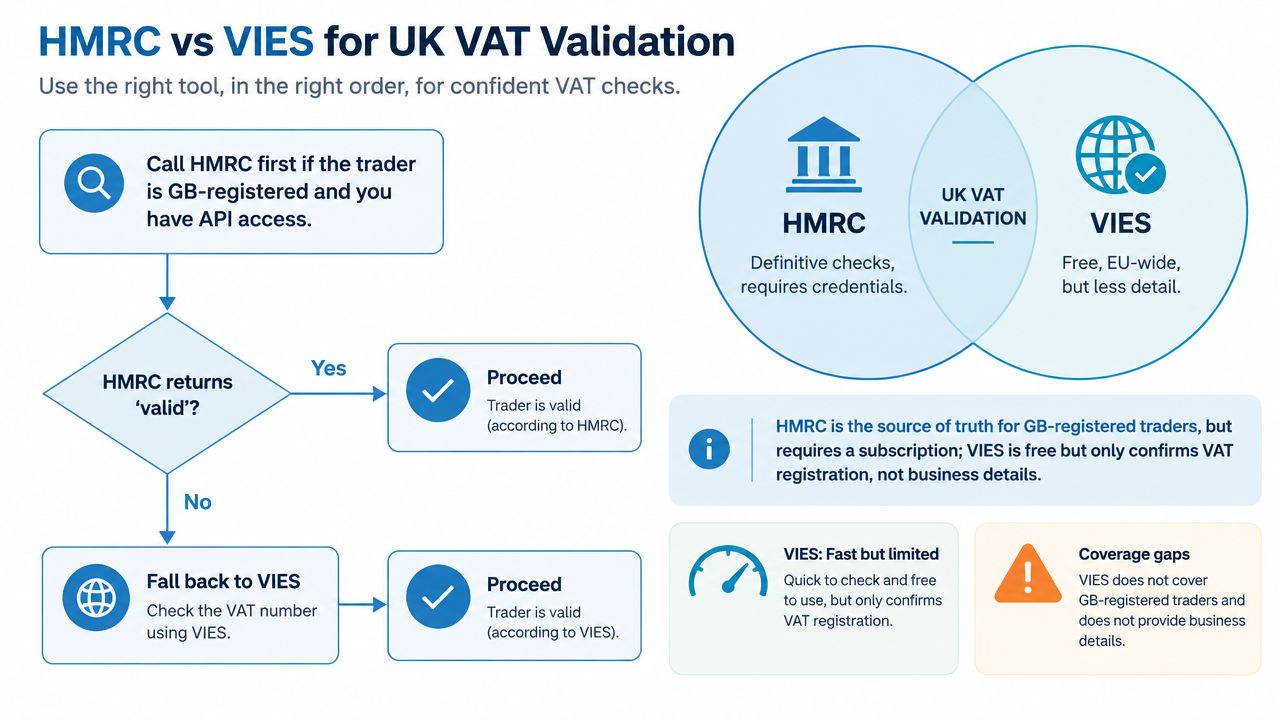
Design the integration around coverage
A flow looks like this:
- Normalize the input. Preserve the raw value and derive a canonical representation.
- Classify the prefix and format. Separate GB, XI, EU, and special UK formats.
- Select the primary service. Use HMRC for GB, and VIES for XI when relevant.
- Interpret the response. Store status, timestamp, source, returned identity, and any service error.
- Apply tax treatment separately. A valid registration is evidence for the customer record, not the entire tax decision.
A fallback can help when a primary service is unavailable, but fallback isn't the same as equivalent authority. If HMRC is unavailable, don't transform a failed lookup into an automatic approval merely because another service responds. Mark the result as provisional or route it to review according to the risk of the transaction.
The VAT number and VIES integration overview is relevant when your billing system handles both EU registrations and UK-related routing. The implementation detail that matters most is consistent error semantics. Your application should distinguish an invalid number from a timeout, throttling event, maintenance response, or missing record.
Never make the invoice decision from an HTTP success code alone. A successful transport response can contain a negative validation result, incomplete business details, or a temporary visibility state. Your billing service needs to inspect the business response and retain it as evidence.
Why a Valid Number Can Still Fail in Production
A VAT validator has at least three operational states: invalid, not yet visible, and unavailable. The distinction matters because each state calls for a different customer experience and a different audit record.
HMRC's service guidance identifies a concrete example. During a planned maintenance period from 9am Monday 20 April to 5pm Friday 24 April 2026, newly registered VAT numbers may not appear in the checker. HMRC's service availability notice makes this a live operational concern for systems handling new registrations.
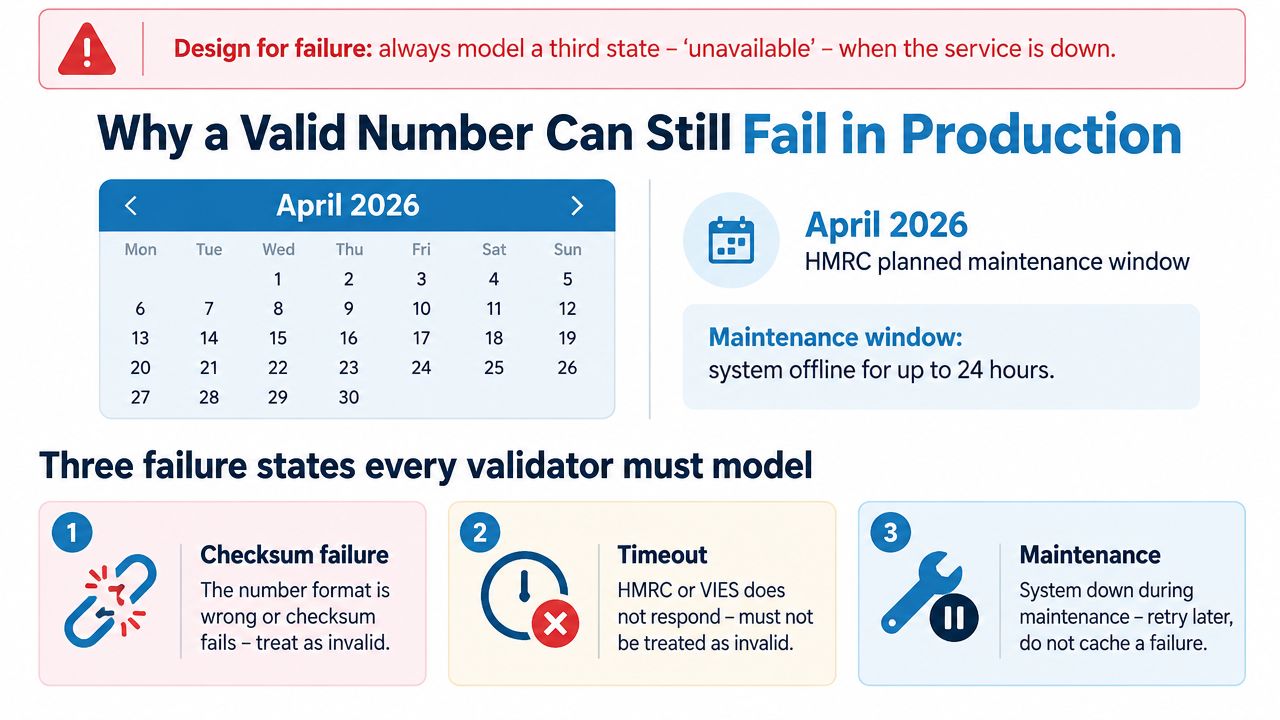
Model each result deliberately
Invalid means the local format or checksum fails, or the authoritative service confirms that the number isn't valid. This can justify a hard stop at checkout when the customer is asking for VAT treatment that depends on registration. Log the submitted value, normalized value, service, response, and decision.
Not yet visible is different. A newly registered business may have a plausible number but not yet appear in the trader data available through the checker. Don't tell the customer their number is fraudulent. Ask for supporting evidence, keep the order in a review queue, and schedule a later retry.
Unavailable covers maintenance, timeout, throttling, and service faults. A system that turns all of these into invalid creates false negatives and frustrates legitimate buyers. Return a recoverable status, avoid destructive caching, and allow the customer or finance team to retry.
| State | Checkout response | Audit treatment | Order handling |
|---|---|---|---|
| Invalid | Explain that the number couldn't be confirmed | Store the negative result and reason | Reject or request correction |
| Not yet visible | Explain that confirmation is pending | Record the lookup and retry context | Hold for review |
| Unavailable | Explain that the authority is temporarily unreachable | Record the outage or timeout | Retry or hold, don't reject automatically |
Operational rule: A
200response confirms transport success. It doesn't make the billing decision for you.
Choosing a Validation Approach for Your Stack
Choose the validation architecture based on the cost of a false negative, the jurisdictions you support, and the amount of failure handling your team wants to maintain. A UK-only invoicing system with a small customer base may call HMRC directly. A pan-European SaaS checkout needs a broader routing layer because it may receive GB, XI, and EU registrations in the same field.
Compare the options
| Feature | HMRC | VIES | Unified API |
|---|---|---|---|
| Primary coverage | UK registrations, especially GB | EU registrations and relevant XI checks | Multiple jurisdictions through one interface |
| Best fit | UK-focused finance and billing workflows | EU-facing cross-border checks | Mixed-country checkout, invoicing, and supplier workflows |
| Main implementation concern | Availability, credentials, and UK-specific responses | Coverage boundaries, rate limits, and service faults | Provider coverage, pricing, and dependency management |
| Response handling | Interpret UK registration status and returned details | Interpret EU validation status and returned details | Map one normalized response model to your billing rules |
| Fallback design | Retry with care, don't assume another source is equivalent | Retry with care, don't treat outage as invalid | Centralize retries, caching, and error semantics |
HMRC is the sensible primary source when your records concern GB registrations and you can accommodate its service behavior. VIES belongs in the path for EU registrations and relevant XI transactions. A unified provider can reduce integration work when one checkout accepts several jurisdictions, but you should still understand which underlying authority supports each result.
TaxID is one example of that unified approach. Its developer-facing API supports UK VAT validation through an HMRC-backed workflow and returns status and available business details through a consistent interface, while also supporting EU and other jurisdictions. It can fit teams that want one request model, centralized retry handling, and machine-readable failure states instead of separate HMRC and VIES adapters.
Before choosing, answer three practical questions:
- What does your stack need to accept? GB-only, XI and EU, or a wider set of country formats?
- What happens when a service is down? If the answer is “the checkout blocks every B2B customer,” you need explicit unavailable handling.
- How much evidence does finance require? Store the source, timestamp, normalized number, response, and tax decision together.
Start with a small integration test matrix containing valid-looking, malformed, special-format, newly registered, and unavailable-service scenarios. Then visit TaxID if you want a single API layer for UK and EU VAT validation, with the routing and response normalization handled outside your billing code.