Most advice about a validate VAT number API treats the endpoint itself as the product. That misses the buying decision. You're not choosing a lookup box. You're choosing how your billing flow behaves when official registries are slow, partially unavailable, or split across jurisdictions.
That matters because VAT validation sits inside a compliance workflow, not a demo app. The European Commission's VIES service is the core public mechanism for checking whether an EU or Northern Ireland VAT number is valid, and that result affects how cross-border B2B invoices are issued and whether reverse-charge treatment may apply. At the same time, the Commission's 2024 VAT gap report estimated the EU-27 compliance gap for 2022 at EUR 89.3 billion, equal to 7% of total VAT liability. Validation isn't a cosmetic field check.
The practical question is narrower and harder. Which tool gives you the right registry coverage, the clearest failure states, the least brittle integration path, and enough evidence to defend past decisions later?
I'm comparing official registries, lightweight REST tools, broader compliance platforms, and developer-first APIs using the same criteria: jurisdiction coverage, source dependency, failure handling, response usability, pricing evidence, SDK support, and operational fit. I'll also separate confirmed capabilities from unresolved questions, because many vendors are easy to trial but much harder to assess for production reliability.
Table of Contents
- 1. TaxID
- 2. European Commission VIES SOAP API
- 3. HMRC Check a UK VAT number
- 4. Vatcomply
- 5. vatlayer
- 6. Vatstack
- 7. IBAN.com VAT Suite API
- 8. Cloudmersive Validate API
- 9. Quaderno Tax IDs API
- 10. AbstractAPI VAT Validation and Rates API
- Top 10 VAT Validation APIs Comparison
- Choose by Workflow, Not by Endpoint
1. TaxID
The useful question is not whether TaxID can validate a VAT number. Many tools can. The better question is whether it reduces the operational costs of relying on official registries without hiding that dependency.
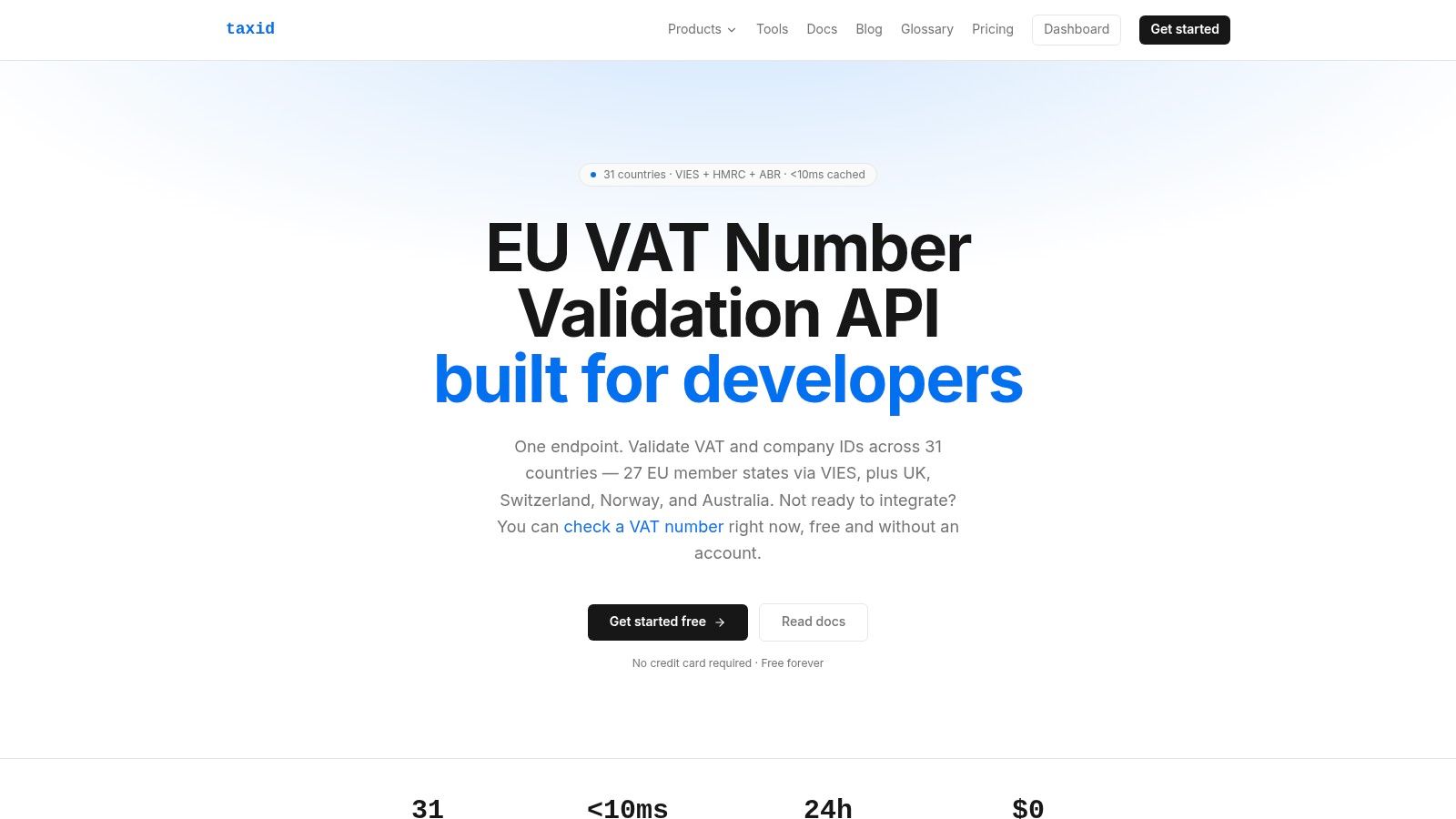
TaxID is a developer-first REST API focused on that middle layer. It sits between raw registry access and a broader tax platform. Coverage is narrower than full compliance suites, but broader than EU-only wrappers. The documented scope includes EU member states via VIES, plus the UK, Switzerland, Norway, and Australia. For teams selling mainly into Europe, that coverage matches common invoicing and checkout requirements. For companies that need wider tax ID support across many non-European jurisdictions, it does not.
Its clearest advantage is production handling rather than registry reach. TaxID performs country-level format checks before attempting remote validation, which helps separate bad input from upstream lookup failures. It also documents caching, including Redis-backed storage and fast repeat responses for recently validated numbers. That design matters because VAT validation rarely fails for one reason. Some requests are malformed. Some are valid but temporarily unverifiable because the underlying registry is unavailable. A useful API should preserve that distinction.
TaxID appears to do that better than many lightweight REST wrappers. The API returns structured error states such as vat_invalid, service_unavailable, and country_not_supported instead of forcing implementers to infer meaning from free text. For billing systems, that changes application behavior in practical ways. Invalid format can stop the user immediately. Temporary registry failure can trigger a retry path, a manual review queue, or a provisional checkout rule. Cached results can reduce user-facing latency when the same business customer is checked repeatedly.
That is the main implementation trade-off to understand. TaxID simplifies access to official validation sources, but it does not replace them. If VIES or another authority is unavailable, TaxID can improve failure handling and reduce unnecessary calls. It cannot make the underlying registry authoritative and always online at the same time.
Decision criteria view
- Jurisdiction coverage: Strong for EU-centered workflows, with added support for the UK, Switzerland, Norway, and Australia. Less suitable if your requirement is broad global tax ID validation.
- Source dependency: Still tied to official registries for authoritative results. The abstraction layer improves integration and response consistency, but upstream availability remains a real dependency.
- Failure handling: Better specified than many simple wrappers. Format validation, caching, and structured errors make it easier to build retries and fallback logic.
- Response usability: REST and JSON are easier to implement than SOAP in modern application stacks. Returned business details such as company name and address are directly usable in invoicing flows.
- Pricing evidence: Pricing is publicly visible, which is still uncommon in this category. The site lists a free tier and paid plans, giving buyers more evidence up front than vendors that require a sales conversation before any estimate.
- SDK support: The documentation is oriented toward common developer environments rather than enterprise integration tooling. That improves speed for product and platform teams, but larger organizations may still need to build their own internal wrappers.
- Operational fit: A good fit for SaaS billing, marketplaces, finance automation, and checkout systems that need machine-readable validation results. A weaker fit if you want tax calculation, filing, or a wider compliance suite in the same product.
The unresolved questions are mostly enterprise ones. Public materials make the API shape, pricing, and validation workflow reasonably clear. They are less clear on SLA terms, support guarantees, and formal assurance requirements that larger procurement teams often ask for.
Compared with direct registry access, TaxID offers a cleaner interface and more usable failure states. Compared with broader compliance platforms, it stays focused on validation rather than trying to own the entire tax workflow. That focus is its strength, provided your team is solving a production engineering problem and not shopping for end-to-end tax operations.
2. European Commission VIES SOAP API
Free and official sounds like the obvious winner. In production, VIES is often the baseline source rather than the finished solution.
That distinction matters if you are comparing official registries, lightweight REST tools, compliance platforms, and developer-first APIs on the same criteria. VIES scores well on source authority and pricing visibility because both are clear. It scores less well on response usability, failure handling, and implementation speed, especially for teams standardizing on REST and JSON across billing, onboarding, and invoicing systems.
VIES exposes SOAP operations such as checkVat and checkVatApprox through the Commission's official WSDL endpoint. That gives you direct access to the underlying EU validation mechanism used for intra-EU VAT checks, without paying an intermediary and without relying on a vendor's interpretation of registry results.
The trade-off is direct dependency on the registry path itself. If a member state source is unavailable, delayed, or returning incomplete data, your integration inherits that behavior. VIES does not add a caching layer, input normalization, structured REST errors, or JSON-first responses. Those gaps shape application design more than the headline fact that the service is free.
That is where the comparison with TaxID becomes useful, even if your final source of truth still traces back to VIES. TaxID adds format checks before a registry call, returns REST and JSON responses that fit modern app stacks, and exposes structured errors that are easier to route into retries, user messaging, and monitoring. Caching also changes the operational picture. It can reduce avoidable calls and smooth over short-lived source instability, though teams still need to decide how much freshness risk they can accept for tax-sensitive workflows.
A direct VIES integration fits teams that want the shortest path to an official EU source and are prepared to own SOAP handling, retries, timeouts, and downstream normalization. It is less attractive for checkout systems or high-volume onboarding flows where a registry timeout needs a clear product decision, not just a transport-level failure.
On the article's common decision criteria, the picture is fairly clear:
- Jurisdiction coverage: EU VAT validation only.
- Source dependency: Directly dependent on the European Commission service and the connected member state systems.
- Failure handling: Largely your responsibility. The official service is authoritative, but it is not designed as a resilience layer.
- Response usability: Adequate for back-office integrations, less convenient for product teams building around REST/JSON conventions.
- Pricing evidence: Clear. Public service, no usage fee.
- SDK support: Modest compared with developer-first API vendors.
- Operational fit: Strong for compliance-led internal systems. Weaker for teams that want one API contract across validation, retries, and user-facing error handling.
The unresolved question is not whether VIES is legitimate. It is whether your team wants to integrate a source, or consume a service built around that source. For EU-only validation with in-house engineering tolerance for SOAP and source volatility, VIES can be enough. For customer-facing systems, VIES often works better as the dependency behind a wrapper than as the full interface your application talks to directly.
3. HMRC Check a UK VAT number
Official status solves one problem, not the whole integration problem.
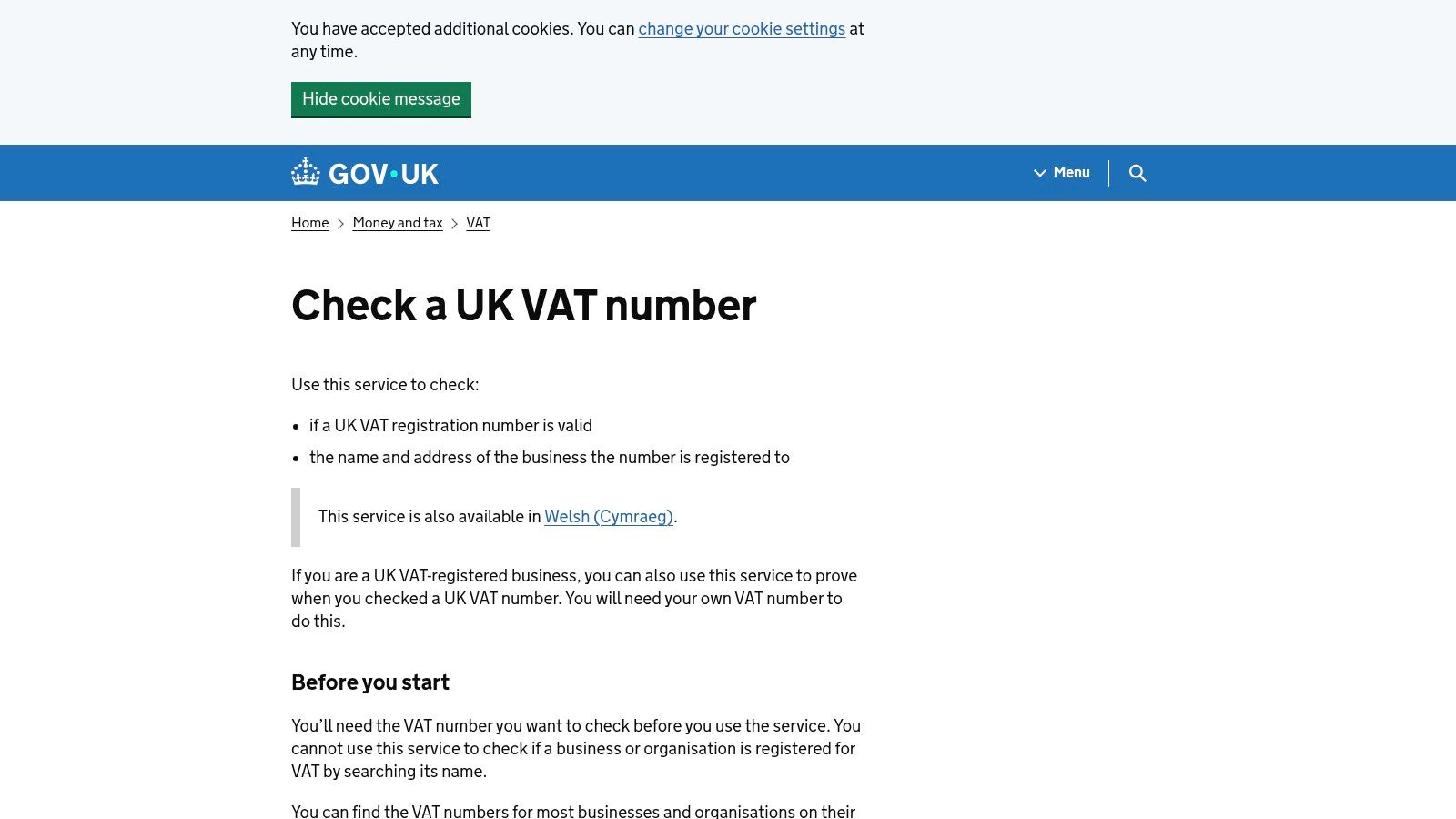
HMRC's UK government VAT checker is the authoritative reference for GB VAT checks. That matters because UK validation no longer sits neatly inside an EU-only design. A team validating both GB and EU tax IDs usually ends up comparing two architectures: direct registry access for each jurisdiction, or a service layer that normalizes those checks behind one contract.
For audit-sensitive use cases, HMRC has a clear advantage. Finance and compliance teams can point to a government source for GB verification, and that is often easier to defend than a third-party data service. The trade-off shows up in application design. HMRC covers one jurisdiction, so product teams still need a second path for EU VAT numbers, plus a policy for what happens when one source responds and the other does not.
That split has practical consequences. Error handling, user messaging, and test coverage become jurisdiction-specific. The question is not whether HMRC is trustworthy. It is whether your system wants to talk to each official source directly, or consume a developer-facing layer that standardizes source behavior across countries.
TaxID is relevant here because it addresses the production issues HMRC leaves to the integrator. As noted earlier, its format checks can reject obviously invalid input before any upstream lookup, caching can reduce repeated calls for the same identifier, and structured REST/JSON errors are easier to route through checkout, onboarding, or ERP workflows than registry-specific responses. That does not make HMRC less authoritative. It changes where the engineering burden sits.
A practical buying view looks like this:
| Decision criterion | HMRC Check a UK VAT number |
|---|---|
| Jurisdiction coverage | GB only |
| Source dependency | Direct dependence on the UK official source |
| Failure handling | Largely your responsibility unless you add your own retry, fallback, and messaging layer |
| Response usability | Suitable for confirmation workflows, but less convenient than developer-first APIs built around JSON contracts |
| Pricing evidence | Public government service. No typical SaaS-style pricing model to compare |
| SDK support | Limited compared with API vendors that publish client libraries and implementation guides |
| Operational fit | Strong for UK-specific verification and audit posture. Weaker as a single interface for multinational validation flows |
The unresolved question is operational, not legal. If you only need GB checks, HMRC may be sufficient on its own. If you need one validation flow across GB and EU numbers, an official checker is only part of the system you are buying or building.
4. Vatcomply
Vatcomply is easy to like for one reason. It reduces VAT validation to a plain REST call, which is a very different operational model from official registries and from broader compliance suites. The Vatcomply documentation reflects that positioning clearly.
That simplicity has value, but it shifts the buying question. The issue is not whether a developer can connect to the API quickly. The issue is whether the service gives enough evidence on coverage, source dependency, failure behavior, and support for production tax decisions.
Compared with the official services above, Vatcomply is less about audit posture and more about implementation speed. Compared with developer-first APIs such as TaxID, the gap is less about transport format, since both use REST and JSON, and more about production guardrails. TaxID's model is explicit about practical controls such as input format checks, caching of repeated lookups, and structured error handling. Those details affect system design because they shape how a checkout flow, onboarding form, or ERP sync behaves during invalid input and temporary source failures. Vatcomply is easier to assess as a lightweight utility than as a fully evidenced validation layer.
Decision criteria view
- Jurisdiction coverage: Appears oriented to common VAT use cases, especially EU-related workflows. Buyers should confirm exact country support and validation scope before standardizing on it.
- Source dependency: Less transparent than official registry tools. If validation depends on upstream government databases, the practical question is how that dependency is surfaced to the caller.
- Failure handling: Public materials make the request model clear, but they leave open questions about retries, degraded responses, and how upstream outages are represented.
- Response usability: Strong for teams that want straightforward REST and JSON responses without SOAP translation or registry-specific payload handling.
- Pricing evidence: Attractive for cost-sensitive use cases, though that is different from clear enterprise pricing, support commitments, or published service guarantees.
- SDK support: Standard HTTP patterns lower adoption effort, even without the broader client library ecosystem some API vendors publish.
- Operational fit: Best suited to internal tools, prototypes, and lighter production workloads where ease of integration matters more than formalized compliance operations.
The non-obvious trade-off is that lightweight tools can reduce engineering time at the start while increasing diligence work later. If your team only needs a quick validation utility, Vatcomply may be enough. If you need consistent handling across jurisdictions, explicit error semantics, and clearer evidence about upstream dependency management, the lighter surface area becomes a limitation rather than an advantage.
5. vatlayer

Convenience often wins the shortlist before reliability questions get asked. vatlayer is a good example. It presents VAT validation in the form many software teams prefer: REST, API keys, public documentation, and a commercial wrapper that feels easier to buy than official registry access. The product is presented through the vatlayer product site.
That packaging matters, but it does not answer the same questions that matter in production. Across the options in this market, the useful comparison is consistent: official registries maximize source proximity, lightweight REST tools minimize integration effort, compliance platforms add workflow controls, and developer-first APIs such as TaxID put more emphasis on response design, structured errors, caching strategy, and format checks. vatlayer sits between the lightweight tool category and the more polished developer-product category.
The practical appeal is clear. Teams can get started quickly, test against a free tier, and avoid SOAP or country-specific registry quirks. For internal finance tooling or SaaS onboarding flows, that lowers implementation time.
What remains less explicit is how much operational behavior is exposed when upstream validation sources are slow or unavailable. That is the core diligence item here.
A useful way to assess vatlayer is to separate what is confirmed from what still needs verification before rollout:
- Confirmed from public product positioning: REST and JSON delivery, commercial packaging, published plans, and support for VAT-related lookup use cases.
- Needs architecture review: Which registries or intermediaries are used by jurisdiction, whether responses can be cached safely, how stale or partial results are marked, and what error structure clients should expect during source outages.
That distinction affects implementation more than marketing copy suggests. A team choosing between vatlayer and an official registry is not only choosing an endpoint style. It is choosing how much source dependency is abstracted away. A team comparing vatlayer with TaxID is making a narrower decision: both reduce raw registry friction, but TaxID's emphasis on format validation, cache handling, structured error responses, and plain REST/JSON output can simplify production logic if you need predictable client behavior rather than only a successful lookup path.
Instead of repeating a full checklist, the buying case is simpler here. vatlayer fits buyers who want visible pricing, fast API adoption, and a vendor-managed interface for common EU VAT validation flows. It fits less well when procurement, engineering, or compliance teams need explicit evidence about upstream dependency handling, jurisdiction-by-jurisdiction coverage, or failure semantics under degraded conditions.
The non-obvious trade-off is this: vatlayer reduces integration effort at the edge of the system, but it may still leave your team to define retry policy, cache rules, and unavailable-state handling inside the application. For some teams, that is an acceptable middle ground. For others, especially those standardizing validation across several tax-ID workflows, the missing operational detail becomes the deciding factor.
6. Vatstack
A VAT validation endpoint is often too narrow for teams that also need tax calculation, evidence capture, invoice support, and event handling. Vatstack is easier to assess from that broader operational angle than from the narrower question of whether it returns a valid or invalid VAT number. The product is presented through the Vatstack site, and the positioning is clearly aimed at SaaS and e-commerce workflows rather than at single-purpose registry lookups.
That distinction matters because it changes the comparison set. Against the European Commission VIES SOAP API or HMRC's checker, Vatstack is not competing on official-registry purity. Against lightweight REST tools, it is not competing on minimalism. It sits closer to a compliance platform that happens to include validation, which can reduce system sprawl for finance and engineering teams that would otherwise stitch together several services.
The benefit is architectural, not only functional.
If your workflow starts with checkout validation and ends with tax evidence, invoice logic, and status changes that trigger downstream actions, a platform model can lower internal integration work. If your requirement is limited to fast VAT checks inside a form, that same model can add cost, abstraction, and implementation surface area you may never use.
A practical way to judge Vatstack is to apply the same criteria used elsewhere in this comparison:
- Jurisdiction coverage: Broader tax workflow ambition than a narrow EU VAT checker, but buyers should confirm country coverage at the tax-ID level rather than infer it from the wider product scope.
- Source dependency: Public positioning makes the workflow layer clear, but upstream registry dependency and fallback behavior still need verification by jurisdiction.
- Failure handling: Likely better suited than a bare lookup API for pending states, retries, or asynchronous follow-up, because workflow products can model more than a single synchronous success path.
- Response usability: Better fit for systems that benefit from structured tax objects, workflow context, and event handling. Less attractive if the calling service only wants a simple validation result.
- Pricing evidence: Public pricing is less obvious than with lightweight self-serve API products, so commercial evaluation may require a sales conversation.
- SDK support: API-led teams should review client library coverage and documentation depth before assuming parity with developer-first tools.
- Operational fit: Stronger where tax validation is one step in a recurring process, especially for SaaS billing and e-commerce operations.
The sharper comparison is with TaxID, not with the raw registries alone. Both reduce direct exposure to registry-specific integration work, but they optimize for different operating models. TaxID's emphasis on cache behavior, format checks before lookup, structured errors, and plain REST/JSON responses helps teams design predictable application flows around source downtime or malformed input. Vatstack is more attractive when validation belongs inside a wider tax operations system and the team accepts a larger product footprint in exchange for workflow coverage.
So the unresolved question is not whether Vatstack can validate a VAT number. It is whether your team wants a validation component or a tax operations layer. For organizations standardizing tax handling across billing, checkout, and compliance review, that broader scope can be justified. For teams choosing purely on endpoint clarity, pricing visibility, and failure semantics, the extra scope may complicate procurement and implementation more than it helps.
7. IBAN.com VAT Suite API
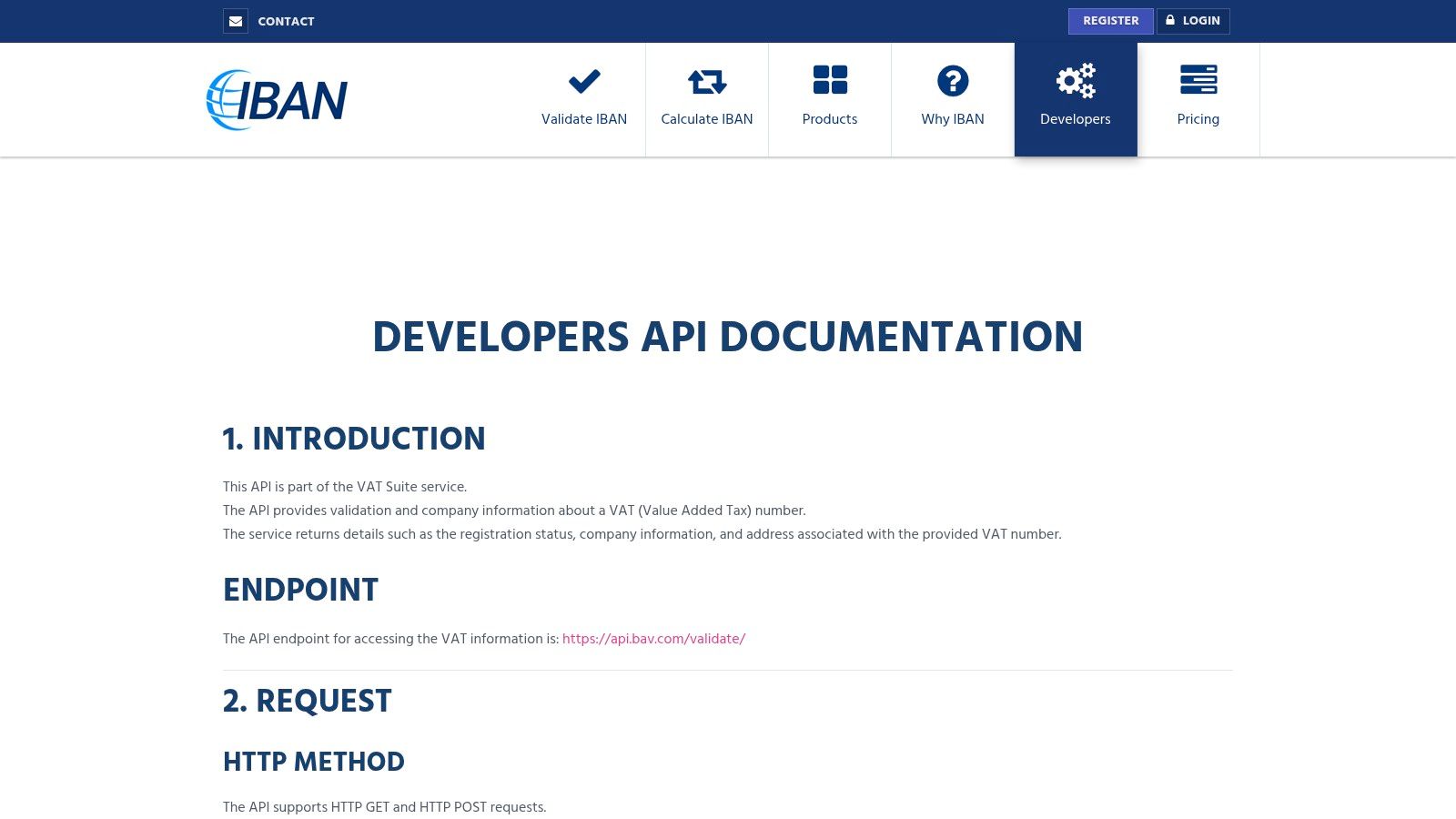
Buying a VAT validation API from IBAN.com usually means you are solving a wider verification problem, not choosing a standalone tax endpoint. Its IBAN.com VAT API page sits alongside IBAN, BIC, and payment-data products, which makes the offer more relevant to finance teams handling supplier onboarding, invoice controls, or payee checks than to developers who only want the lightest possible VAT lookup.
That positioning changes the evaluation criteria.
A lightweight REST tool is usually judged on endpoint clarity, rate limits, and self-serve pricing. IBAN.com makes more sense to judge on vendor consolidation, finance-data overlap, and whether one contract can cover VAT checks together with bank-account verification. For procurement-heavy environments, that can reduce review overhead. For product teams comparing pure API ergonomics, it can be a drawback if commercial and technical details are harder to confirm upfront.
The public VAT API page lists product scope, but it does not publish per-call pricing or visible rate-limit terms on the page itself. Buyers should verify quota policy, error responses, and retry guidance in the documentation or sales process before committing. That is the practical gap, and it matters because VAT validation quality depends as much on failure behavior as on successful lookups.
Using the same criteria applied across this list, IBAN.com lands in a specific spot:
- Jurisdiction coverage: Check the supported country scope against your actual filing and onboarding footprint. The public positioning is broader than a single-registry utility, but coverage detail should be confirmed before rollout.
- Source dependency: It appears to operate as a commercial layer over official validation sources rather than as a registry operator. That means upstream source constraints can still shape final reliability.
- Failure handling: This is the area to inspect closely. Ask how the API distinguishes invalid format, unavailable source, timeout, and unsupported jurisdiction.
- Response usability: Potentially stronger for finance workflows if the payload returns company-identification context that helps AP or compliance review, not just a valid or invalid flag.
- Pricing evidence: Public self-serve pricing is not visible on the product page, so cost comparison against developer-first APIs is slower.
- SDK support: Review documentation depth before assuming the same implementation speed you would get from a REST-first vendor with extensive examples.
- Operational fit: Strongest where VAT validation is one control in a larger supplier or payment verification process.
The useful comparison is with TaxID. TaxID is easier to slot into production application flows when a team cares about REST/JSON responses, format checks before lookup, structured errors, and caching that reduces repeated dependency on upstream registries. Those features affect real system design. They shape what your service does during source outages, how much validation you can complete before calling an external registry, and how predictable your error handling stays under load. IBAN.com can still be the better fit if vendor consolidation matters more than low-friction developer implementation.
So the decision is less about who can validate a VAT number, and more about which dependency model fits your operations. If finance verification already sits under an IBAN or payee-validation program, IBAN.com has a credible operational case. If your team is optimizing for transparent pricing, explicit failure semantics, and fast API integration, the unresolved questions on public pricing and technical behavior deserve closer scrutiny first.
8. Cloudmersive Validate API
Cloudmersive makes the most sense if your buying decision starts with platform consolidation rather than VAT validation depth. The Cloudmersive Validate API sits inside a wider validation product set, so its appeal is operational consistency. One account, one authentication model, and a familiar REST pattern can matter more than tax-specific feature nuance for teams already using the same vendor elsewhere.
That shifts the evaluation criteria.
Official registries such as VIES and HMRC are strongest on source authority, but they pass source outages and uneven response formats straight into your application. Lightweight REST tools often improve developer usability, yet many still depend heavily on those same registries. Compliance platforms add more workflow context, audit support, and adjacent tax functions, though they usually bring more setup weight. Cloudmersive fits closest to the developer platform camp. It is easier to place in a general validation stack than in a tax-control architecture designed around evidence retention, retry policy, and jurisdiction-specific exception handling.
The open question is how much VAT-specific resilience Cloudmersive adds beyond wrapping external checks in a cleaner API surface.
A practical way to assess it is to separate what is visible from what needs confirmation:
- Coverage and jurisdiction fit: Public positioning suggests relevance for common EU and UK VAT checks, but buyers should verify exact country support before committing.
- Source dependency: If the service relies on official registries for final status, upstream downtime and latency still shape production behavior.
- Failure handling: The important detail is not whether an error exists, but whether unavailable, malformed, unsupported, and source-timeout states are returned distinctly enough for application logic.
- Response usability: REST/JSON delivery is a real advantage over direct SOAP integration, especially for web teams standardizing validation across services.
- Pricing evidence: Trial access is visible. Clear public cost comparisons for sustained production use are less obvious, which slows procurement review.
- SDK support: Cloudmersive generally targets developers, so implementation friction should be lower than with registry-native interfaces. The depth of VAT-specific examples still deserves inspection.
- Operational fit: Strongest for organizations that already buy validation as a shared service across email, phone, documents, and business data.
That profile creates a useful contrast with TaxID. TaxID is easier to reason about in production when a team cares about pre-check format validation, structured errors, caching strategy, and predictable REST/JSON responses tied specifically to tax ID workflows. Those details affect more than developer convenience. They determine whether your system can reject obvious bad input before an external lookup, reduce repeated calls to upstream registries, and handle temporary source failures without collapsing into generic exceptions.
Cloudmersive can still be the better operational choice if vendor consolidation outweighs VAT-specific design control. If the requirement is narrower, namely a validate vat number API that exposes tax-oriented failure semantics clearly enough for billing, onboarding, or checkout logic, confirm those behaviors in documentation and testing before treating it as interchangeable with a specialist API.
9. Quaderno Tax IDs API
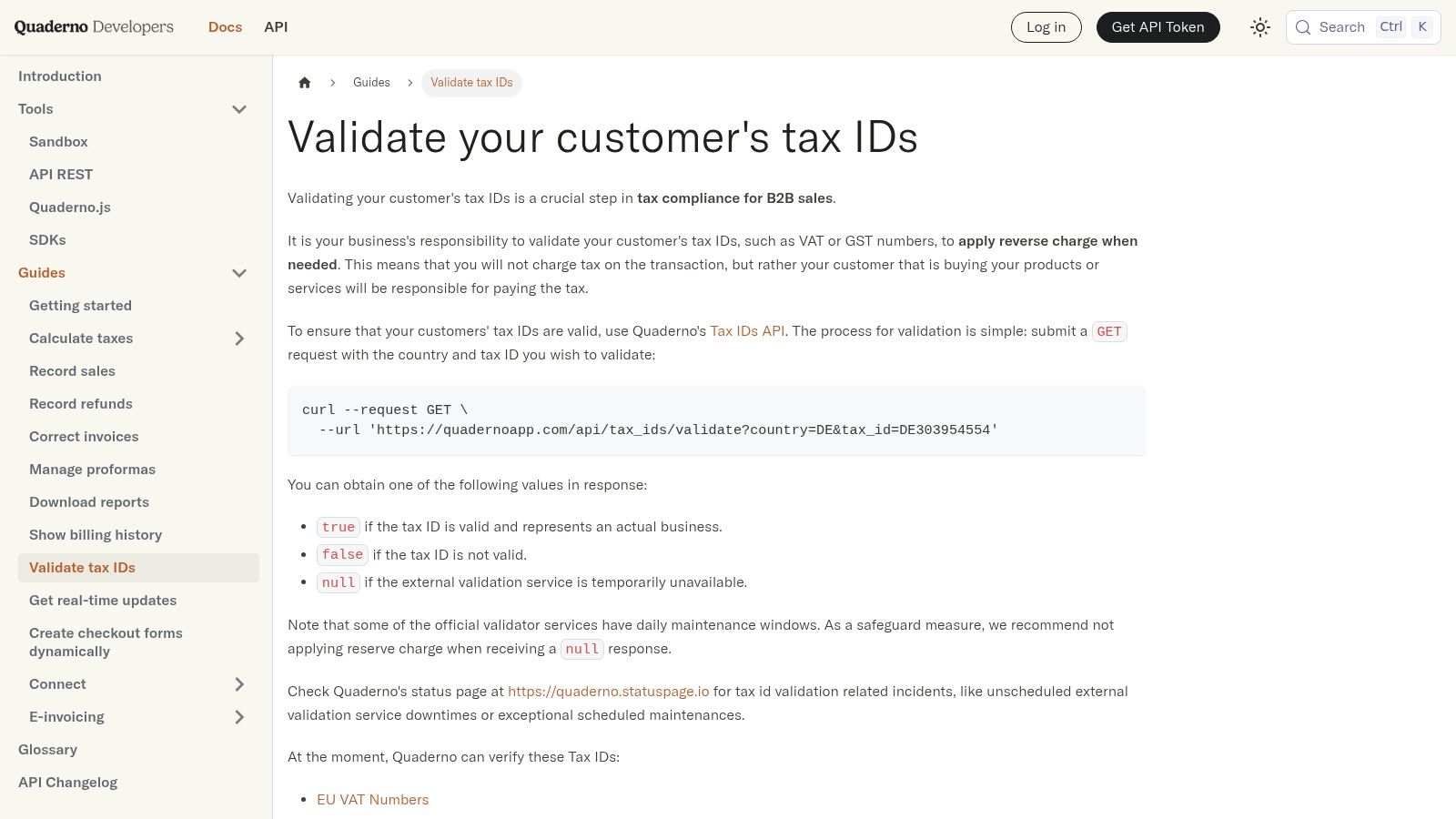
Quaderno makes the most sense when VAT validation is not a standalone service decision. It is part of a broader tax operations stack that also covers invoicing, tax calculation, and cross-border selling flows, as shown in its Tax ID validation guide.
That changes the evaluation criteria.
Official registries optimize for authority. Lightweight REST tools optimize for quick integration. Compliance platforms such as Quaderno optimize for workflow continuity across tax-sensitive steps, which can matter more than a bare valid or invalid response if the same customer record later drives invoicing, exemption handling, and audit support. The unresolved question is whether your team wants that extra context badly enough to accept a heavier platform dependency.
A useful contrast is TaxID. TaxID is easier to model as a dedicated validation component because its production-facing details are explicit: cache behavior, format checks before upstream lookups, structured errors, and REST/JSON responses. Those features affect system design directly. They let engineers reject malformed IDs early, control retry logic with fewer generic failures, and reduce repeated registry calls. Quaderno can still be the better fit if validation is only one step inside a larger tax workflow, but the trade-off is different. You are choosing a tax platform interface, not just a validate vat number API.
One implementation detail deserves scrutiny. If Quaderno sits between your application and official registries, source dependency does not disappear. It becomes abstracted. That abstraction can simplify development, yet buyers should still verify what happens during upstream outages, whether temporary failures are exposed with usable status information, and how much evidence the API returns for later reconciliation.
Instead of a feature checklist, Quaderno is easier to assess as an operational profile:
- Jurisdiction coverage: Broader than an EU-only VAT checker if your business also deals with other tax ID workflows.
- Source dependency: Still relevant. Confirm which validations rely on official registries and how fallback or deferred handling works.
- Failure handling: Potentially stronger for billing workflows if the API exposes states your application can act on, rather than a flat pass or fail result.
- Response usability: Better suited to systems that need validation data to flow into invoicing, customer records, or tax determination.
- Pricing evidence: Public pricing is usually framed around platform usage, not per-validation transparency, which can slow direct API cost comparison.
- SDK support: More useful for teams adopting several tax functions at once than for a single lookup endpoint.
- Operational fit: Strong for SaaS and e-commerce teams that want one vendor handling tax IDs alongside adjacent tax operations.
Quaderno is easier to justify after a workflow review than after an endpoint comparison alone. If your requirement is narrow, dedicated developer-first APIs remain simpler to price, test, and swap. If your requirement includes validation plus tax execution around the same transaction, Quaderno has a clearer case than many lighter REST wrappers.
10. AbstractAPI VAT Validation and Rates API
A polished REST API does not remove the hard parts of VAT validation. It mostly changes where they show up.
AbstractAPI is a good example. The product is easy to evaluate, the AbstractAPI documentation hub is approachable, and teams already buying email, IP, or company data APIs from the same vendor may prefer one account, one billing model, and one support channel. That operational convenience is real. It also means you should separate interface quality from validation depth before putting it in a checkout, invoicing, or account onboarding path.
The most useful way to assess AbstractAPI is against the same criteria used for official registries, lightweight tools, compliance platforms, and developer-first APIs.
For jurisdiction coverage, it appears aimed at the common EU VAT validation and rate lookup use case rather than the broader tax ID scope some platforms target. For source dependency, the unresolved question is the important one. If a result ultimately depends on VIES or another registry path, production behavior still inherits registry downtime, member-state availability gaps, and occasional delayed responses. A clean JSON wrapper improves implementation effort. It does not change the dependency chain.
That distinction matters in system design. TaxID makes the trade-off explicit by combining format checks, cached responses, structured machine-readable errors, and REST/JSON output around the registry dependency, which helps teams decide when to validate synchronously and when to defer. AbstractAPI may still fit well, but buyers should confirm the same operational details directly: whether invalid format is separated from source failure, whether transient upstream errors are distinct from firm negatives, and whether responses contain enough structured fields for retries, audit trails, and support workflows.
Response usability is likely one of AbstractAPI's stronger points. Generalist developers usually prefer REST over SOAP, and vendor consistency can shorten implementation time if the team already knows the platform's authentication and response conventions. SDK support also tends to matter more here than with narrower tax specialists, because the value proposition includes reuse across several APIs, not only VAT checks.
The gaps are commercial and operational visibility. Public pricing is often easier to find than in enterprise compliance suites, but teams still need to inspect request limits, overage behavior, and what is included in the VAT product versus the rates product. Reliability also needs direct testing, not just a quick read of the docs. If your workflow requires clear distinctions between valid, invalid, unavailable, timeout, and retry-later states, ask for sample error payloads before committing.
AbstractAPI fits best when procurement simplicity and familiar developer ergonomics carry real weight. It is less convincing when your priority is evidence-rich validation behavior, explicit upstream failure handling, or jurisdiction-by-jurisdiction certainty about the original data source.
Top 10 VAT Validation APIs Comparison
| Provider | Core features / coverage | Quality & UX | Price & value | Best for / USP |
|---|---|---|---|---|
| 🏆 TaxID | REST/JSON; validates 31 countries (EU27 + UK/CH/NO/AU); returns status, company_name, address; format checks; 24h Redis cache | ★★★★☆ sub‑10ms cached; clear docs; Stripe‑style machine errors | 💰 Free 100/mo; Starter $19/1k; Growth $49/10k; scalable plans | 👥 SaaS, marketplaces, billing ops; ✨ lightweight VIES wrapper, caching & dev‑friendly errors |
| European Commission VIES (official) | SOAP checkVat/checkVatApprox; canonical EU source; returns name/address where available | ★★★☆☆ Authoritative but intermittent; SOAP/WSDL only | 💰 Free (public service) | 👥 Regulatory/official use; ✨ canonical source for EU VAT |
| HMRC “Check a UK VAT number” (official) | UK VAT registry; web UI + developer sandbox/API references | ★★★★☆ Authoritative for GB; public notices & sandbox | 💰 Free (government service) | 👥 UK-only compliance; ✨ official GB data |
| Vatcomply | REST GET /vat; VAT rates, currency, IP geolocation; OpenAPI | ★★★☆☆ Simple & fast; no formal SLA | 💰 Free / prototype-friendly | 👥 Prototypes, low-volume projects; ✨ consolidated tax utilities |
| vatlayer (apilayer) | REST VAT validation + rates; VIES-backed options; SDKs & dashboard | ★★★★☆ Mature SDKs & docs; reliable tooling | 💰 Free tier + paid plans (metered) | 👥 Developers needing SDKs & tooling; ✨ long-standing provider |
| Vatstack | VAT/GST validation (including bulk), rates, evidence storage, webhooks | ★★★★☆ Compliance-focused; reporting & webhooks | 💰 Paid (features/pricing for compliance workflows) | 👥 SaaS & e‑commerce needing evidence/reporting; ✨ end-to-end tax ops |
| IBAN.com, VAT Suite API | VAT checks as part of IBAN/BIC/banking suite; REST + company data | ★★★☆☆ Enterprise support available; commercial focus | 💰 Commercial / enterprise pricing | 👥 Finance/fintech customers; ✨ one vendor for banking + VAT |
| Cloudmersive Validate API | POST /validate/vat/lookup; returns company info; SDKs; broad validation suite | ★★★★☆ 600 free calls/mo; SDKs & console | 💰 💰 Free 600/mo trial; paid tiers for scale | 👥 Teams wanting broad data validation; ✨ large free quota |
| Quaderno Tax IDs API | Validates many Tax IDs (EU, GB, CH, AU/NZ, CA, etc.); integrated with invoicing & tax calc | ★★★★☆ Mature product; sandbox & status page | 💰 Product/transaction pricing (not per-call) | 👥 Businesses needing invoicing+tax automation; ✨ end-to-end tax + invoicing |
| AbstractAPI, VAT Validation & Rates | REST VAT validation & rates; part of multi‑API platform; good docs | ★★★☆☆ Simple REST, quickstarts; check quotas | 💰 Per‑product pricing; free tier (limits apply) | 👥 Users of Abstract suite; ✨ unified developer account for multiple APIs |
Choose by Workflow, Not by Endpoint
The most common mistake in this category is choosing on interface style alone. REST beats SOAP for developer ergonomics, but that doesn't mean every REST wrapper is equally usable in a live billing flow. A validate VAT number API should be judged by what happens when the source registry is slow, unavailable, split by country, or correct only for the instant you queried it.
Start with official registries when authority is the main requirement. Use the European Commission's VIES service when direct EU-source validation matters and your team can manage SOAP, retries, and cache design. Use HMRC when you need an official GB answer and want your UK checks anchored in the government source rather than in a third-party abstraction.
Choose lightweight APIs when speed of integration matters more than broader tax workflow support. Tools like Vatcomply, vatlayer, Cloudmersive, and AbstractAPI can reduce implementation effort, especially for prototypes, internal apps, and teams that already standardize on those vendors. The catch is that convenience doesn't remove source dependency. It just changes how much of the dependency the vendor exposes to you.
Move up to broader compliance platforms when validation is only one step in a longer process. Vatstack, Quaderno, and IBAN.com make more sense when you also need evidence capture, invoicing, payee checks, tax calculation, or workflow automation. In those cases, buying a more opinionated platform can reduce operational handoffs even if the per-validation comparison looks less favorable.
TaxID fits a narrower but important slot. It's strong when you want a focused REST/JSON integration for 31-country coverage, including all EU member states via VIES plus the UK, Switzerland, Norway, and Australia, without building your own wrapper. Its production advantages are practical rather than abstract: country-specific format checks, caching, structured errors, and pricing that's visible before you talk to sales. That combination is especially useful for B2B SaaS teams using Stripe, Node.js, Python, or React in customer-facing billing flows.
One more point often gets missed. A validation result doesn't prove everything you need for compliance forever. VIES confirms that a number is active at the moment of the query. It doesn't provide historical validity windows. That means your implementation should preserve evidence, not just display a green checkmark.
Use this shortlist when you evaluate vendors:
- Country support: Confirm the exact jurisdictions you sell into, not just “EU” or “global.”
- Response fields: Check whether you get company name, address, consultation references, and machine-readable errors.
- Retry and cache policy: Ask how the system behaves when the registry times out or returns a service-unavailable state.
- Outage behavior: Separate
invalidfromunavailable. They aren't the same business event. - Usage limits: Verify quotas, throttling, and whether malformed inputs consume billable requests.
- Pricing evidence: Prefer vendors that publish plans clearly if you want predictable rollout.
- SDK fit: Match the docs and examples to your actual stack.
- Audit requirements: Decide what evidence your finance team needs to store for later review.
- SLA reality: If a vendor hints at enterprise reliability, check whether the SLA is documented.
The best tool here isn't the one with the prettiest docs. It's the one whose failure modes your billing system can survive.
If you want authoritative VAT validation without building around SOAP and registry quirks yourself, TaxID is one of the cleanest options in this category. It gives you a focused REST/JSON API, 31-country coverage, caching, structured errors, and transparent pricing that fits real checkout and billing workflows.