Greece's VAT system runs on a 24% standard rate, with reduced rates of 13% and 6% layered on top, plus a narrow set of zero-rate exceptions. Greek VAT numbers always start with EL followed by nine digits, a pattern that matters when you're verifying business customers from outside the country.
Table of Contents
- Understand Greece's VAT Rates
- Why the Rate History Matters
- Regional Reductions Add Another Layer
- Where SaaS Sellers Usually Land
- Getting a Greek VAT Number
- A Practical SaaS Example
- Build Invoices That Actually Hold Up to Scrutiny
- Keep Records for the Full Required Period
- What VIES Validation Confirms
- Why Direct Integration Creates Friction
- Compare Your Integration Options
- Design for Failure
- Must a Non-EU SaaS Company Register?
- What If the VAT Number Is Invalid?
- How Often Should VIES Checks Be Recpeated?
- Does Greece's 24% Rate Change SaaS Pricing?
Understand Greece's VAT Rates
Think of VAT as a relay race. Each business in the chain charges tax, subtracts the VAT it legitimately paid on its own purchases, and hands the difference up the line. The final consumer absorbs the cost. For SaaS and B2B sellers, this means the customer's status and location often weigh just as heavily as the headline rate.
Here's the quick-reference breakdown:
| Rate | Applies To | Notes |
|---|---|---|
| 24% | Most goods and services | Greece's standard rate |
| 13% | Selected essentials and services | Covers food, hospitality, and transport |
| 6% | Limited categories | Certain medicines, books, and cultural items |
| 0% | Specific qualifying transactions | Confirm eligibility before applying |
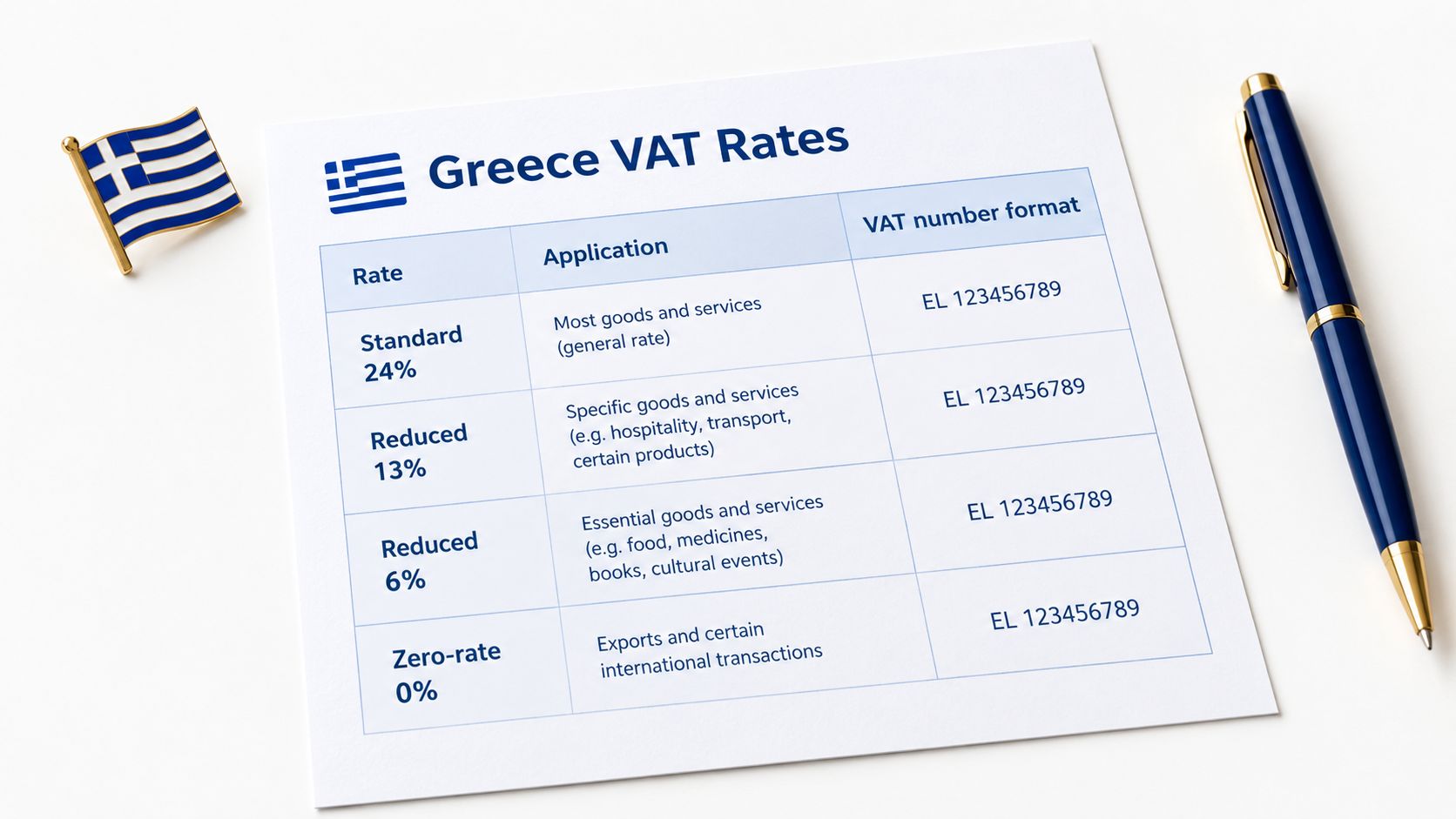
This puts Greece's 24% standard rate above the EU average of roughly 21.9%, with its 6% and 13% reduced brackets offering some relief in specific categories. For category-by-category checks, read the detailed Greece VAT rate guide.
Now, why does this matter if you're a foreign SaaS company billing a Greek customer? A valid EL VAT number is what unlocks B2B treatment and the reverse charge mechanism. Miss that step, and your checkout might charge VAT you didn't need to collect, or worse, grant an exemption you can't back up during an audit.
Three things to keep separate:
- Confirm the buyer is genuinely B2B, not just someone with a company name.
- Validate the Greek VAT number before you apply reverse charge.
- Map the product or service to the correct Greek rate.
This table gives you a starting point, but it's no substitute for transaction-specific advice. Rules shift, and reduced or zero treatment hinges on the exact nature of the supply.
Greece introduced Value Added Tax in 1987, starting with a standard rate of 18%. That origin story matters more than you might think — the rate now applied to most goods and services sits at 24%, a six-point climb over nearly four decades.
The early years brought several adjustments. During the 1990s, Greece moved through standard rates of 16% and 19%, reflecting shifting fiscal priorities and gradual alignment with broader European VAT frameworks.
Then came the crisis. The standard rate jumped to 21% in March 2010, then climbed again to 23% in July 2010 just months later. After further fiscal pressure and successive policy changes, it settled at the current 24% level in July 2016.
Greece's VAT history is a reminder that tax rates are a moving part of business planning, not a fixed backdrop you can set and forget.
Why the Rate History Matters
For a SaaS company, even a two-point swing can ripple across thousands of recurring invoices. A subscription priced at €100 before tax now carries €24 VAT at the standard rate. Under the original 1987 system, that same invoice would have added just €18.
Greece has never relied on a single rate. Reduced categories have persisted throughout:
- 13% applies to selected essentials and services, including many food, hospitality, and transport transactions.
- 6% covers a narrower set of categories, including certain medicines, books, and cultural products.
- The exact classification of a transaction still determines which rate applies — getting it wrong isn't a minor rounding error.
The 2026 European VAT rate table confirms Greece's current setup: 24% standard, with 13% and 6% reduced rates — the structure businesses work with today.
Regional Reductions Add Another Layer
Several Greek islands benefit from geographically targeted reductions, with rates cut by 30% in eligible areas. This isn't just an accounting footnote. It creates a genuine decision point for companies selling physical goods, accommodation, or location-dependent services.
A billing system, then, needs far more than a country field. You may need the customer's precise location, the supply type, the effective date, and the applicable regional rule all working together. Before automating anything, cross-check the current treatment against official guidance — especially since the eligible islands and rate details can change without much fanfare.
If you're planning to do business in Greece, VAT registration hinges less on hitting some magic revenue number and more on what you're selling, who you're selling to, and where your business is actually based.
There is a €10,000 annual turnover exemption that applies to businesses making taxable supplies from Greece itself. You can find it listed in the 2026 European VAT registration thresholds.
But that's a domestic Greek rule. Don't mix it up with the EU-wide €10,000 distance-selling threshold, which kicks in for certain cross-border B2C sales of goods and e-services. Cross that line, and you'll generally start charging VAT in the buyer's country, most likely through the One Stop Shop (OSS) system.
Where SaaS Sellers Usually Land
If you're a non-Greek company selling to a Greek business that's VAT-registered, the typical path is reverse charge. Your Greek customer handles the VAT on their own return, which means you don't necessarily need to register in Greece just because you've picked up a B2B client there.
B2B services tend to push the VAT reporting onto the Greek customer; B2C sales tend to pull it back to you.
Before you lean on that logic, make sure the customer is genuinely a business and that their Greek VAT number checks out. A company name by itself won't cut it.
You'll likely need to register when any of these apply:
- You're selling digital services to Greek B2C customers and you've gone past the relevant EU threshold.
- You're making taxable supplies from Greece that don't qualify for reverse charge.
- You're storing inventory, operating locally, or otherwise creating a taxable presence there.
- You want to voluntarily register to reclaim input VAT or meet local commercial expectations.
Getting a Greek VAT Number
If you do need to register, treat it like a real project, not something you scramble together at the last minute. Greek authorities typically want incorporation documents, evidence of business activity, ID for directors or representatives, a registered address, and authorization if you're using a local tax representative.
You submit the application to the relevant Greek tax authority, and expect several weeks of processing. Timelines stretch if documents need translations or if your foreign company requires a local representative.
A Greek VAT number looks like EL followed by nine digits. Once you have it, the implications go beyond invoice formatting. Your billing system will likely need to handle VAT calculations, submit returns, maintain records, and manage payment flows in ways that account for Greek requirements.
Get these pieces in place before you go live:
- Classify every customer as either B2B or B2C.
- Validate the customer's VAT number.
- Choose the right treatment: reverse charge, OSS, or Greek VAT.
- Set up your invoicing and reporting before the first payment comes in.
Thresholds are a rough guide, not a guarantee you're in the clear for every transaction. Before you start billing customers in Greece, run your specific situation by a Greek tax adviser.
For cross-border SaaS, reverse charge hands the VAT reporting responsibility to the buyer. A non-Greek supplier bills the Greek business without adding Greek VAT, and the customer handles the calculation and reporting on its own return.
This typically kicks in when a business outside Greece provides digital services to a legitimate VAT-registered Greek company. That customer’s EL VAT number isn’t just a box to tick — it’s what justifies the entire tax treatment.
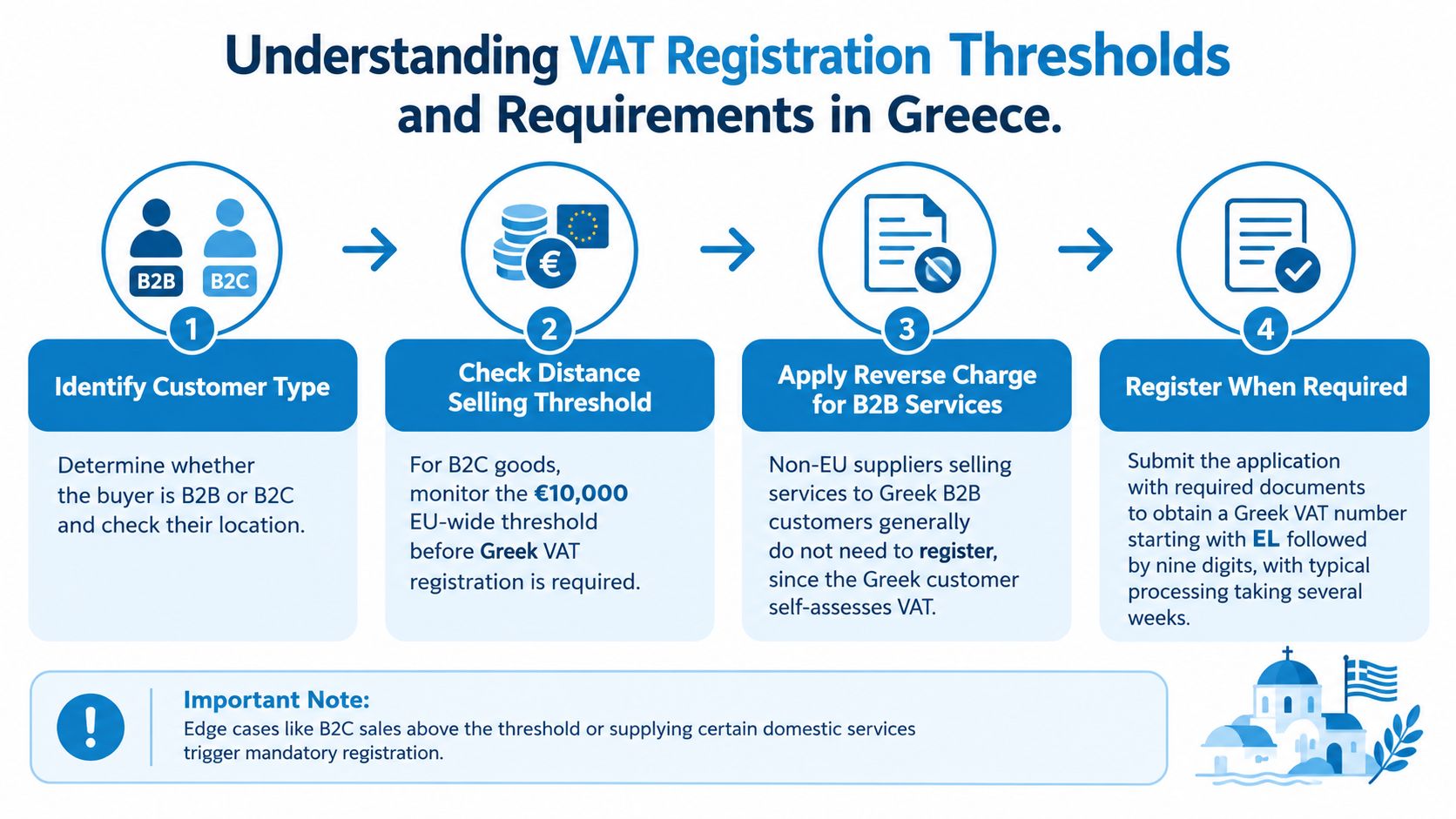
The infographic above maps out the decision flow, starting with the customer’s classification, checking the €10,000 EU-wide threshold, then working through reverse charge rules and whether Greek registration is necessary.
The basic idea is straightforward: B2B services generally push VAT accounting onto the Greek customer. B2C sales or certain domestic supplies, on the other hand, can land registration and collection obligations squarely on the seller.
A Practical SaaS Example
Say a US or French software company sells a €1,000 monthly subscription to a Greek business. If the buyer supplies a valid Greek VAT number, the supplier issues an invoice for the full €1,000 with €0 Greek VAT.
The Greek customer then self-assesses 24% VAT — logging €240 as output VAT and, where permitted, claiming the same amount back as input VAT. The supplier never touches that €240.
The invoice itself needs to be airtight:
- Supplier and customer legal names and addresses
- Both VAT identification numbers
- A unique invoice number and supply date
- A clear description of the SaaS service
- The net amount with VAT shown as zero
- A clear “Reverse charge” note
Never accept a company name as proof of B2B status. Always validate the customer’s VAT number through VIES before zero-rating the invoice.
If VIES can’t confirm the number, stop the exemption flow and dig further. Depending on the situation, standard VAT may apply, or you may need to register. For deeper background, see this guide on EU reverse charge VAT rules.
For billing teams, the most reliable sequence is:
- Identify the customer type and location.
- Check the Greek VAT number through VIES.
- Store the validation result and timestamp.
- Apply reverse charge only after the number checks out.
- Revalidate whenever customer details change.
That approach embeds tax treatment directly into the billing system instead of relying on someone’s gut call at the invoice stage.
Build Invoices That Actually Hold Up to Scrutiny
An invoice is essentially the paper trail for a transaction. Before you start calculating tax for Greek customers, you need to know which type you're dealing with: a B2B reverse charge invoice or a standard B2C invoice. They look different and serve different purposes.
A reverse charge invoice typically shows no Greek VAT at all. What it does need is both parties' legal names, addresses, VAT numbers, and a prominent "Reverse charge" statement. A B2C invoice, on the other hand, breaks out the applicable Greek VAT rate and amount line by line.
Here's what every Greek invoice should contain:
- A unique, sequential invoice number with no gaps
- The issue date and supply date (if they differ)
- Full identification details for both supplier and customer
- The customer's EL VAT number for qualifying B2B sales
- A clear description of what was sold
- Net price, currency, VAT rate, and VAT amount shown separately
- Payment terms plus any required exemption or reverse charge wording
For SaaS businesses, specificity matters. Writing "annual cloud subscription, January 2026" is far better than "monthly software." Vague descriptions are harder to reconcile if a tax authority comes knocking.
Keep Records for the Full Required Period
Greece mandates that invoices and supporting documentation be kept for at least ten years. Digital storage works fine as long as files stay readable, complete, retrievable, and protected against unauthorized changes.
Your billing platform needs to store more than just the final invoice PDF. Preserve the original invoice, calculation inputs, customer VAT status, validation timestamp, and every adjustment made afterward. When someone makes a manual edit, it should leave a visible audit trail instead of silently overwriting the previous version.
An automated invoice is only compliant when its template, tax logic, and change history are all compliant.
Recurring subscriptions need a separate invoice or a legally recognized periodic document for each taxable supply. If you're dealing with partial deliveries, record each delivery date and allocate the appropriate value to it. When a customer gets a refund, discount, or cancellation, issue a linked credit note that references the original invoice and reverses the correct net and VAT amounts.
A straightforward lifecycle checklist helps keep everything in order:
- Lock in the tax treatment before capturing payment.
- Generate sequential numbering with no gaps or unexplained cancellations.
- Reconcile credit notes against the original invoice they relate to.
- Export searchable records and backups on a regular schedule.
If you're juggling deposits, receipts, VAT calculations, and credit notes all at once, this Samba receipt generation guide walks through some practical approaches worth reading. Before rolling any invoice template out to customers, run it through reverse charge, B2C, partial-period, renewal, refund, and credit note scenarios to catch issues early.
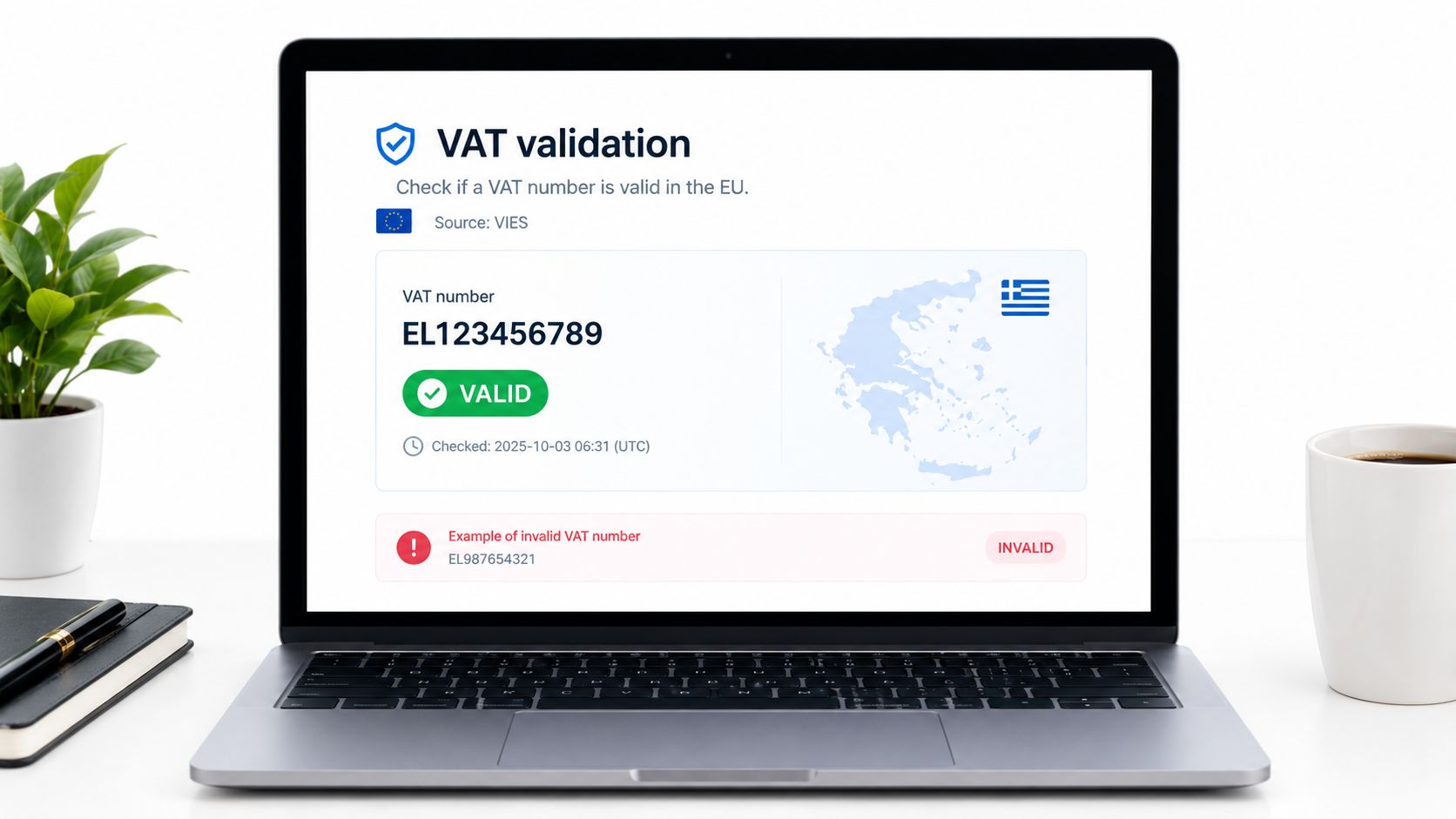
A Greek VAT number isn't just another field on a form. It's the proof behind your reverse charge decision, and a single wrong digit can shift a VAT-free invoice into an unexpected tax liability.
Greece is worth paying attention to here. VAT collections sat at roughly 9.5% of GDP in 2025, well above the EU average of 7.2%. That gap signals active enforcement and real scrutiny — not the kind of environment where a missing checkbox goes unnoticed.
If the number can't be validated, treat the reverse charge as unproven until the customer provides reliable evidence.
What VIES Validation Confirms
The EU's VIES system checks whether an EL VAT number followed by nine digits is currently active for intra-EU transactions. A successful lookup returns a valid status and may also surface the registered business name and address.
Here's a practical flow to follow:
- Strip spaces and punctuation, then confirm the
ELprefix and nine-digit format are intact. - Submit the number to VIES with Greece selected as the member state.
- Store the response, timestamp, request identifier, and the customer details you used.
- Cross-check the returned name and address against what the buyer provided you.
An invalid response usually means a typo, a dormant registration, or a number that hasn't been enabled for intra-EU trade. A service unavailable response is a different beast entirely — it's a technical failure on the server side, not a verdict on your customer. Either way, don't quietly waive VAT based on those outcomes.
Why Direct Integration Creates Friction
VIES runs on a legacy SOAP-based interface. Expect downtime, inconsistent error messages, and almost no structured handling of edge cases. For a small team, building retries, timeouts, caching, logging, and fallback logic around that foundation can burn more engineering hours than the tax feature justifies.
That's exactly why a lot of billing teams lean on a wrapper like TaxID's Greek VAT validation endpoint. It handles format checks locally, returns predictable error states, and keeps validation records ready for an audit down the line.
The math is straightforward. On a €1,000 SaaS invoice, one unverified number could leave you on the hook for €240 in Greek VAT. Validate before applying the reverse charge, and keep the decision traceable.
A VAT check should work like a traffic light, not a coin toss. Before your system applies reverse charge to a Greek customer, it needs a dependable answer about the customer's VAT number, registration status, and the time of validation.
The simplest option is calling VIES directly. However, its SOAP-based interface, intermittent availability, inconsistent responses, and limited error detail create friction for teams building checkout or recurring billing flows.
Compare Your Integration Options
| Approach | Best For | Main Trade-Off |
|---|---|---|
| Direct VIES calls | Large teams with tax infrastructure | Highest maintenance burden |
| Internal wrapper | Teams needing custom control | Requires retries, caching, and monitoring |
| Validation API | Most SaaS and B2B checkouts | Adds a service dependency |
A direct integration means your developers must handle Greek format checks, timeouts, retries, audit logs, and service failures themselves. A wrapper improves control, but your team still owns every operational problem when VIES changes or becomes unavailable.
A modern REST API removes much of that plumbing. TaxID's Greek VAT validation endpoint checks the country format before contacting VIES, returns company details in structured JSON, and standardizes failures with codes such as vat_invalid and service_unavailable.
Validation should support the billing decision, not become a second billing system.
Caching is especially useful during busy checkout periods. TaxID stores successful results for 24 hours, and cached responses return in under 10 milliseconds, reducing repeated upstream requests without forcing customers to wait.
Design for Failure
A resilient flow should distinguish between an invalid number and an unavailable service:
- Validate the
ELprefix and nine digits locally. - Check a recent cached result.
- Query the validation service when necessary.
- Store the response, timestamp, and customer details.
- Apply reverse charge only after a valid result.
If VIES is temporarily unavailable, pause exemption, request supporting evidence, or route the order for review. Never treat an outage as proof that the number is valid.
For most small and mid-sized SaaS teams, an API is the practical choice. Direct VIES access may suit high-volume companies with dedicated compliance engineers, while a managed service fits teams prioritizing launch speed, predictable errors, and lower maintenance. Start with TaxID's 100 free monthly validations, then choose a paid plan as volume and compliance exposure grow.
Must a Non-EU SaaS Company Register?
In most cases, no — at least not when you're selling digital services to a VAT-registered Greek business. The customer handles VAT on their end through the reverse charge mechanism, as long as their EL VAT number checks out and the transaction qualifies as a genuine B2B sale.
That said, registration can still become necessary. Think B2C sales to Greek consumers, domestic supplies sourced within Greece, or establishing a taxable presence there. One number worth keeping in mind: the €10,000 EU-wide threshold. If your cross-border B2C digital sales to customers across the EU exceed that, it can trigger registration obligations depending on where you choose to register.
What If the VAT Number Is Invalid?
Don't just assume reverse charge applies and move on. An invalid VIES result could mean anything from a simple typo to a lapsed registration — or a business that hasn't been properly authorized for intra-EU transactions.
The sensible move is to ask the customer to double-check their details and try again. Until you've got a verified number on file, hold off on applying the exemption. Consider charging the applicable VAT instead, and make sure you document the decision so your audit trail is clean. Also worth noting: a VIES service outage isn't the same as an invalid number. Your billing system should treat those as two separate scenarios.
How Often Should VIES Checks Be Recpeated?
Timing matters here. You should revalidate when a customer first submits their VAT number, whenever their legal or billing details change, and ahead of major contract renewals. For ongoing subscriptions, running a monthly check makes sense for higher-risk accounts. Lower-risk customers can follow a documented periodic schedule — quarterly or even less frequently, depending on your risk assessment.
Save the full response: the result, the timestamp, and the company details that matched. This isn't just housekeeping — it's the evidence you'll need to justify every reverse-charge invoice if questioned later.
Does Greece's 24% Rate Change SaaS Pricing?
It can affect B2C pricing and your cash flow, but it rarely changes the bottom line for a VAT-registered B2B customer who can reclaim input VAT. The key is transparency — show VAT clearly rather than burying it in the price. Model your consumer and business pricing separately so the math stays clean.
Price the subscription first. Then let the customer's tax status determine whether Greek VAT gets added on top.
TaxID helps you validate Greek VAT numbers reliably. Try TaxID free.