A developer on a growing SaaS team usually discovers VAT compliance software at the least convenient moment. European businesses are ready to buy, Stripe can collect the payment, and then someone asks whether the invoice should use reverse charge. The team finds VIES, discovers that the EU service is a SOAP endpoint, and learns that a remote authority can respond slowly or fail without warning. An in-house wrapper that looked like a small task starts consuming weeks.
The buyer's problem is that “VAT compliance” describes very different products. Some platforms calculate tax, generate invoices, and manage filings. Others provide a narrow validation API. Both may use the same label, but they solve different operational problems.
This guide compares tools by features, integration fit, reliability, evidence quality, and use case, rather than declaring one universal winner. The broader compliance environment justifies taking the problem seriously. The EU's total VAT compliance gap was estimated at EUR 89.3 billion in 2022, equal to 7% of total VAT Total Tax Liability (European Commission data). Validation software won't eliminate that gap, but it can prevent avoidable identity errors and preserve evidence for billing decisions. For a plain-language foundation, start with this overview of what VAT compliance involves.
Table of Contents
- Introduction
- What VAT Compliance Software Actually Does
- The Feature Matrix That Matters
- Integration Friendliness for Developer Teams
- Use Cases and Team Profiles
- Common Pitfalls and the Limits of Validation
- Recommendations by Team Size and What Comes Next
Introduction
The first production failure usually isn't a tax calculation. It's a checkout decision made with incomplete information.
A customer enters a VAT number, your billing system accepts it, and your application applies reverse charge. Later, the validation service returns an ambiguous response, the customer's legal entity doesn't match the account, or the government endpoint is unavailable when the invoice is issued. A team that only wanted to bill a European business now needs a policy for retries, evidence, manual review, and invoice correction.
That's why the useful question isn't, “Which VAT compliance software has the most features?” It's, “Which part of the compliance chain are we buying, and what happens when its dependencies fail?”
A validation API can sit beside Stripe Billing and provide structured tax identity checks. An invoicing suite may own invoice creation, tax calculation, and accounting exports. A filing platform can take responsibility for returns and submissions across jurisdictions. Buying the largest product in the category can create unnecessary integration work, while buying only a lookup endpoint can leave finance teams without the records they need.
The comparison below focuses on practical trade-offs. It looks at validation coverage, caching, error semantics, audit trails, structured transaction data, and future reporting requirements. The right choice depends on whether you're a small SaaS team, a marketplace, an operations group, or a platform embedding compliance capabilities for other customers.
What VAT Compliance Software Actually Does
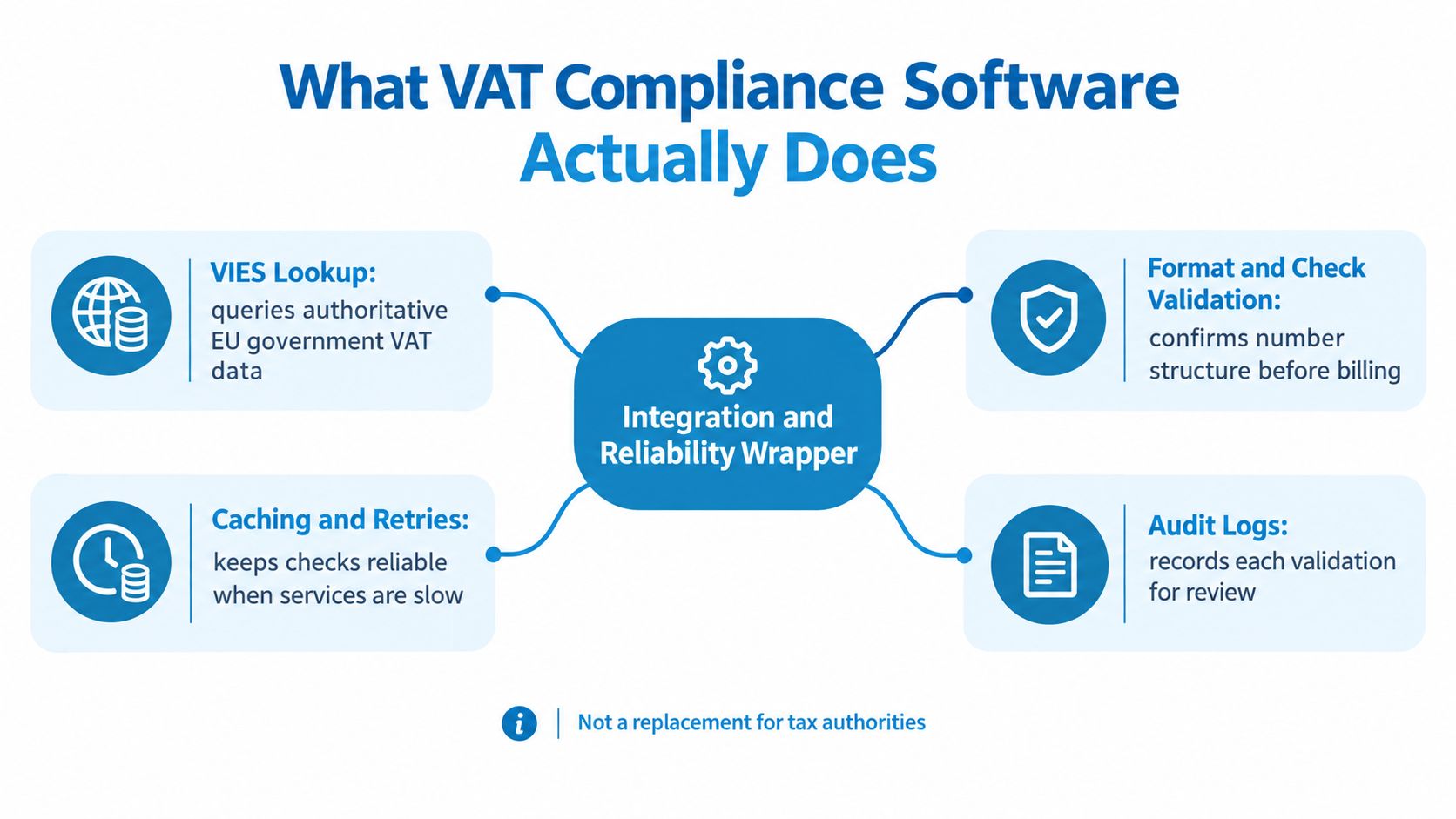
Most VAT compliance software is best understood as an integration and reliability layer around authoritative government data. It can validate an identification number, normalize the response, preserve the result, and expose a usable API. It generally cannot replace the tax authority or independently decide every legal question about a supply.
VIES illustrates why that distinction matters. The system was created in 1993 under the administrative-cooperation framework of Regulation 218/92/EC to exchange information about VAT-exempt intra-Community supplies. It became fully operational for the then-15 Member States by 1 January 1995, although it was originally expected to last only about four years (OECD background on digital tax administration).
That history explains the developer experience. A system designed for inter-administration exchange isn't automatically a high-volume, friendly API for checkout traffic. A modern wrapper adds country-specific format checks, normalized responses, caching, retry logic, outage classification, and audit records.
Three product categories
You can place most products into one of three categories:
- Validation layer: Checks VAT or company identification numbers and returns registration details. It belongs inside checkout, onboarding, billing, procurement, or KYC workflows.
- Invoicing and billing suite: Calculates tax, creates invoices, handles credit notes, and often connects to payment and accounting systems.
- Filing platform: Prepares or submits VAT returns, manages reporting calendars, and supports reconciliation across legal entities and jurisdictions.
The categories overlap, but the ownership boundary matters. A validation layer can coexist with Stripe Billing. A filing platform may require your transaction ledger, tax codes, and accounting data. Treating all three as interchangeable creates poor procurement decisions.
Teams comparing vendors should also understand the wider operating context, including international tax compliance tips that cover obligations beyond a single VAT-number lookup. The practical conclusion is simple: buy software for the control you need, then verify exactly which decisions remain with your finance or tax function.
The Feature Matrix That Matters
A feature list is useful only when it maps to a failure mode. “Supports VAT validation” tells you little. You need to know whether the tool checks input before making a remote request, distinguishes invalid data from an unavailable authority, stores the response, and lets you reproduce the decision later.
The matrix below compares categories rather than individual vendors. It's a way to identify the product shape that fits your system.
| Criterion | Validation API, such as TaxID | Invoicing and Billing Suite | Full Filing Platform |
|---|---|---|---|
| VAT-number validation | Core capability, usually exposed through REST | Often included as part of customer and invoice workflows | Usually available, but not always optimized for checkout |
| Invoice generation | Usually delegated to Stripe, ERP, or billing system | Central capability | May support filing inputs rather than full billing |
| Filing automation | Limited or absent | Varies by product and country | Core capability |
| Multi-country coverage | Useful for targeted identity checks across supported jurisdictions | Often tied to tax calculation and invoice rules | Broad jurisdiction and return coverage is usually the priority |
| Caching and outage handling | Critical for synchronous applications | Important, but may be hidden behind the suite | Important for data imports and submissions |
| Audit evidence | Validation result, timestamp, request and response metadata | Invoice and tax-decision records | Filing records, reconciliations, submissions, and acknowledgements |
| Integration effort | Low when REST and JSON are clean | Moderate to high because the suite owns more workflow | High when ERP, accounting, and filing data must be mapped |
| Best fit | SaaS checkout, onboarding, marketplaces, embedded platforms | Teams wanting billing and invoicing in one system | Finance and tax teams responsible for returns |
Validation needs to be cheap before it needs to be clever
A country-specific format check can reject malformed input before the application spends time on a remote lookup. That matters in checkout flows and reduces noisy requests to government services. Caching then handles repeated checks, especially when the same customer appears across subscription changes, invoices, or multiple orders.
For a checkout-sensitive integration, ask whether the vendor explains its cache policy, freshness behavior, and response metadata. A cached response can keep the application moving, but your evidence record should say that it was cached rather than imply that a live authority response occurred at that moment.
Audit trails also deserve more attention than they usually receive. The OECD reports that close to 40% of surveyed tax administrations can prefill VAT returns using electronic-invoicing technologies (OECD digital transformation report). As authorities consume more structured data, a system that stores only a rendered PDF becomes harder to reconcile and defend.
Practical rule: Evaluate the tool on whether you can reconstruct a historical tax decision, not only whether its current API response looks correct.
Here's the trade-off. A validation API usually integrates quickly and leaves your existing billing system in control. A full platform can reduce the number of separate tools, but it also becomes a larger dependency with more configuration, migration, and ownership implications. Choose the narrowest category that provides the control you need.
The section's video can help teams visualize the validation workflow before they compare vendors.
Integration Friendliness for Developer Teams
A technically capable tax product can still be a poor choice if developers have to translate every response into application-specific rules. The integration should make ordinary paths easy and exceptional paths explicit.
A clean REST endpoint should return structured JSON with the submitted identifier, normalized country and number, validation status, registered business details where available, and an error state that your application can act on. Node.js and Python SDKs are helpful, but they don't compensate for unclear semantics. A small, well-documented HTTP API is often preferable to a large SDK that hides important behavior.
Stripe workflows make the boundary clear. At checkout, the application can validate a customer's VAT number before applying a reverse-charge treatment. On a subscription update, it should decide whether to revalidate, use an existing evidence record, or route the change to review. The tax decision belongs in your billing workflow, while the validation service supplies authoritative input and operational metadata.
Error states must be part of the contract
A response such as vat_invalid means something different from service_unavailable. The first may justify asking the customer to correct the number. The second should usually trigger a retry, a queued review, or a policy that avoids treating an outage as proof of invalidity.
Text parsing is a maintenance trap. If a vendor changes “number not found” to “registration unavailable,” brittle integrations can classify a genuine outage as an invalid identity. Machine-readable error codes let developers define deterministic behavior and test it.
Webhooks and idempotency matter once validation becomes part of a longer workflow. A webhook may notify your system that a background check completed, while an idempotency key prevents a retry from creating duplicate evidence or duplicate downstream actions. The documentation should explain timeout behavior, retry expectations, cache indicators, request identifiers, and rate limits without forcing developers to infer them from examples.

A thin validation API is a good companion to Stripe Billing when Stripe already owns subscriptions, payment collection, and invoice rendering. A billing suite becomes more appropriate when the team wants one product to own tax calculation, invoice state, credit notes, accounting exports, and customer-facing billing operations.
Support integrations follow the same principle. Teams that need to connect compliance events to ticketing or customer workflows can use patterns described in this guide to integrations for support teams, but the important design decision remains local: decide which events require automation and which require human review.
For developer-oriented implementation guidance, see this resource on a VAT API for developers. The strongest documentation shows complete request and response examples, not only a happy-path curl command. It also explains what your application should do when the upstream authority is delayed, unavailable, or returns incomplete information.
Use Cases and Team Profiles
The same product can be either a clean fit or an expensive mistake depending on who owns the workflow.
A SaaS team billing European businesses through Stripe usually needs a validation layer. The application has a customer identity, a billing address, a VAT number, and a decision about reverse charge. It doesn't necessarily need a new invoice engine or filing platform. The useful capabilities are a REST endpoint, clear JSON, country-aware checks, cached responses, and errors that the checkout team can handle without tax-specific guesswork.
A marketplace has a different tolerance for latency and repetition. VAT numbers can be entered at cart, account creation, or seller onboarding. Cached responses are valuable because the same identifier may be checked repeatedly, while the checkout path should remain separate from slower evidence enrichment or manual review. WooCommerce, Shopify Plus, and custom storefronts can all use this pattern, provided the integration doesn't block the customer indefinitely when an authority is unavailable.
Small teams and finance operations
An indie hacker launching a micro-SaaS usually wants low commitment first. A free plan with 100 monthly validations and no credit card can make it possible to test the workflow before introducing procurement friction. The key is to confirm what happens when usage grows, whether the response contract remains stable, and whether evidence can be exported later.
Finance and operations teams validating supplier numbers before payment care less about checkout speed. They need batch workflows, review queues, timestamps, and a connection to tools such as Zapier or Make. A supplier check should attach to the invoice or vendor record, not disappear as an isolated API response.
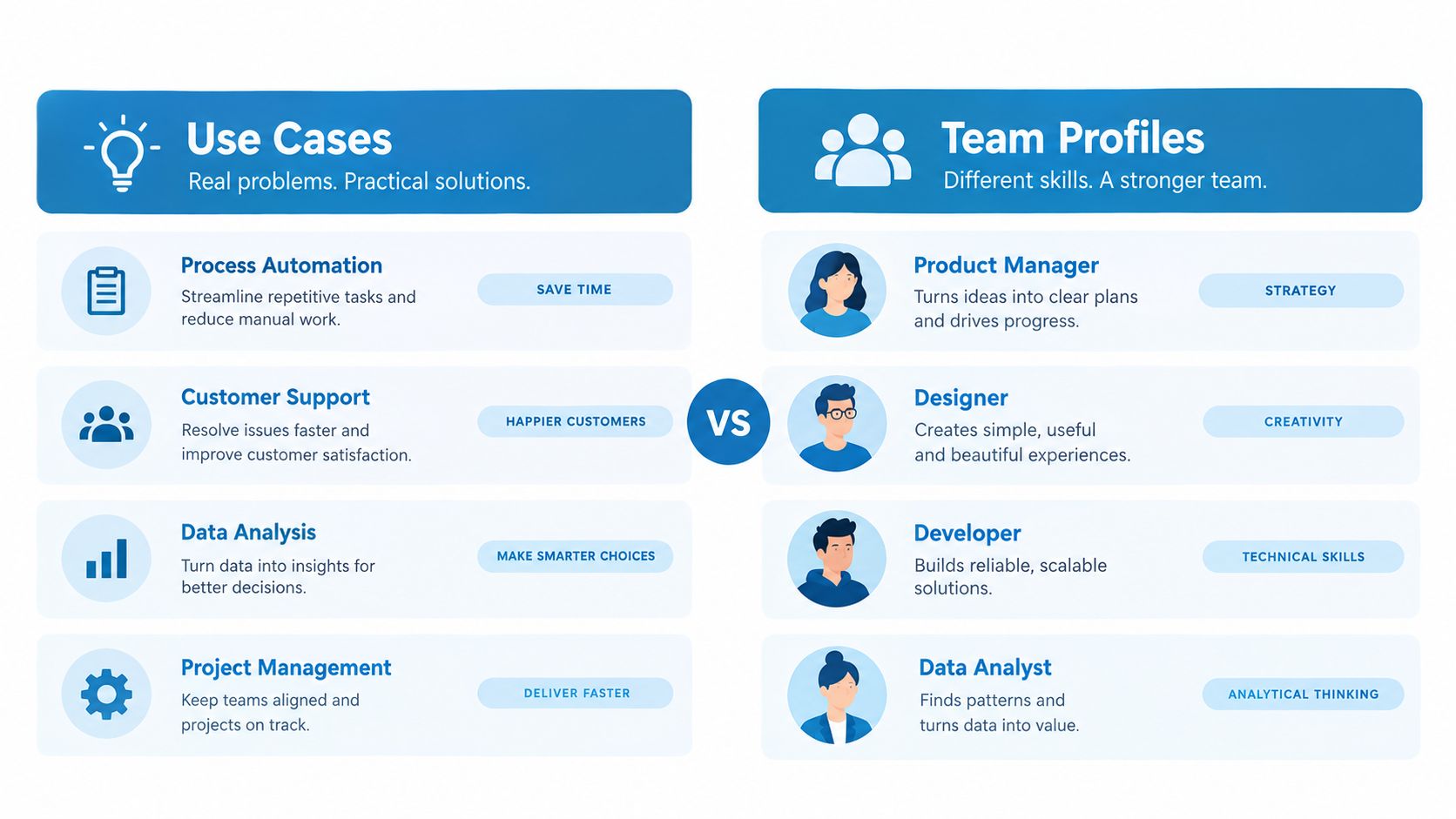
Fintech and accounting platforms need an infrastructure contract rather than a dashboard. They may embed validation inside onboarding, invoice creation, or customer management. Their review should focus on stable schemas, tenant isolation, usage visibility, support escalation, and the vendor's ability to preserve evidence across many downstream customers.
The common over-buying pattern is a small SaaS team adopting a filing platform before it has a reliable customer tax-data model. The common under-buying pattern is a marketplace using a basic lookup and storing only “valid” as a boolean. Both choices create future work because the team hasn't decided who owns tax evidence, revalidation, and exception handling.
A useful profile test is:
- SaaS billing: Choose an API that fits Stripe and your application language.
- Marketplace checkout: Prioritize cache behavior, predictable latency, and safe outage handling.
- Indie product: Start with an accessible validation plan and verify the upgrade path.
- Finance operations: Require batch processing, exports, and supplier-level evidence.
- Embedded platform: Treat schema stability, observability, and commercial support as core requirements.
Common Pitfalls and the Limits of Validation
A green VAT-number response is not the same thing as a compliant invoice.
A valid number doesn't independently prove that the customer is the contracting entity, that the supply qualifies for reverse charge, or that the customer held the relevant status on the invoice date. It also doesn't prove that your product classification, place-of-supply reasoning, invoice wording, or supporting evidence is correct.
The wider compliance data makes the limit clear. The EU's VAT compliance gap was estimated at EUR 89.3 billion in 2022, or 7.0% of total VAT liability, and it includes insolvency, administrative errors, evasion, and fraud (European Parliament document). A lookup can reduce one class of avoidable error. It cannot resolve every cause of non-compliance.
Design for uncertainty instead of hiding it
The most damaging implementation mistake is treating every non-green response as the same. A temporary authority outage, a malformed identifier, a genuine invalid number, and an ambiguous response need different workflows.
A defensible record should include:
- Timestamped result: Store when the check occurred, using a consistent time representation.
- Request identifier: Preserve the provider's request or correlation ID for support and audit investigation.
- Source status: Distinguish live authority data from a cached response.
- Policy context: Record which billing or reverse-charge rule consumed the result.
- Retry decision: Store whether the system retried, queued the check, or sent it for review.
- Invoice relationship: Connect the validation evidence to the customer, transaction, and invoice.
Storing only a PDF is another recurring failure. A rendered invoice is useful for people, but it's a poor source for reconciliation and future reporting. Preserve structured fields such as supplier and customer tax IDs, jurisdiction, tax rate, exemption or reverse-charge reason, invoice date, currency, and line-level taxable amounts.
A validation service should help you make a defensible decision. It shouldn't encourage you to pretend that uncertainty doesn't exist.
Revalidation policy needs to match the business event. A new customer, a legal-entity change, a subscription update, and an invoice correction may each justify a different check. The important point is to define the policy explicitly, then retain enough evidence to explain why the system used a live result, a cached result, or manual approval.
Teams should also test failure paths before launch. Simulate a slow authority, a hard outage, malformed input, a changed registration status, and a duplicate webhook. If the application can't distinguish those states in a test environment, it won't distinguish them reliably in production.
Recommendations by Team Size and What Comes Next
A solo founder usually needs one thing first. A reliable way to decide whether a tax ID can be trusted at checkout, and a record that still makes sense months later during a dispute, refund, or audit. Start with a validation API that offers 100 monthly validations without a credit card, then check the parts that cause trouble in production: response structure, usage visibility, error semantics, and the upgrade path as volume rises. Keep your application's tax decision record separate from the provider response so a vendor change does not force you to rewrite billing history.
For a small SaaS team, the cleanest setup is often a developer-first API alongside Stripe Billing. Stripe can keep handling payment flows and billing objects while your application owns the customer tax decision, the evidence link, and the logic for what to do when an authority is slow or unavailable. Look for market coverage that matches where you sell, cached checks for repeated checkout events, country-specific input validation, and Stripe-style error codes that make failure handling predictable.
Mid-market finance and operations teams should care less about a polished validation screen and more about audit trails, reconciliation, and accounting exports. At that stage, VAT software stops being a convenience feature and starts acting as an evidence layer around government systems. The tool needs to connect supplier and customer identities to invoices, payments, adjustments, and review outcomes in a way your team can reproduce later. A filing platform can make sense when return preparation and submission are part of the job, but it is the wrong choice if the actual gap is poor evidence quality or weak integration with billing and accounting.
Larger platforms with multinational exposure need stricter boundaries between real-time decisions and background processing. Checkout should return quickly. Reporting, submission, and status reconciliation should run asynchronously through queues with retries, exponential backoff, idempotency keys, and durable acceptance or rejection records. The internal tax model should stay canonical, with country-specific adapters at the edge. That structure gives you a better chance of surviving authority outages, API changes, and reporting changes without breaking the buyer experience.
Build for the regulatory direction
The VAT in the Digital Age package was adopted on 11 March 2025 and is currently scheduled to roll out progressively through January 2035, with mandatory electronic invoicing and digital reporting for intra-EU B2B transactions currently planned from 1 July 2030, subject to final implementation timelines (European Commission overview of ViDA).
That does not mean every team should build every future reporting flow now. It does mean your billing stack should preserve structured, append-only tax decisions today. Store the source, timestamp, customer identity, jurisdiction, tax treatment, rule version, response status, and related invoice data. Keep country-specific behavior behind an API boundary so future reporting adapters do not force a checkout rewrite.
Use this VAT compliance checklist as a procurement filter. Before signing, ask:
- Can the tool distinguish invalid data from an unavailable authority?
- Does it preserve timestamped, invoice-level evidence?
- Can it return structured fields rather than only a rendered document?
- Does it support idempotent retries and asynchronous workflows?
- Can your team reproduce a historical tax decision?
- Does it integrate with the billing and accounting systems you already operate?
- Is the product category appropriate for your actual responsibility, validation, invoicing, or filing?
The right VAT compliance software fits your control boundary and stays explainable when an upstream service fails. TaxID provides a developer-first REST API for VAT and company identification validation across 31 countries, with normalized JSON, format checks, caching, and machine-readable errors for billing and checkout workflows. Visit TaxID if you want to evaluate the validation layer before committing to build and maintain a VIES integration yourself.