France's VAT rates are 20% standard, 10% reduced, 5.5% reduced, and 2.1% super-reduced. The correct rate depends on the product or service, its classification, and the transaction's place of supply, so a French customer doesn't automatically mean you should charge 20%.
You're probably dealing with this at an awkward point in the billing flow. A French customer has entered a VAT number at checkout, your subscription engine has selected a tax treatment, and finance wants to know whether the invoice should show French VAT, reverse charge, or no VAT at all. A static rate table can answer the first question, but it usually won't answer the operational one: what should the code do before the invoice is issued?
Table of Contents
- Why French VAT Rates Matter for Your Billing Stack
- The 20% Standard Rate and What It Covers
- Reduced Rates at 10% and 5.5% for Everyday Goods and Services
- The 2.1% Super-Reduced Rate and When It Actually Applies
- Reading a French VAT Invoice Line by Line
- Place of Supply and Tax Point Rules for Cross-Border Sellers
- Reverse Charge and VIES Validation for B2B Transactions
- Recent Changes and What to Watch in 2026
- Quick Reference Table of Current French VAT Rates
- Authoritative Sources and Where to Verify Before You Charge
Why French VAT Rates Matter for Your Billing Stack
A French customer can enter a valid VAT number at checkout while your billing system still selects the wrong treatment. The workflow must make two separate decisions: classify the supply under the correct French rate, then determine whether French VAT applies to the transaction at all.
For domestic taxable supplies, the structure is:
- 20% for most taxable goods and services.
- 10% for selected food, transport, renovation, and cultural categories.
- 5.5% for specific essential goods, books, energy-related supplies, and other qualifying categories.
- 2.1% for a narrow group of products and services.
The French tax administration's business VAT guidance confirms this four-rate structure and explains that reduced-rate eligibility depends on the precise classification of the supply. France's standard rate has been 20% since 1 January 2014, when it replaced the previous 19.6% rate, according to the OECD's France consumption tax profile.
A product name is not a sufficient tax rule. “Software,” “food,” or “home services” can cover supplies with different treatments. Store a tax category in the catalogue, retain the classification used at invoice time, and version changes so historical invoices remain explainable.
Practical rule: Treat the rate as the output of a documented decision, not as a value copied from a product name.
The same controls matter in cross-border billing. Before issuing 0% under a B2B reverse-charge treatment, check the customer's country, VAT status, place of supply, and VAT number through the appropriate validation process, including VIES where applicable. A failed or missing validation should route the invoice to an exception path rather than produce a zero-tax invoice automatically.
Teams designing invoice capture and exception workflows can also consult guidance on invoice automation for Australian SMBs.
For a SaaS product, retain the customer country, validated VAT number, product tax category, place of supply, selected rate, and reverse-charge reason. Those fields turn corrections into controlled billing changes instead of manual investigations.
The 20% Standard Rate and What It Covers
A French invoice usually starts with 20% unless a narrower rule changes the outcome. That rate covers the default case for taxable domestic supplies, so it is the baseline many billing systems should reach only after the tax category check is complete.
For SaaS products, that usually means subscriptions, consultancy, software licences, and many electronically supplied services. The practical trap is assuming that a useful or socially important product gets a reduced rate by association. French VAT follows the legal category, not the product's business value.
A 20% mapping is usually the safest choice for:
- SaaS subscriptions that do not fit a special treatment.
- Professional and consultancy services.
- Software licences and ordinary electronic services.
- Telecommunications and many digital services.
- Household appliances, new vehicles, tobacco, and alcoholic drinks.
- Food and beverages where the reduced-rate conditions are not met.
- Accommodation or leisure services outside a qualifying reduced category.
The implementation detail that matters is versioning. If a product later becomes eligible for a reduced rate, store the effective date, keep the earlier tax rule on historical invoices, and identify subscriptions that need to switch on renewal or at the next billing event.
The French tax administration's VAT guidance for international professionals is the right reference for the transaction mechanics as well as the rate. It explains that goods are generally taxed at the rate in force where delivery takes place in France, while certain cross-border electronic services to non-taxable customers use the date of effective payment as the tax point.
Checkout logic should not assign 20% just because the billing address is French. The system should first classify the supply, then determine whether the customer is a consumer or a taxable business, whether the supply is domestic or cross-border, and whether a reduced category or reverse-charge rule applies.
A safer sequence is:
- Identify the supply and its tax category.
- Determine customer status and place of supply.
- Check whether a valid VAT number changes the treatment.
- Select the rate or reverse-charge outcome.
- Store the evidence used for the decision.
That sequence is easier to audit than a country-to-rate lookup. France's 20% rate is the default benchmark, but it is not the answer for every French-facing invoice.
Reduced Rates at 10% and 5.5% for Everyday Goods and Services
The reduced bands are where broad catalogue labels start to break down. France applies 10% and 5.5% to specific categories, and the right rate can depend on how the item is supplied, consumed, or used.
The 10% rate commonly covers restaurant and catering services, certain passenger transport, renovation and cleaning work for qualifying private dwellings, timber, some housing-related works, and selected cultural admissions. The 5.5% rate applies to a different set of essential or public-interest supplies, including qualifying food, books, certain household energy supplies, some equipment, and eligible energy-efficiency work.
Compare the category, not just the product name
| Rate | Product or service | Notable edge cases |
|---|---|---|
| 10% | Restaurant and catering services | Drinks, takeaway formats, and alcoholic beverages can be treated differently. |
| 10% | Certain passenger transport | The service must fit the applicable transport category. |
| 10% | Qualifying renovation and cleaning work | The property and nature of the work matter. |
| 10% | Selected cultural admissions | The event or admission type must qualify. |
| 5.5% | Basic qualifying groceries | Preparation, presentation, and intended use can change the classification. |
| 5.5% | Physical and digital books | Stationery, advertising material, and some catalogue-like products do not automatically qualify. |
| 5.5% | Certain household energy supplies | The specific energy product and current conditions need checking. |
| 5.5% | Eligible energy-efficiency renovation | The work and technical characteristics must meet the applicable rules. |
A checkout system should separate the commercial SKU from the tax category. “Book” can map to 5.5%, while a notebook, art catalogue, or advertising publication may not. “Food” can map to different rates depending on whether it is sold for immediate consumption, supplied as a takeaway item, or sold as a qualifying grocery product.
Build an exception path
A reliable product model should include:
- A tax category chosen by finance or tax operations.
- A source reference for the classification.
- An effective date for the mapping.
- A review status for ambiguous products.
- A fallback route that blocks invoicing when the category is unknown.
Do not bury these decisions inside Stripe price metadata or a Chargebee plan name without ownership and documentation. Payment platforms can carry the selected rate, but they should not be the only place where the reasoning exists.
The EU VAT rates framework permits reduced rates within defined limits, while France's structure includes the 5.5% and 10% bands plus the 2.1% super-reduced rate. That context helps, but the transaction still needs to be matched against French guidance before the rate is bound in code.
Engineering rule: If two products look similar to a customer but have different legal classifications, give them different tax categories even if they share the same checkout flow.
The 2.1% Super-Reduced Rate and When It Actually Applies
A 2.1% rate is not a general discount for software, charities, or low-margin businesses. In France, it applies only to narrow categories such as certain medicines, qualifying press publications, and a few limited cultural or public-service cases.
The European Commission explanation of EU VAT rates places France's 2.1% treatment in the super-reduced bracket, below the ordinary reduced-rate floor. For billing teams, that means the rate should be controlled by tax rules, not exposed as a manual choice in checkout.
Why SaaS systems should reject it by default
A 2.1% line on an ordinary SaaS subscription is a warning sign. A customer may describe software as educational, public-interest, or mission-driven, but that description does not move the supply into a super-reduced category.
Use an allowlist for products that can ever receive 2.1%. Each entry should require:
- A specific approved tax category.
- A documented legal basis.
- Review by the person responsible for tax configuration.
- An effective date and audit trail.
- A test confirming that ordinary digital services are excluded.
Do not derive the rate from customer-entered descriptions, discount codes, or sector labels. If a product does not match an approved category, route it to the standard or reduced-rate review path instead of forcing 2.1%.
For teams that have already issued incorrect invoices, the correction path should identify affected transactions, calculate the difference, issue compliant corrective documentation, and preserve the original decision. The goal is not just a new number on the next invoice. It is a tax trail that another reviewer can explain without guessing.
Reading a French VAT Invoice Line by Line
A French invoice should allow a reviewer to move from the supply to the tax calculation without guessing. Each line needs to identify what was supplied, the applicable rate, the taxable base, and the VAT amount before the document presents the totals.
Consider two invoices with the same broad commercial context. One contains a SaaS subscription classified at 20%. The other contains qualifying renovation work classified at 10%. The point of the comparison is not the price. It's the structure of the evidence.
| Line | 20% SaaS example | 10% renovation example |
|---|---|---|
| Supply description | Subscription period and service description | Detailed work performed and property context |
| Supplier details | Legal name and French business identifiers | Legal name and French business identifiers |
| Customer details | Customer name, address, and business status | Customer name, address, and business status |
| VAT number | Customer intra-community number where relevant | Customer intra-community number where relevant |
| Unit price | Price excluding VAT | Price excluding VAT |
| Rate | 20% | 10% |
| Tax base | Total taxable amount for the SaaS line | Total taxable amount for the renovation line |
| VAT amount | VAT calculated on the SaaS base | VAT calculated on the renovation base |
| Total | Total including VAT | Total including VAT |
The invoice date and supply date also need to be distinguishable where the applicable rules require it. For B2B transactions, include the relevant customer VAT number and preserve the validation record when the treatment depends on that number.
Mixed-rate invoices need separate bases
A single aggregated VAT line is risky when an invoice contains supplies subject to different rates. List each product or service, assign its rate, calculate its separate base and VAT amount, then show the totals by rate.
This is also where EU VAT invoice requirements for SaaS can help teams turn legal requirements into invoice-field requirements. For broader finance workflows, guidance on how to automate your invoice management is useful when routing invoices through approval, matching, and exception queues.
Audit perspective: The rate shown beside each line is not decoration. It is the visible result of the classification decision your billing system made.
When a line is wrong, don't overwrite the original invoice record. Create a correction workflow that retains the original document, records the reason for the change, recalculates the affected tax, and links the replacement document to the original transaction.
Place of Supply and Tax Point Rules for Cross-Border Sellers
The domestic rate table answers only part of the question. A French customer may receive an invoice with 20% French VAT, a reduced rate, or no French VAT charged by the supplier, depending on customer status and place of supply.
For a cross-border B2B service, the customer's location generally determines where the service is taxed under the EU place-of-supply framework. A French SaaS business supplying a taxable business established in another EU member state may therefore issue an invoice without French VAT, provided the conditions for the cross-border B2B treatment are met and the customer's VAT status is validated.
Separate three decisions in the data model
Your billing engine should distinguish:
- Customer status: taxable business or non-taxable customer.
- Place of supply: where the transaction is treated as occurring.
- Tax point: when the VAT obligation is triggered.
These fields prevent a common mistake, where a developer treats the customer's billing country as the only relevant input. For some electronic services supplied to non-taxable customers, official French guidance uses the date of effective payment as the relevant point. Goods and other services may use different rules.
For B2C electronic services, the One-Stop Shop can simplify reporting where its conditions apply. It doesn't turn every French-facing sale into a domestic French transaction, and it doesn't replace the need to understand the underlying place-of-supply rule.
A SaaS example
A French company sells a yearly subscription to a Belgian business. The customer provides a Belgian intra-community VAT number, the supplier validates it, and the service is treated as a cross-border B2B supply. The invoice should show the applicable reverse-charge treatment rather than French domestic VAT, and the supplier should retain the evidence supporting the decision.
The important point is that 0% in this workflow isn't a reduced French VAT rate. It is the result of a place-of-supply and customer-status analysis. The invoice and reporting records should make that distinction clear.
For a practical explanation of the broader mechanics, see this guide to cross-border VAT rules. Before deployment, have the tax treatment reviewed for the countries, customer types, and service categories your product supports.
Reverse Charge and VIES Validation for B2B Transactions
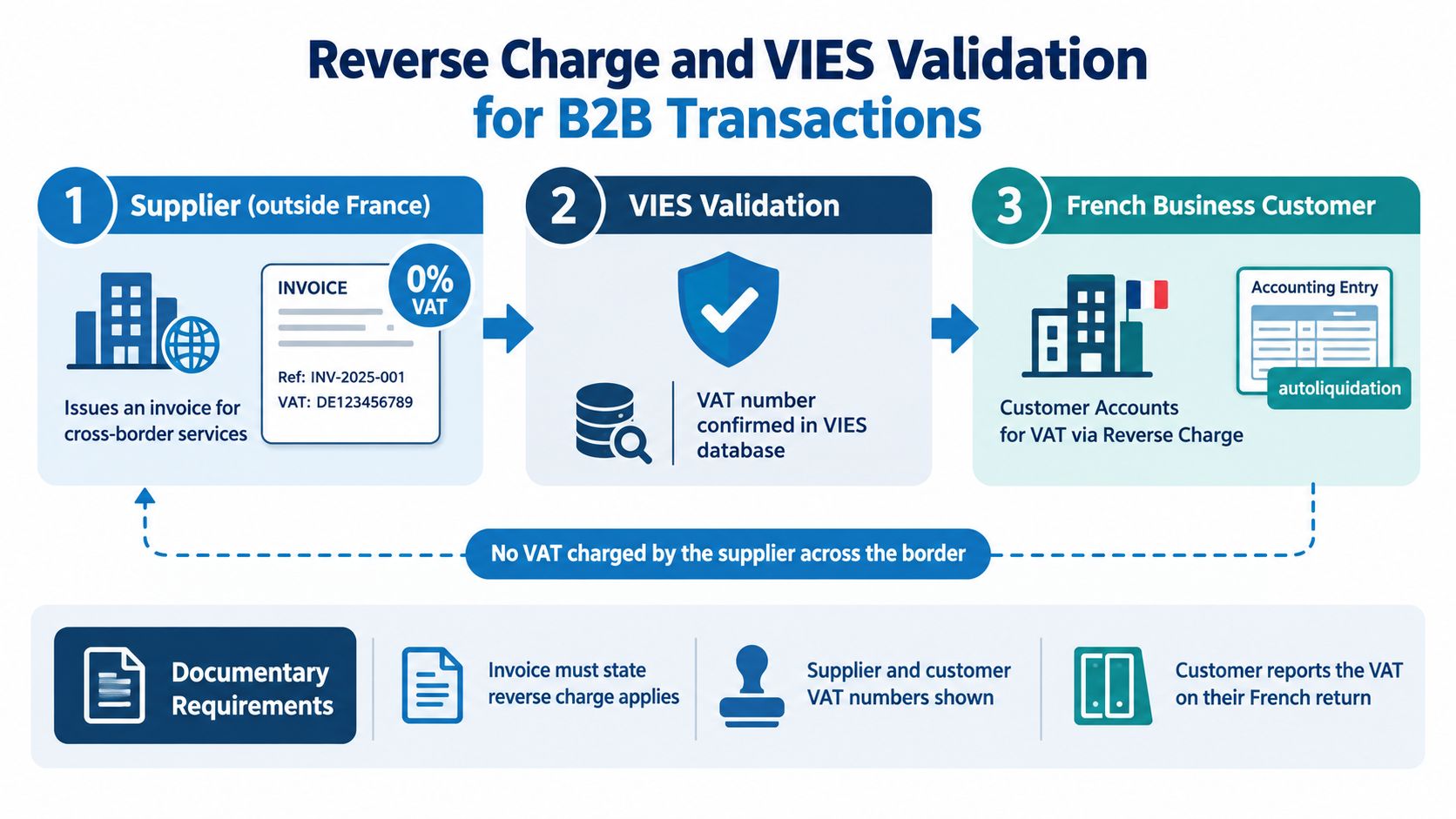
Reverse charge shifts the VAT accounting obligation from the supplier to the customer. In a common cross-border B2B service flow, the supplier charges no French VAT, states that reverse charge applies, and the French business customer accounts for the tax in France.
The critical control is not the presence of a VAT number in a text field. It's whether the number is valid for the transaction and whether your system can show what it checked.
What to verify before issuing the invoice
Capture the following before applying the reverse-charge outcome:
- Customer identity: Match the legal name and address returned by the validation service against the customer record.
- VAT status: Confirm that the number is valid for intra-community trade where that status is required.
- Timing: Associate the validation result with the supply or invoice date.
- Invoice wording: Include the required reverse-charge indication, such as “autoliquidation” where applicable.
- Evidence: Store the response, request context, and invoice reference with the transaction.
A failed lookup shouldn't become a zero-rated invoice. Route temporary service failures to a retry or manual-review state, and route a confirmed invalid number to the domestic-tax decision path.
For implementation patterns around the invoice decision itself, see this guide to reverse charge VAT. A VAT-validation API such as TaxID can perform format checks, call VIES, return structured validation results, and provide a machine-readable record for billing systems. Your own retention policy should follow the applicable compliance requirements rather than relying on an arbitrary cache duration.
Checkout checklist
Before the invoice is finalized, verify:
- The customer selected a business purchase flow.
- The VAT number includes the correct country prefix.
- The returned legal identity matches the account.
- The validation result is linked to the transaction.
- The place-of-supply rule supports reverse charge.
- The invoice contains the required wording and both parties' details.
- A failed or unavailable validation cannot produce a tax-free invoice.
This checklist belongs in the checkout path and in the invoice-generation path. A customer can change its billing details after checkout, so validating only once at account creation leaves a gap.
Recent Changes and What to Watch in 2026
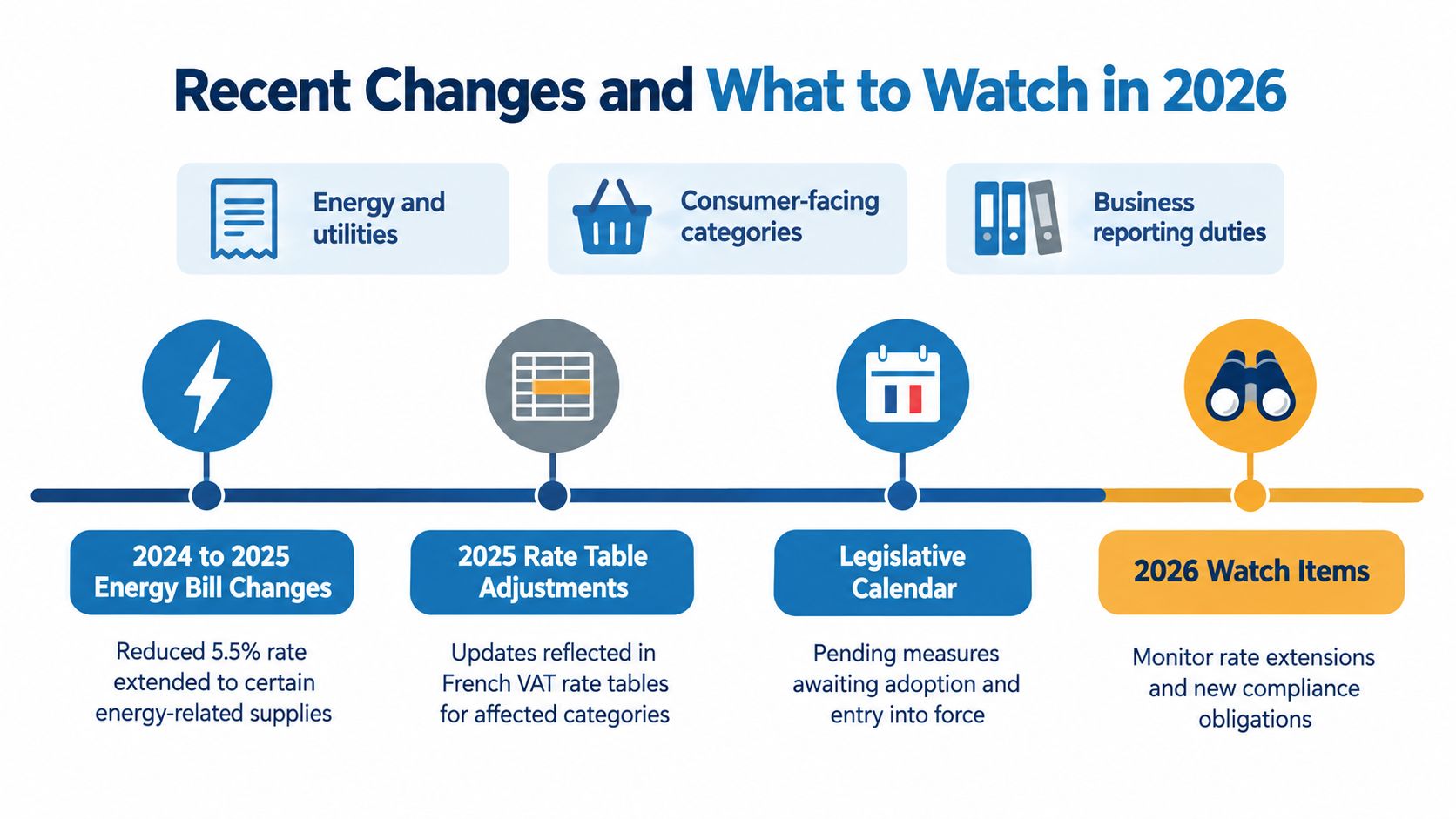
France's rate structure remains centered on 20%, 10%, 5.5%, and 2.1%, but individual sector treatments can change without changing the headline rates. That matters to engineers because a static country table can remain apparently correct while a product-level mapping becomes outdated.
French guidance finalized in 2026 confirms a 5.5% treatment for cooling energy distributed by network, effective from 21 February 2026, following a public consultation in 2025, as reported in the supplied French VAT rates analysis from Avalara. This is the kind of change that can affect a specific category while leaving the top-level rate table unchanged.
Maintain a watch list
Review the following on a recurring basis:
- Energy categories: Check whether network-distributed energy, heating, cooling, or related equipment has received a new treatment.
- Product definitions: Look for changes that depend on form, use, or technical characteristics rather than the commercial name.
- Invoice obligations: Track French e-invoicing and reporting guidance separately from VAT rate changes.
- EU policy: Monitor how EU rate-policy changes are implemented in French doctrine.
- Configuration impact: Identify active products that depend on a changed category and version the mapping.
Teams building European SaaS billing workflows may find a current overview of SaaS compliance for EU VAT 2026 useful alongside primary French and EU materials. Use secondary guidance to identify issues, then confirm the actual rule before changing production tax logic.
Quick Reference Table of Current French VAT Rates
Use this matrix as a billing reference, not as the final tax decision. Attach the verification source to the tax category in configuration, so a reviewer can see why the rate was chosen and when it was last confirmed.
| Rate | Category | CGI article | Example product | Verification source |
|---|---|---|---|---|
| 20% | Standard taxable goods and services not assigned to a reduced category | Current French standard-rate provision | Ordinary SaaS subscription or consultancy | French tax administration business VAT guidance |
| 10% | Selected intermediate-rate goods and services | Current French reduced-rate provisions | Qualifying restaurant service or renovation work | French tax administration VAT guidance for international professionals |
| 5.5% | Essential goods and selected public-interest supplies | Current French reduced-rate provisions | Qualifying food, book, or energy supply | European Commission VAT rates overview |
| 2.1% | Narrow super-reduced categories | Current French super-reduced-rate provisions | Qualifying medicine or press publication | European Commission VAT rates overview |
The practical problem is classification, not the headline rate. A product can start at 20% and still be wrong if it is bundled, delivered digitally, or reclassified by use. For that reason, each mapped item should have a category owner, a legal review note, and an effective date.
Keep the table close to your invoice rules and close to your product catalog. If the rate changes, update the category first, then the billing logic, then the evidence trail.
Authoritative Sources and Where to Verify Before You Charge
Start with the French tax administration for current rates, official doctrine, invoice requirements, and forms. Use the European Commission VAT rules and rates page for the EU framework and France's rate structure, as noted earlier.
For cross-border B2B billing, validate the customer's VAT number through the official VIES service. Keep the result tied to the transaction, and do not treat an unavailable response as proof that the number is valid.
Before releasing a billing change, use this sequence:
- Pull the current French rate and category guidance into reviewed configuration.
- Validate a real French VAT number through VIES in a controlled test.
- Test domestic 20%, reduced-rate, invalid-number, and reverse-charge paths.
- Add a CI check that fails when a product has no known VAT category.
- Review rate-sensitive products whenever French or EU guidance changes.
The strongest workflow combines official tax content with automated validation and an auditable invoice decision. It keeps the rate table, customer evidence, and invoice output linked instead of leaving each team to reconcile them manually.