You've just pushed a Norway checkout live, and the first invoice lands in your queue with a simple question attached to it: do you charge 25% VAT, a reduced rate, or nothing at all? If your billing engine only knows one number, Norway will expose that shortcut fast. The main work is deciding whether VAT applies, and then mapping the transaction to the right rate and registration path.
Table of Contents
- Why the Norway VAT Rate Is More Than Just 25 Percent
- Decoding the Standard, Reduced, and Zero Rates
- Determining Where the Tax Actually Applies
- Understanding the VOEC Regime for Digital Services
- Navigating Registration Thresholds and Obligations
- Common Mistakes to Avoid in Norwegian Tax Logic
Why the Norway VAT Rate Is More Than Just 25 Percent

A lot of teams search for vat rate norway, see 25%, and stop there. That shortcut works until a customer buys food, books transport, or routes through a B2B flow that should be handled differently from a consumer order.
Norway's VAT system is built around general, reduced, and zero-rated treatment, not one flat percentage. The Norwegian Tax Administration states that 25% applies to most taxable goods and services, while 15% and 12% cover defined categories that matter in real invoicing flows (Norwegian Tax Administration VAT rates). The tax engine has to classify the transaction before it calculates anything.
The core implementation rule is simple: start with the SKU or service type, then determine whether the supply is taxable, reduced-rate, zero-rated, or exempt. That ordering keeps checkout logic aligned with billing rules, even when the catalog expands or finance adds a new line item.
For teams working in Shopify or similar carts, the hardest mistakes usually come from assuming customer country alone is enough. A practical tax compliance guide for Shopify stores helps here, especially when storefront logic has to separate product classes and customer types without manual overrides.
Practical rule: if your tax table starts with “Norway = 25%,” you've already lost the cases that matter most.
TaxID's Norway VAT rates page is one rate reference, but the engineering problem is the decision tree behind the rate. Once that tree is correct, the invoice stops being guesswork and becomes a deterministic output from customer type, product class, and place of supply.
Decoding the Standard, Reduced, and Zero Rates
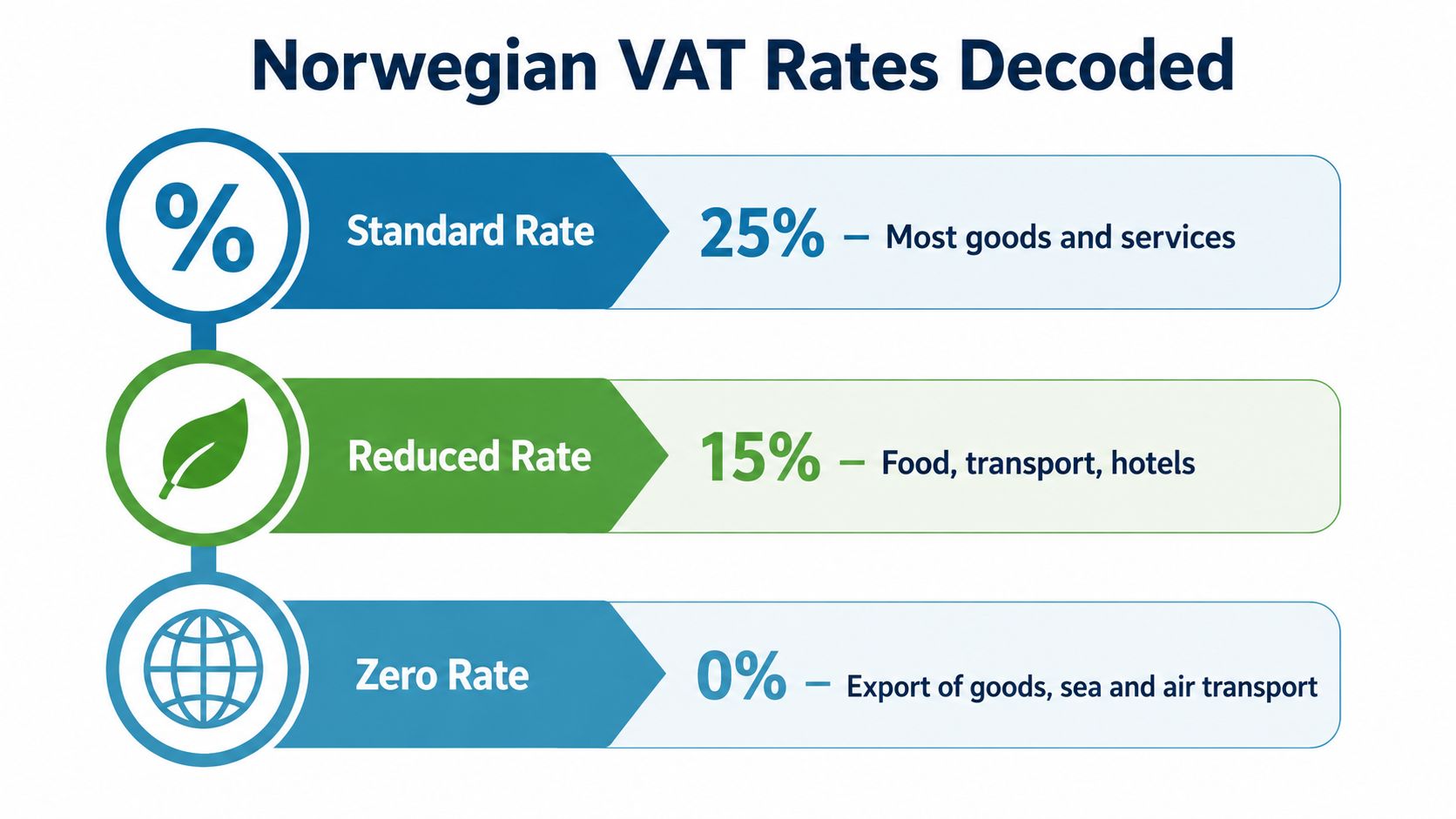
Norway's standard rate is 25%, but that number only covers the broad middle of taxable commerce. Official guidance also identifies 15% for foodstuffs and water services, and 12% for categories such as passenger transport, accommodation, cinema admissions, sporting events, amusement parks, and activity centres. See the full breakdown on TaxID's Norway VAT rates page. If your catalog mixes digital products, hospitality, and physical goods, the rate decision cannot wait until checkout.
Zero-rated is not the same as exempt
The zero-rate is where many billing schemas break. Norwegian guidance lists books, newspapers, and certain electronic publications among zero-rated examples, and the distinction matters because a zero-rated supply stays inside the VAT system while an exempt one is handled differently for input-tax purposes. If your database only stores “taxed” and “not taxed,” you lose the accounting meaning.
That difference shows up in operations. A zero-rated sale can still affect registration logic and VAT reporting, while an exemption can block input deductions in ways finance will notice later. Flatten those two states into one boolean and reconciliation gets harder fast.
Build the categorization first
A better structure is a small rate matrix keyed by product family, not by country alone. For example:
- Standard rate, most taxable goods and services, including many ordinary retail and SaaS purchases.
- Reduced rate, categories with statutory relief, such as food, transport, accommodation, and entertainment.
- Zero rate, supplies that remain in the VAT system but carry a 0% charge.
- Exempt, supplies outside the normal VAT collection pattern.
A tax engine that distinguishes rate, zero-rate, and exemption is easier to audit than one that treats all three as “no VAT.”
The practical rule is straightforward. Norway does not ask you to memorize a single percentage. It asks you to classify the transaction correctly, then apply the rate that matches that classification. For developers, that means the invoice logic has to resolve product type first, then tax outcome, instead of guessing from country and hoping the rate table fills the gap.
Determining Where the Tax Actually Applies
A Norwegian customer can buy the same software from a server in Frankfurt or a company registered in Dublin, and the server location still won't be the deciding factor. Norway uses a destination-based consumption model, so the key question is generally where the customer consumes the service, not where the supplier's legal entity or infrastructure sits (OECD Norway consumption tax trends).
B2B and B2C do different work
That place-of-supply rule changes the implementation path. For B2C, the seller often has to collect Norwegian VAT when the customer is in Norway and the supply is taxable. For B2B, the invoice logic can shift toward customer accounting or other place-of-supply treatment, which means you need to validate the buyer before you decide what to charge (Norwegian government summary on cross-border services).
A verified Norwegian organization number helps, but it isn't enough by itself. It supports your B2B decision, it doesn't prove every tax fact on its own. Keep the evidence alongside the invoice decision, because audit questions usually start with “why was VAT charged or not charged here?”
The cleanest workflow is straightforward:
- Identify the customer type, business or consumer.
- Check the supply type, goods, electronically supplied services, or something else.
- Store the evidence, country, VAT registration signal, and checkout inputs.
- Apply the tax rule, including reverse charge or local VAT where required.
For commerce platforms, the billing layer and the tax layer need to talk to each other here. If you're mapping storefront behavior in a platform context, the tax compliance guide for Shopify stores is useful because it shows how tax settings become checkout behavior.
Practical rule: country alone is never enough. You need country, customer type, and transaction class before you calculate Norwegian VAT.
The main engineering mistake is treating all Norwegian sales as domestic consumer sales. That works until the first B2B account, the first cross-border SaaS renewal, or the first invoice that should have used customer accounting instead of seller-collected VAT.
Understanding the VOEC Regime for Digital Services
A Norwegian consumer buys downloadable software. A foreign vendor needs to decide whether that sale belongs in VOEC, standard Norwegian VAT registration, or customer accounting. That decision depends on the transaction path, not just the country on the invoice. VOEC is the simplified route for qualifying electronic services sold to private consumers, while B2B flows often follow different VAT logic, as outlined in the Norwegian government summary on cross-border services.
VOEC solves one problem, not all of them
VOEC exists to simplify VAT collection for a narrow class of sales. It does not replace ordinary Norwegian VAT registration, and it does not cover every digital or cross-border transaction. Physical goods sit outside that simplification, and business customers can trigger a different treatment even when the product looks similar on the checkout page.
That is where systems often fail. A consumer subscription, an internal software purchase by a company, and a parcel of goods may share the same storefront, but they do not belong in the same tax rule. If a billing engine routes all three through one Norwegian VAT path, the return may look clean until the first audit trail exposes the wrong treatment.
How to keep VOEC separate from ordinary VAT logic
VOEC works best as its own branch in the decision tree, not as a loose flag inside a generic Norway VAT setting. The checkout and invoicing logic should check the customer profile, the supply type, and the registration route before tax is applied. For this use case, the route can be VOEC, standard VAT registration, or customer accounting, depending on the facts you already have.
The evidence matters as much as the outcome. Keep the customer and transaction records that support the classification, because the question after the sale is usually whether the system had enough information to choose the right path. If the record only says “Norway,” that is not enough to defend the tax position.
A useful way to design it is to separate classification from calculation. Classification decides whether the sale belongs in VOEC, ordinary VAT, or reverse-charge handling. Calculation then applies the correct rate or reporting treatment. That keeps the VOEC workflow stable if the business later adds standard Norwegian VAT obligations, because you will not have to unwind digital-service logic from the rest of the billing stack.
Navigating Registration Thresholds and Obligations
A small Norwegian sales test can turn into a registration event faster than teams expect. A business generally must register in Norway's VAT Register when VAT-liable turnover exceeds NOK 50,000 during a rolling 12-month period (Norwegian Ministry of Finance notification). The threshold has to be tracked cumulatively, not invoice by invoice, because several low-value sales can still push a seller over the line.
A practical control is to store each taxable sale with its posting date, then calculate a rolling sum over the last 12 months. In SQL terms, that can be a windowed total or a scheduled job that checks whether cumulative turnover has crossed the threshold and immediately opens a registration workflow. Once that happens, invoice templates, tax treatment, and reconciliation rules need to change together.
A threshold isn't a warning light, it's an operational trigger
A foreign seller can start with a few Norwegian customers, then add consumer traffic and a growing B2B segment. If the system only checks one invoice at a time, it misses the moment when registration becomes mandatory. Once the threshold is crossed, the same Ministry of Finance notification expects the workflow to shift, including registration review, invoice template updates, and cleanup of transactions already billed.
For low-value goods sold by foreign vendors and marketplaces, the NOK 50,000 threshold also matters inside the simplified VOEC context, but only for qualifying sales below the item-value limit described in Norwegian guidance. That is a separate lane from ordinary VAT registration.
Build the monitoring logic like a ledger, not a counter
The system that works in production usually tracks these fields together:
- Jurisdiction, because Norway is not just another country code.
- Rolling turnover, because the threshold is cumulative.
- Supply type, because taxable, zero-rated, and exempt supplies do not behave the same way.
- Registration state, because rate application changes after the trigger.
- Effective date, so historical invoices do not get rewritten by accident.
TaxID's VAT registration threshold glossary is a practical reference point if you are designing that monitoring layer into a product or internal admin tool.
The threshold logic should fire a workflow, not just flip a percentage from off to on.
For developers, the problem is not detecting that tax applies. It is detecting the moment the compliance model changes. After that point, every invoice, report, and refund path needs to know about it.
Common Mistakes to Avoid in Norwegian Tax Logic
The most expensive Norway VAT bugs are usually boring. They come from simplifying the wrong part of the problem, then discovering the edge case only after finance or support gets involved. The headline rate is not the trap. The trap is collapsing rate, place of supply, and registration logic into one field.
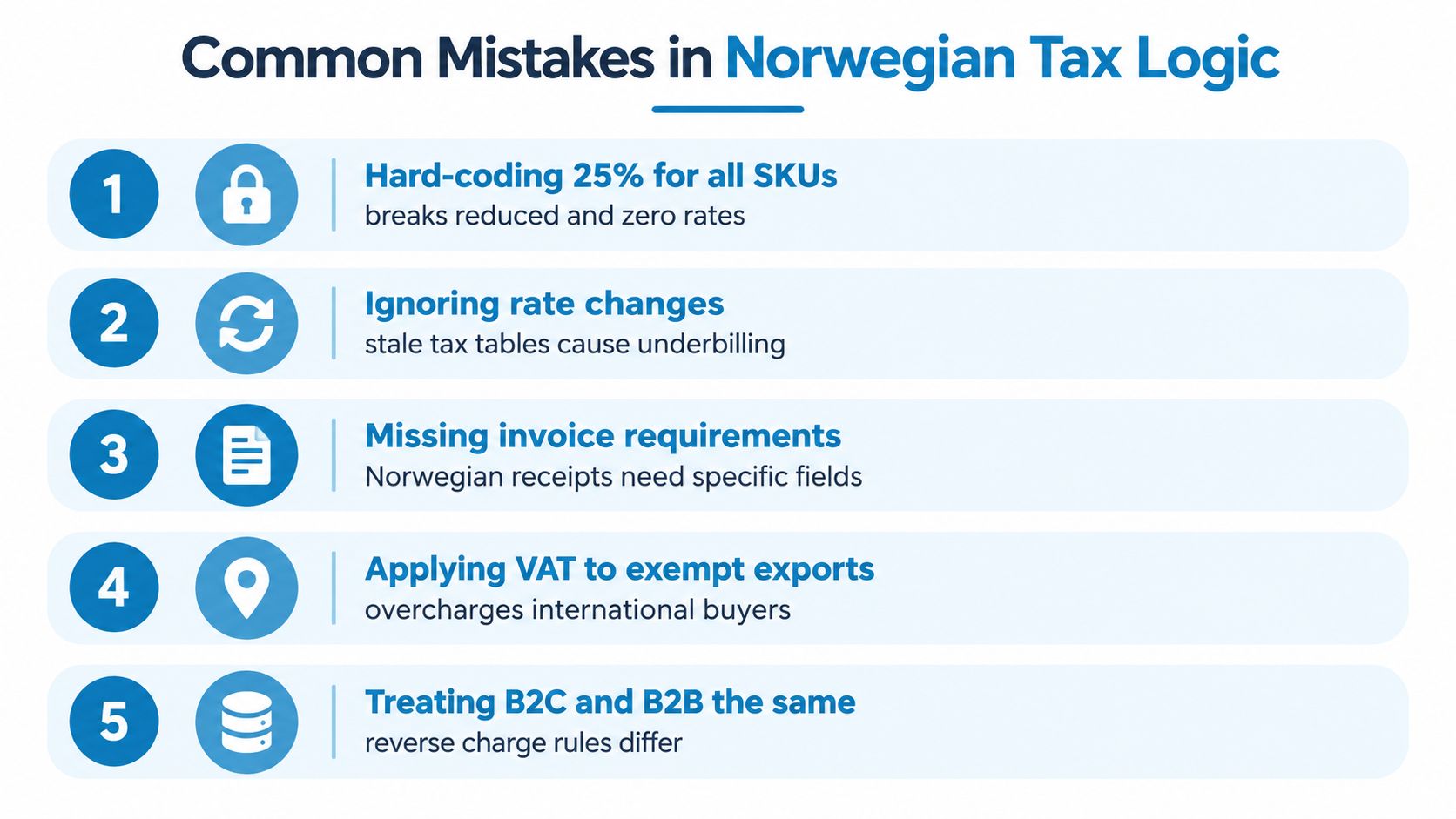
The five failures that keep showing up
- Hard-coding 25% for every SKU, because Norway also has reduced and zero-rated treatment for defined categories.
- Treating zero-rate and exemption as the same thing, which breaks downstream VAT logic and input-tax handling.
- Skipping B2B validation, then charging VAT on invoices that should have used a different treatment.
- Ignoring registration thresholds, then discovering too late that the business crossed into VAT-liable status.
- Letting stale tax tables linger, which is dangerous because the Ministry of Finance says Parliament adopts VAT rates annually, so rate tables can change through budget legislation (Norwegian Ministry of Finance historical account).
The bigger pattern is that Norway's VAT rules are not just about percentage selection. The government's 2026 consultation on internationally traded services shows that liability rules can evolve even when the headline rate stays stable, especially for remotely deliverable services used in Norway (VAT on internationally traded services consultation summary). That means versioned tax logic matters as much as the rate table.
A useful mental checklist is short:
- Classify the supply first.
- Decide whether Norway VAT applies at all.
- Separate B2B from B2C.
- Track thresholds cumulatively.
- Store the evidence that justified the invoice result.
If the invoice can't explain itself later, the tax logic isn't finished.
TaxID can help here by validating VAT and company identification numbers across Norway and other jurisdictions, which is useful when your invoice flow needs a reliable B2B signal before tax is applied. For teams building checkout, billing, or supplier validation into a product, that kind of check belongs upstream of the invoice, not after it.
If you're building Norway into a billing flow, TaxID gives you a way to validate tax IDs before you decide whether VAT should be charged, reversed, or skipped. Visit TaxID if you want a cleaner validation step in your checkout, invoicing, or supplier-review pipeline.