Italy applies a 22% standard VAT rate, with reduced rates of 10%, 5%, and 4% for specifically listed goods and services. The right rate for a transaction depends on its product classification, customer status, location, and any applicable reverse-charge or special invoicing rule.
That makes VAT rates Italy a billing-engineering problem, not just a lookup exercise. A static table can tell you that 22% is the default. It won't tell you how to classify a mixed basket, when a cross-border B2B SaaS invoice should show no Italian VAT, or why a valid rate can still produce a non-compliant invoice if the payload never reaches Italy's electronic invoicing system.
Table of Contents
- Introduction to Italy's VAT System
- The Four VAT Rate Categories in Italy
- How Italy Reached Its 22% Standard Rate
- Reduced Rates and Sector-Specific Exceptions
- Special Regimes Beyond the Rate Table
- Applying Italian VAT Rates in SaaS and B2B Billing
- Classifying Mixed Baskets and Bundled Subscriptions
- Official Sources and VAT ID Validation Workflow
- Quick Reference Summary and Checklist
Introduction to Italy's VAT System
Italy has four principal domestic VAT bands: 22%, 10%, 5%, and 4%. The European Commission's national VAT rules for Italy confirms that the reduced rates apply only to specifically listed goods and services. In practice, a product catalog needs more than a generic “Italy” setting. It needs a classification that can distinguish the standard rate from each reduced band.
For SaaS companies, the first decision is usually not “Which Italian rate applies?” It's “Who accounts for the tax?” A domestic taxable sale will generally require Italian VAT treatment. A qualifying cross-border B2B supply may instead use reverse charge, provided the buyer's status and VAT identification have been checked. A B2C digital sale needs a different location and customer-status analysis.
Practical rule: Treat the VAT rate as the result of a decision tree, not as a property hardcoded onto the country.
This guide focuses on the parts that affect code and operations:
- Rate classification: Select 22%, 10%, 5%, or 4% only after matching the supply to an eligible category.
- Customer treatment: Separate B2B, B2C, VAT-registered, and non-registered buyers.
- Cross-border logic: Validate the buyer before applying a reverse-charge treatment.
- Invoice delivery: Generate the required structured data and route it through the correct channel.
- Exception handling: Account for split payment and other workflows that change who remits VAT.
The European Commission's Italy VAT summary is the right starting point for current rate categories. For historical context, the OECD consumption tax data for Italy shows how the standard rate developed over time.
The Four VAT Rate Categories in Italy
The core structure is simple to describe but easy to implement badly. Italy has a 22% standard rate and three reduced rates, 10%, 5%, and 4%. Each reduced band applies to listed supplies, so a commercial label such as “essential,” “digital,” or “business service” isn't enough to determine the treatment.
Italy VAT rate bands at a glance
| Rate band | Scope | Typical categories |
|---|---|---|
| 22% | General rate for supplies that don't qualify for a reduced category | Most SaaS, software, professional services, and ordinary commercial supplies |
| 10% | Reduced rate for specifically listed goods and services | Certain hotels, restaurants, domestic passenger transport, and other listed supplies |
| 5% | Reduced rate for narrower statutory categories | Certain foods, medicines, and other specifically listed supplies |
| 4% | Lowest listed domestic rate | Certain books, e-books, basic necessities, disability-related goods, and other eligible supplies |
The table is a classification map, not a permission to infer eligibility from the product name. A restaurant-related service, for example, requires a different analysis from a software subscription used by a restaurant. The customer's industry doesn't automatically transfer a reduced rate to the supplier's service.
Zero-rating is a separate treatment. It can apply in export contexts under EU VAT principles, but it shouldn't be represented as a fourth domestic reduced band. In an invoicing model, keep domestic rate buckets separate from cross-border outcomes such as reverse charge or export treatment.
Model the result, not just the percentage
A solid tax result should carry at least:
- Rate code: Standard, reduced, or qualifying zero-rate treatment.
- Percentage: The applicable numeric rate where Italian VAT is charged.
- Legal reason: Why a reduced rate, exemption, export treatment, or reverse charge applies.
- Customer evidence: VAT ID, country, and validation result.
- Invoice route: Whether the invoice needs special handling through Italy's electronic system.
That design prevents a common failure mode in Stripe Billing integrations. A developer adds an Italian tax rate object for 22%, then assumes every exception can be handled with a discount or a manual note. Discounts change the taxable base. They don't change the legal classification of the supply.
How Italy Reached Its 22% Standard Rate
Italy's current standard rate is the result of a long sequence of increases rather than a single recent change. VAT began in Italy on 1 January 1973 at 12.0%, and the standard rate later moved through 14% in 1977, 15% in 1980, 18% in 1982, 19% in 1988, 20% in 1997, 21% in 2011, and 22% in 2013. The OECD's Italy consumption tax data records this historical sequence.
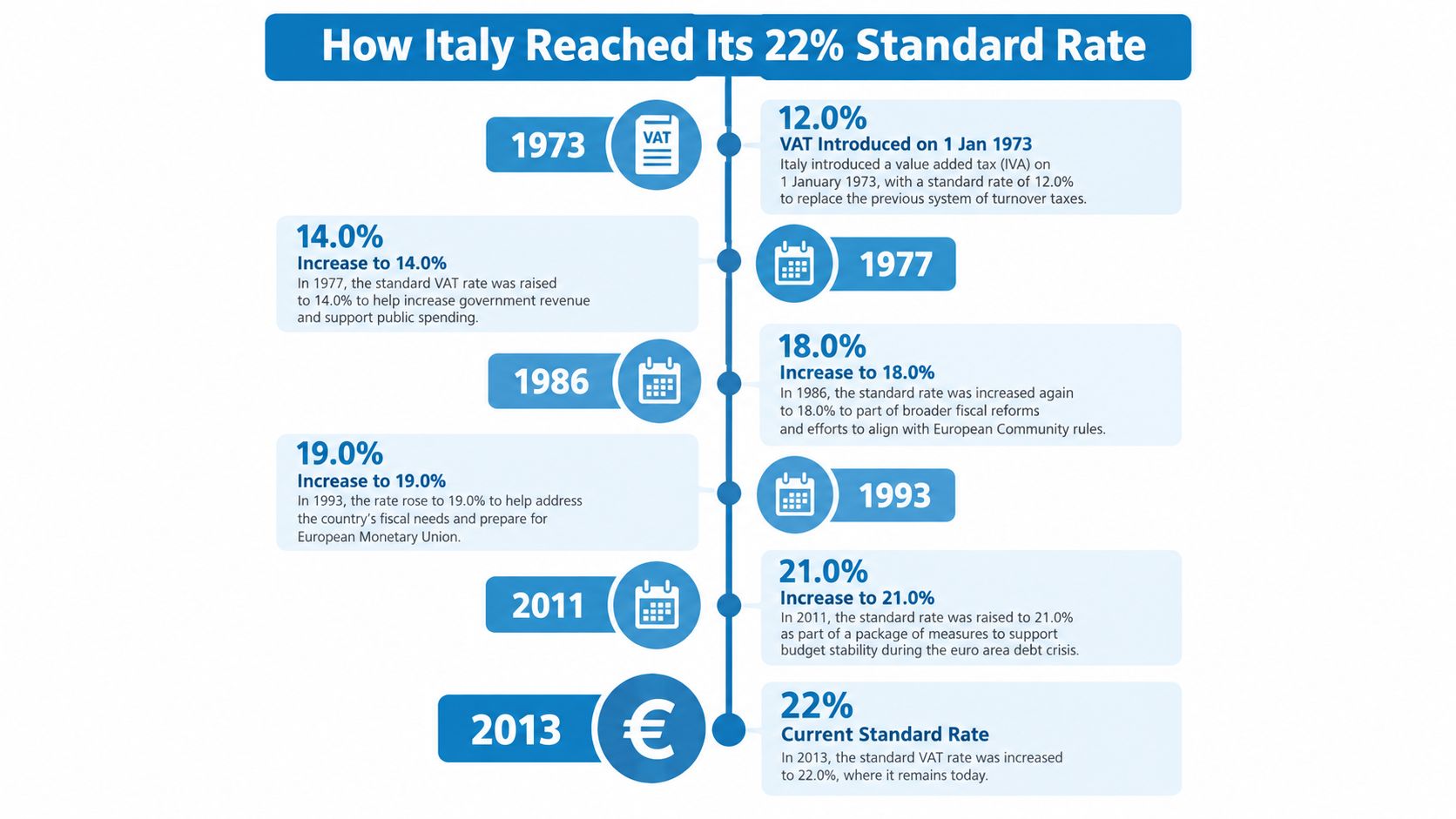
The standard rate has remained at 22% since 2013, and the OECD data places Italy's historical standard-rate range between 12.0% and 22.0% since VAT began. The same source notes that the current standard rate is above the OECD average.
That history matters for pricing architecture. Teams sometimes treat the displayed VAT percentage as presentation data, while the net price carries the core commercial logic. In a VAT-inclusive checkout, the displayed gross price depends directly on the applicable rate. In a VAT-exclusive B2B workflow, the rate affects the invoice total and the buyer's accounting, even when the commercial net price stays fixed.
What the history means for billing teams
Use the historical record as a reason to avoid hardcoding assumptions into product pricing:
- Store net and tax amounts separately. Reconstructing tax from a gross total becomes fragile when a rate changes.
- Version tax rules. Preserve the rule used at invoice time instead of overwriting old invoices when a catalog mapping changes.
- Separate classification from presentation. “VAT included” is a display choice, not a tax determination rule.
- Review forecasts against rate changes. A higher standard rate can affect consumer price perception and margin assumptions.
Italy's standard rate is therefore both a current value and the endpoint of a sustained upward movement. The safe implementation assumption is not that it will change in a particular direction, but that tax logic must be configurable.
Reduced Rates and Sector-Specific Exceptions
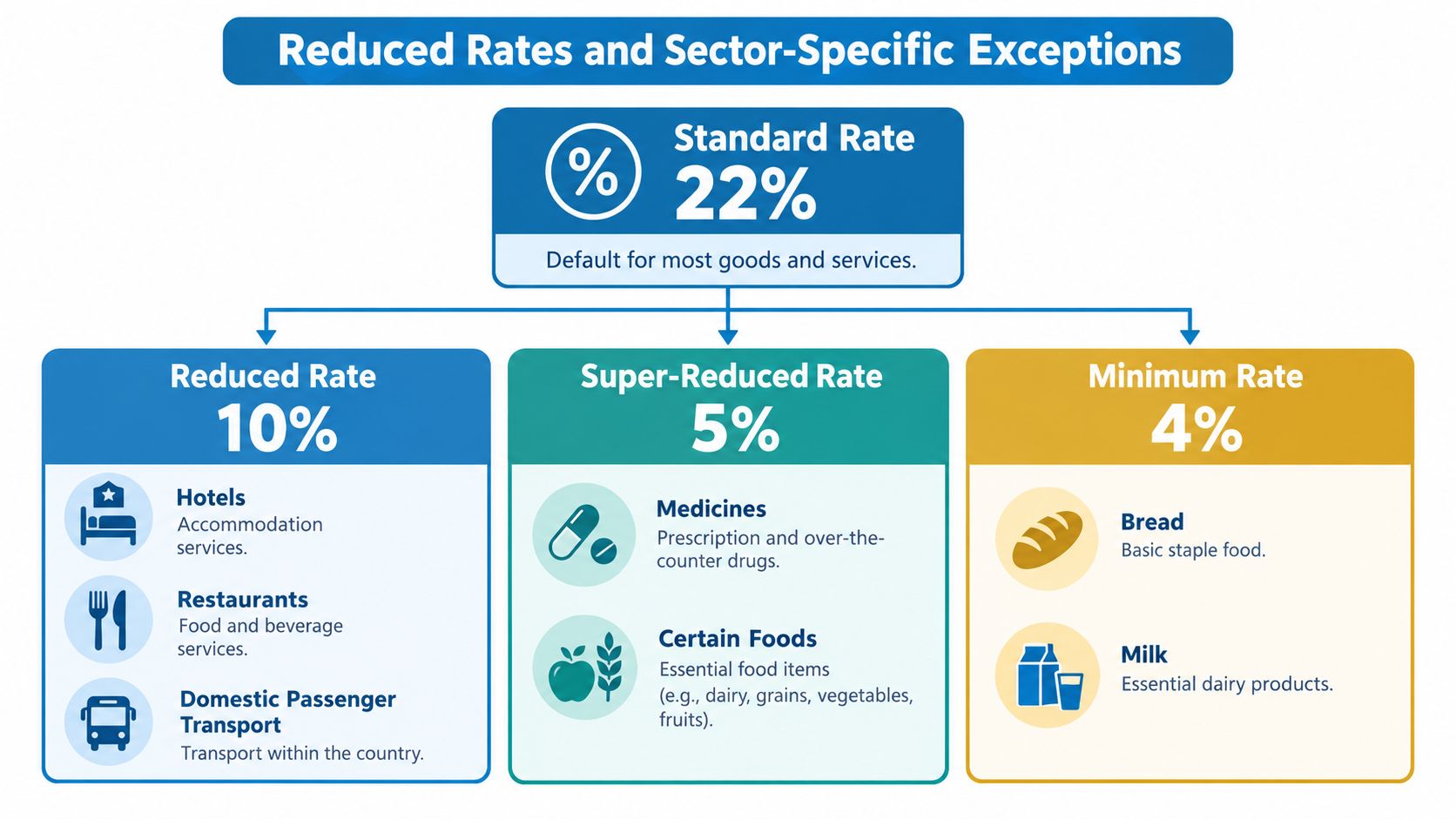
The reduced bands are where a static VAT page stops being useful. Italy reserves 10%, 5%, and 4% for specifically listed categories, and neutral tax summaries identify examples including domestic passenger transport, hotels, restaurants, certain foods, medicines, books, e-books, disability-related goods, and some social services. The Italy VAT rate overview from Taxology provides a sector-oriented view of these categories.
The 10% band
The 10% rate commonly appears in listed service categories such as hotels, restaurants, and domestic passenger transport. That doesn't mean every charge connected to hospitality or travel qualifies. A hotel room and a software platform sold to a hotel are different supplies, with different classification questions.
For a marketplace, model the underlying transaction rather than the merchant's industry. If the platform sells accommodation, the accommodation category may require one treatment. If it sells platform access, payment processing, or advertising to the accommodation provider, those services need their own analysis.
The 5% band
The 5% rate covers narrower listed categories, including certain medicines and foods. Product attributes matter. “Health-related” or “food-related” is too broad for an automated rule unless the catalog stores the specific eligibility basis and supporting product data.
This is especially important for marketplaces with merchant-managed catalogs. Letting each seller select a rate from a dropdown can create inconsistent treatment. A safer approach is to restrict the selectable options, record the classification source, and send ambiguous products to review.
The 4% band
The 4% rate is the lowest of Italy's listed domestic bands and applies only to eligible categories. Books and e-books, disability-related goods, certain basic necessities, and some other listed supplies can fall into reduced treatment, but the category needs to match the statutory conditions.
Digital format alone doesn't determine the rate. An e-book may be treated differently from software access, a hosted application, or a subscription that includes support and community features. The invoice system should classify the supplied service, not just copy the category of a physical analogue.
Why the distinction changes your code
Misclassification affects more than the VAT line:
- Pricing: VAT-inclusive prices change when the rate changes.
- Checkout: The tax engine needs the product and customer context before calculating totals.
- Invoices: The rate and tax amount must agree with the classification.
- Reverse charge: A domestic reduced-rate classification doesn't automatically determine a cross-border B2B result.
- Audit evidence: The business needs a defensible reason for selecting a reduced band.
Italy enacted a new consolidated VAT act in 2026, with the cited materials describing a broad reorganization of VAT rules and tables that will enter into force in 2027. That makes versioned tax tables especially important. Don't bury rate logic inside frontend components or one-off Stripe price settings that can't be reviewed and updated.
Special Regimes Beyond the Rate Table
A correct percentage doesn't guarantee a correct Italian invoice. Since 1 January 2019, Italian VAT-registered businesses have had to issue and transmit electronic invoices through the government's Sistema di Interscambio, or SdI, using the structured FatturaPA XML format. The European Commission's e-invoicing documentation for Italy describes the regime and the information that invoices must carry.
Build the invoice as a compliance object
The payload must include VAT rate and amount data, along with seller and buyer VAT IDs and addresses. Failures can trigger penalties, so a PDF generated by Stripe or an accounting platform isn't necessarily the complete compliance workflow.
A practical pipeline separates four stages:
- Determine: Select the rate or non-charging treatment.
- Validate: Check customer identity, VAT status, and required evidence.
- Serialize: Produce the required structured invoice fields.
- Transmit and reconcile: Route the invoice through SdI and preserve its status.
This separation helps isolate failures. A tax determination error isn't the same as an XML schema error, and an accepted invoice isn't necessarily proof that the original product classification was correct.
Implementation rule: Store the calculation inputs and the final invoice payload together. You need to explain not only what rate was used, but why the system used it.
Split payment changes the cash flow
Split payment is a separate operational treatment from the headline rate. Under the mechanism, the buyer pays the supplier's taxable amount while the VAT is handled through the required split-payment process. It matters particularly when dealing with public-sector and other buyers covered by the applicable rules.
That changes accounts receivable expectations. A payment reconciliation process that expects one gross transfer can mark a valid transaction as short-paid. The invoice and collection workflow must recognize the buyer's status before it posts the expected receivable.
Automated assessment raises the cost of missing returns
Independent tax sources report that, in 2026, Italy's Revenue Agency can assess VAT automatically using e-invoice and digital receipt data when returns are omitted, with penalties and interest attached. This development makes electronic records more than a transmission obligation. They can also provide the data used to evaluate a taxpayer's position.
For software teams, the practical response is traceability. Keep an audit log for tax decisions, validation responses, invoice amendments, transmission outcomes, and failed retries. A rate table without operational history won't help finance explain a mismatch.
Applying Italian VAT Rates in SaaS and B2B Billing
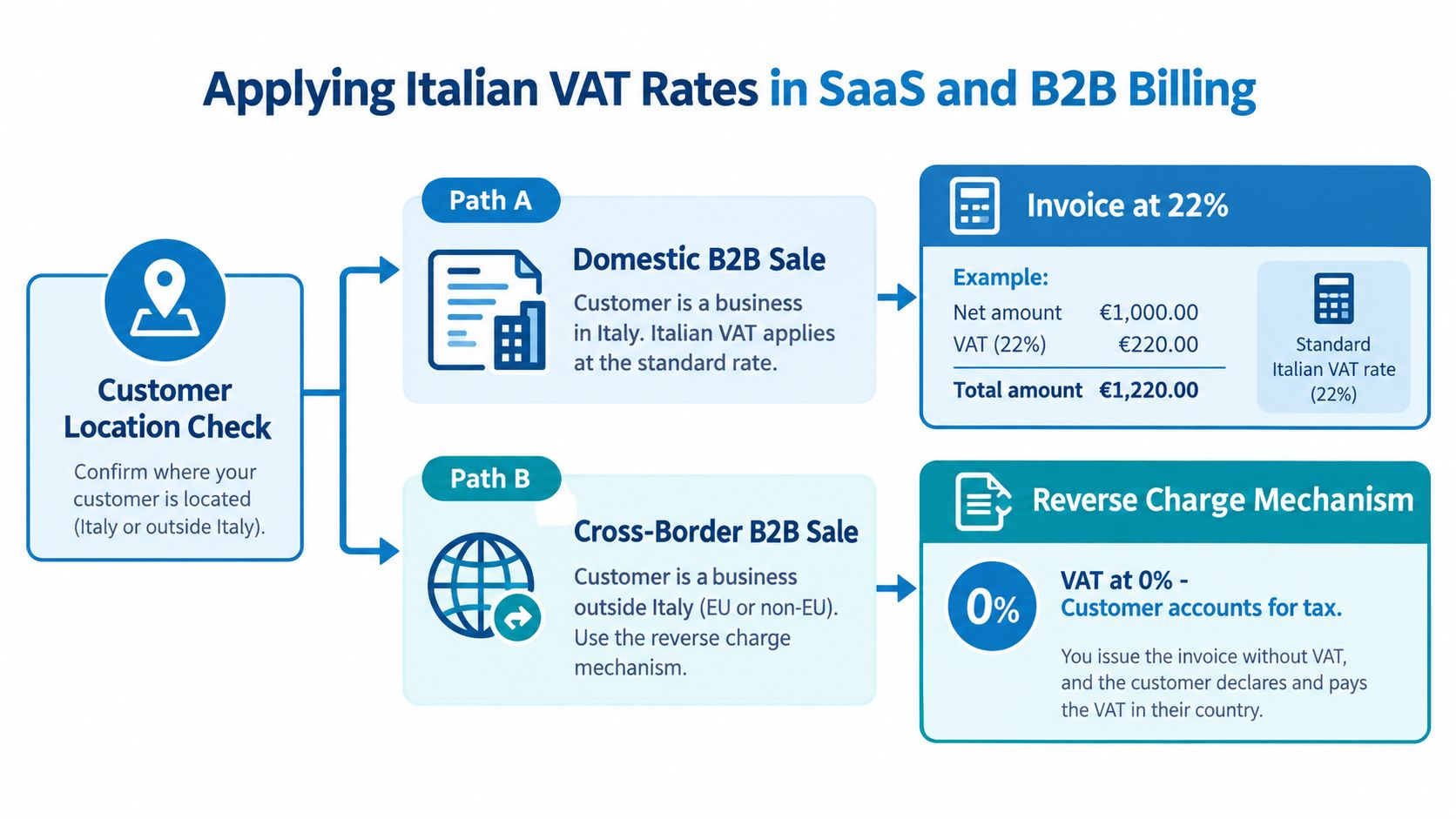
SaaS billing works best when it checks the transaction context before it creates a tax line. The same Italian customer country can produce different outcomes depending on whether the buyer is a consumer, an Italian business, or a business established elsewhere in the EU.
Example one, domestic B2B SaaS
An Italian VAT-registered company buys a standard software subscription from a supplier making a taxable domestic supply. The billing system classifies the subscription as a standard SaaS service, applies 22% Italian VAT, calculates the VAT amount from the net subscription price, and prepares the required invoice data.
The important implementation detail is that the customer's sector doesn't change the SaaS classification. A restaurant buying software doesn't turn that software into restaurant services, and a hotel buying a booking tool doesn't make the subscription hotel accommodation.
Example two, cross-border B2B SaaS
A business established in one EU country supplies SaaS to an Italian business. If the transaction qualifies for the relevant cross-border B2B reverse-charge treatment, the supplier doesn't charge Italian VAT in the ordinary way. The invoice should show the applicable reverse-charge wording and the buyer's VAT ID, while the customer accounts for the tax under the relevant rules.
The system should validate the buyer's VAT ID before applying that treatment. Don't use the presence of an “IT” country selection or a manually entered number as sufficient evidence. If validation fails, route the transaction to review or apply the configured fallback policy rather than removing VAT without notice.
Example three, digital products and customer status
Digital products require a combined customer and location assessment. A B2B sale may follow a reverse-charge path when the buyer's status and identification are valid. A B2C sale requires a consumer-location analysis and may produce a different VAT result.
Keep these values distinct in your billing model:
- Customer type: Business or consumer.
- Customer country: Based on the evidence your workflow accepts.
- VAT ID status: Valid, invalid, unavailable, or pending review.
- Supply type: SaaS, downloadable digital product, support, training, or another service.
- Tax outcome: Italian VAT rate, reverse charge, exemption, or manual review.
For broader implementation context, the Jumpstart Partners nexus compliance guide is useful when comparing indirect-tax obligations across markets. Teams building a European billing flow can also reference TaxID's SaaS billing use cases for the validation step that sits before invoice generation.
Billing principle: Never make “VAT zero” the default when a VAT ID lookup is slow. Make the uncertainty visible and resolve it with a defined retry or review path.
Public-sector and covered large-corporate buyers add another branch because split payment can affect collection and reconciliation. Your tax result should therefore include both the rate decision and the payment treatment.
Classifying Mixed Baskets and Bundled Subscriptions
Mixed baskets expose the weakness of a single tax rate attached to a checkout. A basket may contain a standard-rate SaaS subscription, a separately priced training service, and a physical or digital item that appears eligible for a reduced band. The system must decide whether these are separate supplies or one bundled supply before calculating tax.
Use a classification decision tree
Start with the commercial and contractual reality:
- Identify each promised component. List the software access, support, implementation, training, goods, and other deliverables.
- Check whether each component has its own price. Separate pricing is strong operational evidence that the checkout contains separate lines, though it isn't the only consideration.
- Classify each line independently. Test the item against the listed Italian categories. Don't infer a reduced rate from the buyer's business sector.
- Look for a single supply. If one element is ancillary to a principal service, the treatment may follow the principal supply. Document that conclusion.
- Calculate and display the result. Itemize different rates when the transaction contains distinct supplies, and preserve the classification reason.
A support plan bundled with software can be particularly difficult. Basic assistance that only enables use of the application may be ancillary to the software service. A separately marketed consulting package, training engagement, or managed service may be a distinct supply. The contract, product page, pricing model, and actual fulfillment should tell the same story.
What doesn't work
Avoid these shortcuts:
- One rate per customer: The buyer's country and status matter, but they don't classify every product in the cart.
- One rate per invoice: Different supplies can require different lines.
- One rate per merchant category: A merchant selling books may also sell services that don't share the book treatment.
- Manual overrides without evidence: A reduced rate selected by an operator needs a reason and an approval trail.
- Copying physical categories to digital services: Similar content doesn't automatically mean identical tax treatment.
For teams handling digital catalog design, TaxID's explanation of digital goods offers useful terminology for separating digital products from other electronically supplied services. The implementation goal is a stable tax classification object that can be reused by checkout, billing, invoicing, and reporting.
Official Sources and VAT ID Validation Workflow
Different sources answer different questions, so don't use one document as the entire tax engine. The European Commission's national VAT page is the practical reference for Italy's current rate structure. OECD data is better suited to historical context and comparative consumption-tax analysis. The EU e-invoicing documentation addresses the invoice transmission and payload mechanics.
Match the source to the decision
| Question | Useful reference | What to extract |
|---|---|---|
| Which domestic rate bands exist? | European Commission national rules | Standard and reduced rates, plus scope notes |
| How has the standard rate changed? | OECD consumption tax data | Historical rate sequence and comparison context |
| What must the invoice contain? | EU e-invoicing documentation | SdI, FatturaPA XML, identity, address, rate, and amount fields |
| Does a current workflow need special handling? | Current tax administration guidance | Split payment, reporting, and enforcement changes |
The EU Council extended Italy's authorization to apply split payment until 30 June 2029, while FTSE MIB listed companies were excluded from that scope from 1 July 2025. Independent tax sources also report that automated VAT assessment can use e-invoice and digital receipt data when returns are omitted in 2026. Because these are implementation-sensitive rules, finance teams should confirm the current application before encoding buyer-specific behavior.
Validate before removing VAT
A developer-first validation workflow should run before the invoice is finalized:
- Format check: Reject obviously malformed country and VAT ID combinations locally.
- Remote validation: Query an authoritative VAT validation service when the transaction requires evidence.
- Cache carefully: Reuse recent results according to your compliance policy, but retain the timestamp and response.
- Handle outages explicitly: A service timeout isn't the same as an invalid VAT ID.
- Persist the decision: Store the response alongside the invoice and tax result.
TaxID's Italy VAT number checker can fit this workflow by returning a machine-readable validation result for the buyer's VAT ID. Whether you use it or another service, the key design choice is to make “validated,” “invalid,” and “unavailable” separate states. A checkout shouldn't interpret an upstream outage as permission to apply reverse charge.
Quick Reference Summary and Checklist
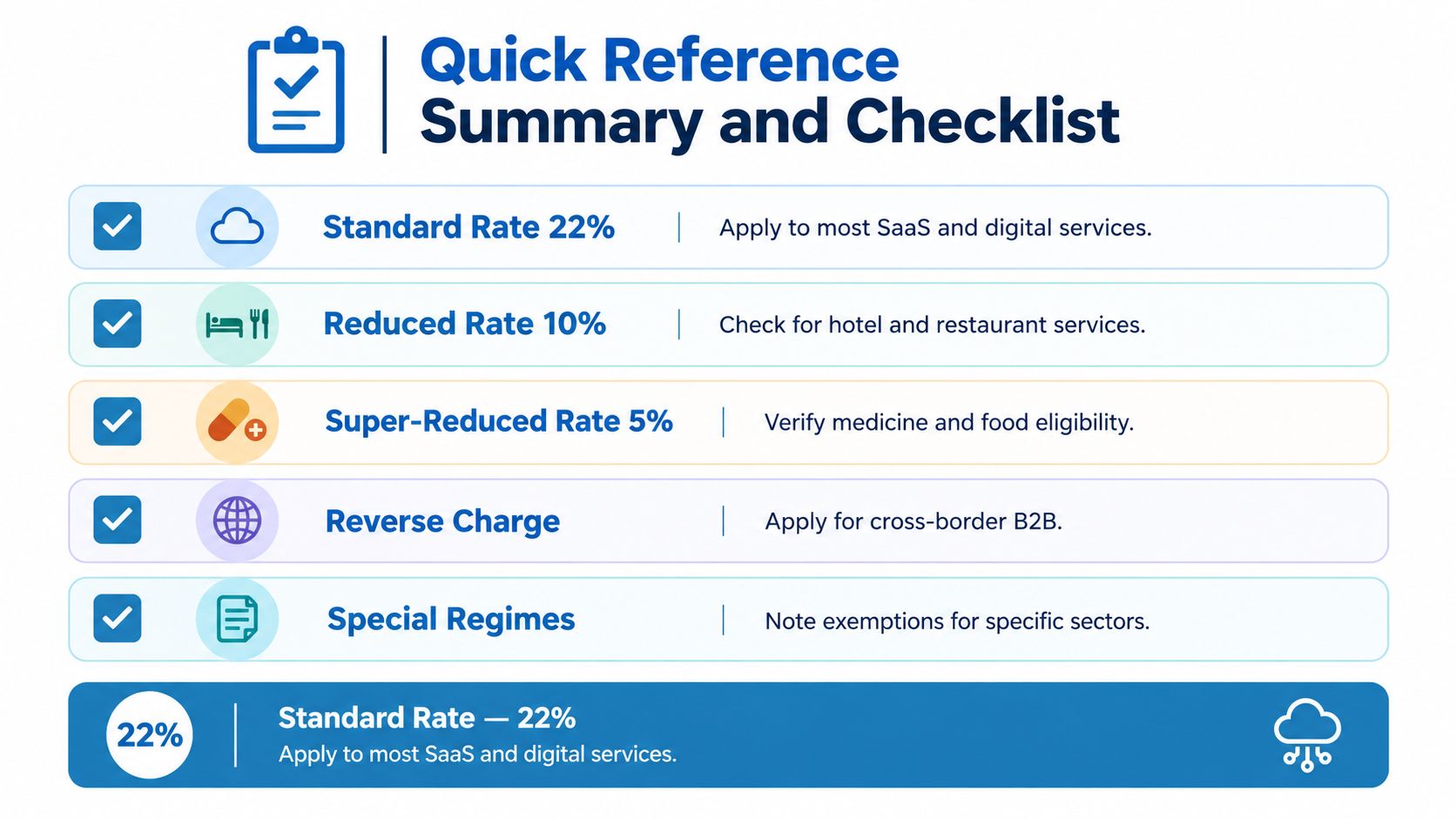
Use the following as the compact version of the implementation model. The rate is only one field in the final result. Customer status, location, product classification, invoice routing, and payment treatment all need to survive into the accounting record.
Rate lookup
| Treatment | Use it when |
|---|---|
| 22% standard rate | The supply is taxable in Italy and doesn't qualify for a listed reduced category |
| 10% reduced rate | The supply matches an eligible listed category such as certain hotel, restaurant, or domestic passenger transport services |
| 5% reduced rate | The supply matches a narrower listed category such as certain medicines or foods |
| 4% reduced rate | The supply matches an eligible lowest-rate category, including certain books, e-books, disability-related goods, or basic necessities |
| Reverse charge or export treatment | The transaction qualifies under the relevant cross-border or export rules, with evidence and invoice wording recorded |
Pre-invoice checklist
- Classify the supply: Identify every component in a mixed basket or bundle.
- Confirm the customer: Separate B2B from B2C treatment.
- Check location: Use the evidence required for the product and transaction type.
- Validate the VAT ID: Don't apply reverse charge based only on customer-entered text.
- Check special treatment: Review split payment and other buyer-specific rules.
- Generate compliant data: Include the rate, VAT amount, seller and buyer IDs, and addresses.
- Route the invoice: Support SdI and FatturaPA XML where the Italian e-invoicing regime applies.
- Preserve evidence: Save the classification, validation result, calculation, and transmission status.
TaxID provides VAT and company identification validation through a developer-focused API, including machine-readable results for billing workflows. To reduce manual checks in Italian SaaS invoicing, connect the VAT ID decision to your checkout and invoice pipeline, then visit TaxID to review the available validation workflow.