It's Friday afternoon in Lisbon, and a small SaaS team has just closed its first B2B contract with a customer elsewhere in the EU. The billing service can produce a polished PDF, Stripe can finalize the charge, and the customer's procurement team is still unhappy. They want a Peppol participant identifier, the French finance contact mentions a Factur-X workflow, and a VIES SOAP call returns a validation error that nobody on the team has seen before.
By Monday, the incident has become three tickets, two urgent calls, and an uncomfortable architecture question. A PDF generator handles presentation, not structured delivery. A VAT lookup can confirm a number, but it doesn't tell the team which invoice format, network, or clearance process applies. The first production invoice exposes the problem: e-invoicing is a reliability and compliance system, not a billing feature toggle.
The European Commission's 2024 assessment records that the share of EU enterprises with at least ten employees sending or receiving eInvoices rose from 10.3% in 2013 to 38.6% in 2023. It also records wide country variation, from 14.8% in Poland to 97.5% in Italy in 2023. Those differences explain why an e-invoicing API must deal with national formats, routing rules, validation layers, and different operating models rather than expose one POST /invoices endpoint. (European Commission data in the Council of the EU document)
The practical question every backend lead eventually asks is simple: do we build this in-house, or route it through a provider?
Table of Contents
- When the First EU Invoice Hits Your Inbox
- What an E-Invoicing API Actually Does
- Standards, Networks, and Country-Specific Schemes
- Integrating an E-Invoicing API in Node.js and Python
- VAT and Company-ID Validation as the Hidden Reliability Layer
- How to Choose an E-Invoicing API Provider
- Designing for Mandate Drift and Clearance Outages
- A 90-Day Rollout Plan for an E-Invoicing API
When the First EU Invoice Hits Your Inbox
The Lisbon team starts with the obvious fix. They add a PDF attachment to the outgoing email and ask the customer whether that's acceptable. The answer comes back quickly: no. The buyer needs structured invoice data that its procurement system can parse, and its accounts-payable team expects delivery through the relevant network or platform.
The engineers then discover that “France” doesn't identify a single technical action. One person searches for Factur-X generation, another investigates a French platform, and a third tries to validate the customer's VAT number through VIES. The VIES endpoint responds with an error, so the team can't tell whether the identifier is wrong, the service is unavailable, or the request format is the problem.

That sequence is common because invoice systems often validate too late. The application creates a customer, charges a card, finalizes an invoice, renders a PDF, and only then asks whether the buyer can legally receive the document in that form. By that point, changing the invoice can mean reopening accounting records, rebuilding tax calculations, or asking finance to repair a document that already entered a collection workflow.
A more durable design starts earlier:
- At customer capture, collect the legal name, registered address, country, VAT number, company identifier, and electronic address.
- Before invoice generation, validate identifiers and resolve the buyer's delivery capabilities.
- During document construction, select the applicable structured format and business rules.
- After submission, track acceptance, rejection, delivery, and clearance as separate states.
The choice between a direct Peppol access point and a managed e-invoicing API follows from that design. A direct access point gives the team more control over transport and operating costs, but it also creates responsibility for participant discovery, message handling, certificate management, rule updates, monitoring, and support. A managed API hides much of that infrastructure, but the team must inspect its export options, status model, outage behavior, and ability to route different countries without forcing a rewrite.
For a useful overview of the compliance decisions that sit around the invoice itself, keep the e-invoice compliance guide close during discovery. The important conclusion is uncomfortable but useful: the current PDF flow isn't a foundation for e-invoicing. It's one output format in a larger transaction pipeline.
What an E-Invoicing API Actually Does
An e-invoicing API has four separate jobs. Treating them as one operation creates ambiguous failures and makes recovery harder.
It creates structured documents
The API either accepts structured invoice data or transforms an internal model into a recognized document format. Depending on the destination, that can involve UBL, UN/CEFACT structures, Factur-X, or a national implementation of a broader standard.
The output must carry more than customer name, line items, and a total. It may need payment terms, VAT categories, exemption information, electronic addresses, identifiers, tax totals, document references, and customization or profile metadata. A PDF can display these values for a human, but it doesn't guarantee that another system can reliably extract them.
It validates meaning, not just syntax
Peppol BIS Billing 3.0 validation is layered across UBL syntax, EN 16931 semantics, Peppol business rules, code lists, participant identifiers, and applicable national rules. A document can be valid XML and still fail because its arithmetic, VAT category, routing field, or profile identifier is inconsistent. (Peppol BIS Billing validation overview)
That's why a good API returns machine-actionable errors. “Invoice invalid” is nearly useless. The client needs to know whether the issue is a missing scheme code, an invalid unit, a tax calculation mismatch, or a recipient that can't be found on the selected network.
It transmits and reports status
Transmission can involve Peppol access points, national portals, or clearance services. The API should expose the submission as an asynchronous process, even when the initial request returns quickly. A successful HTTP response usually means the provider accepted the job, not that the tax authority or buyer accepted the invoice.
The contract should define:
- Authentication and key rotation.
- An idempotency key for safe retries.
- A request identifier that remains stable across state changes.
- Webhook events for submission, delivery, rejection, and clearance.
- Rejection codes with enough detail for automated handling.
- Retrieval of the original structured document and authority response.
This is also an API documentation problem. Teams comparing providers should understand the difference between endpoint descriptions and an operational contract, which is why Tagada's API documentation guide is a useful reference when reviewing authentication, examples, errors, and lifecycle behavior.
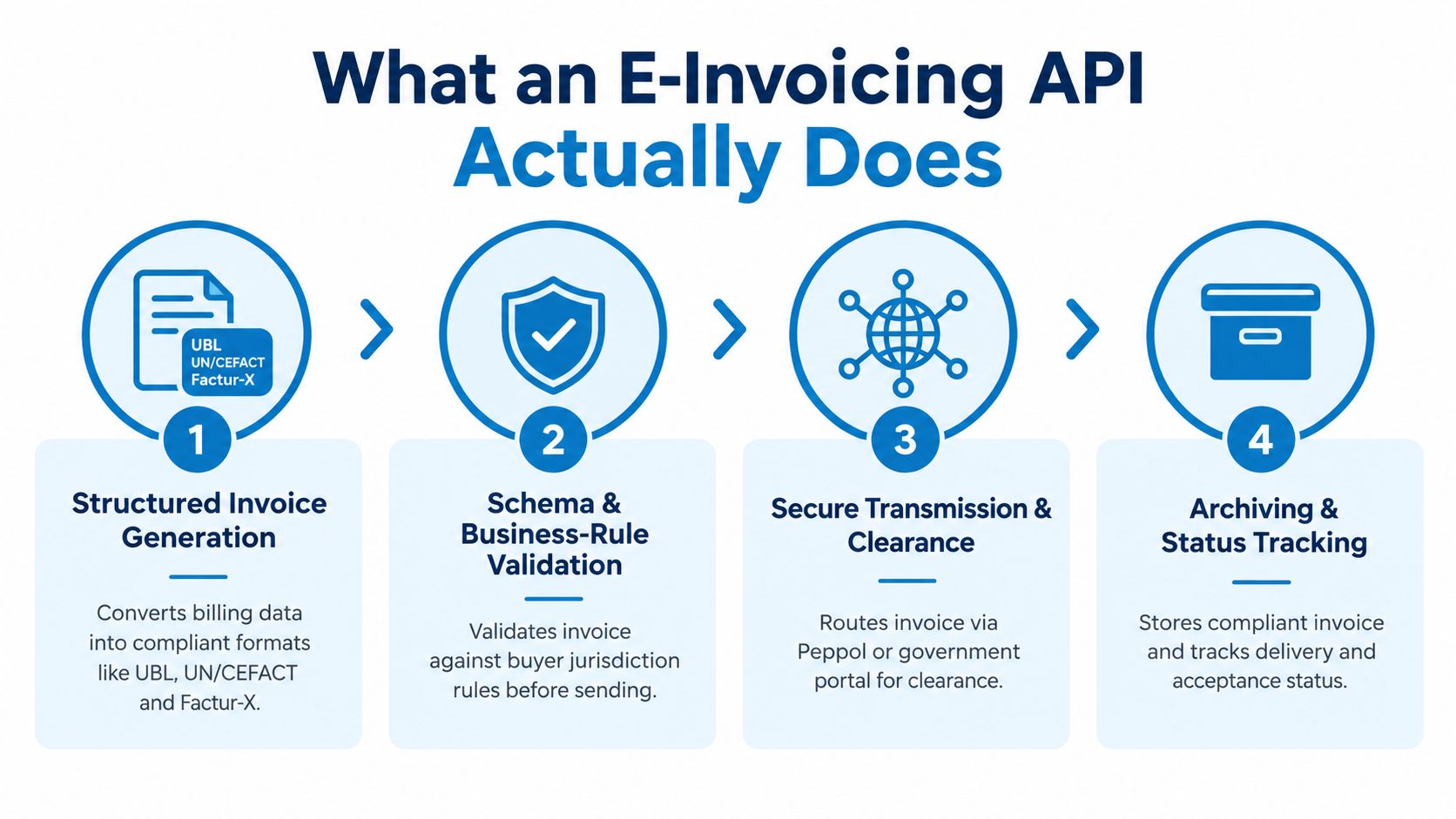
A Stripe invoice endpoint generally stops at billing orchestration and rendering. It may calculate taxes, collect payment, and create a customer-facing invoice, but it doesn't automatically solve the buyer's electronic address, country-specific schema, clearance route, authority acknowledgment, or audit archive.
The lifecycle should therefore look like a state machine:
draft -> validated -> submitted -> accepted or rejected -> delivered or cleared -> archived
Don't collapse those states into sent. Finance users need to know whether an invoice left the application, reached the network, passed authority validation, and became available to the buyer.
Standards, Networks, and Country-Specific Schemes
A provider can accept a valid XML document and still fail at delivery. The format, network, clearance authority, and mandate rules are separate dependencies, and production incidents often occur at their boundaries.
The first layer is the semantic and payload standard. EN 16931 defines the business concepts an electronic invoice should express. Peppol BIS Billing 3.0 packages those concepts into an implementation using UBL and network-specific rules. Factur-X combines a human-readable PDF with embedded structured data, while Italy's FatturaPA and Germany's XRechnung apply national requirements and constraints.
The second layer is transport and clearance. Peppol routes structured documents between access points. Italy uses the Sistema di Interscambio, commonly called SDI, for its national electronic invoice flow. France has separate public-sector and private-sector delivery arrangements with distinct platform responsibilities. Format support alone does not prove that a provider supports the required route, recipient discovery, authority response, or business-rule validation.
Mandate timing adds a third dependency. The European Commission's assessment reports that 17 of 27 EU Member States had introduced legislation requiring suppliers to issue eInvoices to the public sector, with full implementation in 13 countries and partial implementation in 4. (European Commission mandate assessment) B2G requirements helped establish validation, routing, and compliance infrastructure that now affects broader invoicing workflows.
Payload differences matter
| Scheme | Format standard | Transport network | Mandate status |
|---|---|---|---|
| Peppol BIS Billing 3.0 | UBL with EN 16931 semantics and Peppol rules | Peppol access points | Active EU specification, with release changes that APIs must track (OpenPeppol technical documentation) |
| Factur-X | Hybrid PDF with embedded structured invoice data | French platforms or applicable delivery route | Country and transaction context determine the required path |
| FatturaPA | Italian XML implementation | SDI | Established national clearance model |
| XRechnung | German structured invoice profile | Peppol or applicable public-sector route | Buyer and public-sector requirements determine the accepted profile |
| ZUGFeRD | German hybrid invoice format | Depends on recipient and use case | Format support does not by itself establish a delivery obligation |
A single REST endpoint can simplify the interface, but it does not remove routing logic. The application still has to select the buyer country, tax treatment, document profile, electronic address scheme, delivery route, and fallback behavior. Keep those decisions in a versioned routing layer rather than scattering country checks through checkout and billing handlers.
Ruleset changes also belong in deployment planning. OpenPeppol's documentation records a May 2026 release of Peppol BIS Billing 3.0 for EU use and notes a mandatory date version. APIs need the active specification version, effective date, validation rules, and rollback procedure stored as operational configuration, not buried in documentation. (OpenPeppol billing documentation)
Integrating an E-Invoicing API in Node.js and Python
The provider call shouldn't run inside the Stripe webhook handler. Stripe needs a fast acknowledgment, while clearance can involve network discovery, validation, queuing, or an authority that isn't available at that moment.
A production path looks like this:
- Verify the Stripe webhook signature.
- Accept
invoice.finalized. - Store the invoice event and enqueue a durable job.
- Build the e-invoice payload from your own canonical model.
- Validate required fields locally.
- Submit through the e-invoicing API with an idempotency key.
- Consume status callbacks and reconcile the result.
In Node.js, the client can stay deliberately boring:
import axios from "axios";

export async function submitEInvoice(invoice) {
  const response = await axios.post(
    process.env.EINVOICE_API_URL,
    {
      invoiceNumber: invoice.number,
      issueDate: invoice.issueDate,
      seller: invoice.seller,
      buyer: invoice.buyer,
      lines: invoice.lines,
      totals: invoice.totals,
      format: "UBL_2_1",
      participantId: invoice.buyer.participantId
    },
    {
      headers: {
        Authorization: `Bearer ${process.env.EINVOICE_API_KEY}`,
        "Idempotency-Key": `stripe-invoice-${invoice.id}`
      },
      timeout: 10000
    }
  );

  return response.data;
}
The queue owns retries. Use exponential backoff with jitter, cap the number of attempts, and move persistent failures to a dead-letter queue. A provider-side 5xx should be retried differently from a business-rule rejection, which should produce a repair task rather than another identical submission.
Python teams can apply the same boundary with httpx.AsyncClient and Pydantic:
from httpx import AsyncClient
from pydantic import BaseModel

class InvoicePayload(BaseModel):
    invoice_number: str
    buyer: dict
    lines: list[dict]
    totals: dict
    format: str = "UBL_2_1"

async def submit_einvoice(invoice: InvoicePayload, invoice_id: str):
    async with AsyncClient(timeout=10) as client:
        response = await client.post(
            "https://api.example.test/einvoices",
            json=invoice.model_dump(),
            headers={
                "Authorization": "Bearer YOUR_API_KEY",
                "Idempotency-Key": f"stripe-invoice-{invoice_id}",
            },
        )
        response.raise_for_status()
        return response.json()
| Concern | Node.js | Python |
|---|---|---|
| Webhook boundary | Verify signature, enqueue BullMQ job | Verify signature, enqueue Celery or equivalent job |
| HTTP client | axios with timeout and status handling |
httpx.AsyncClient |
| Payload validation | TypeScript types or runtime schema library | Pydantic model |
| Retry ownership | Worker, not Stripe handler | Worker, not webhook route |
| Callback security | Verify provider signature and event identity | Verify signature and validate event model |
Keep your internal invoice model separate from the provider's JSON. That makes provider replacement possible and lets the application map UBL fields without leaking vendor-specific names across billing code. For the VAT-specific validation boundary, see the VAT ID checker implementation guide.
VAT and Company-ID Validation as the Hidden Reliability Layer
A VAT error can surface only after the invoice reaches clearance. A mistyped German USt-IdNr., an outdated company record, or a missing electronic address can turn a routine B2B invoice into an accounts-receivable investigation. Validate the counterparty before document generation, not after rejection.
The failure chain often starts at checkout. A customer enters an identifier, the application accepts it, Stripe finalizes the invoice, the e-invoicing API builds the document, and the access point rejects the submission. Finance then sees a delivery failure instead of the bad field that caused it. The supplier may have an invoice in its internal ledger while the buyer has no usable document.
Use a validation service that returns structured data rather than a Boolean hidden behind a brittle SOAP response. TaxID provides one example of this wrapper pattern. It validates VAT and tax IDs through a REST interface, applies country-specific format checks before remote calls, and returns status and company details in JSON. Its documented reliability model includes Redis-backed caching for 24 hours and sub-10-millisecond cached responses. (TaxID product information)
Store the decision with the customer
Run validation at two boundaries:
- At checkout or customer onboarding, give the user immediate feedback and prevent an invalid exemption decision.
- Before invoice issuance, recheck when the customer's tax status or delivery route requires confirmation.
Store the submitted value, normalized value, country, validation timestamp, returned company name and address, and a confidence or status field on the customer record. Downstream services can then distinguish a verified counterparty from an unverified one without parsing free-text errors.
Caching reduces dependence on the upstream service, but a cached result should not become permanent truth. Define whether cached data is acceptable for checkout, invoice creation, or display only. Separate “identifier invalid” from “validation service unavailable.” The first requires customer-data correction. The second is an infrastructure failure and should usually create a review or deferred workflow, rather than automatic tax treatment.
National identifiers also need a deliberate normalization layer. The company registration number validation guide covers implementation considerations for that boundary. Identity validation protects the invoice pipeline much like idempotency protects payment submission: it prevents bad input from becoming an expensive downstream failure.
How to Choose an E-Invoicing API Provider
Start with live obligations, not a country map. A provider that lists a country but only supports PDF export, an old schema, or manual portal upload isn't covering your requirement.
Ask the provider to demonstrate a complete path for each target jurisdiction:
- Can it create the required structured payload?
- Does it validate syntax, semantics, code lists, and national rules?
- Can it discover or verify the buyer's electronic address?
- Does it submit through the correct access point or clearance portal?
- Does it return authority responses and preserve the cleared document?
- What happens when the portal is unavailable?
Country support should be evaluated by mandate model. Italy's SDI path is a different engineering problem from Peppol delivery. France's platform requirements differ from Germany's profiles and routing choices. Poland's KSeF requires its own roadmap and operational treatment. A provider that handles one network well may still be a poor fit for a company selling across several models.
Compare operational depth
| Selection area | What to verify | What often fails |
|---|---|---|
| Country coverage | Current mandate scope, route, formats, and buyer-side requirements | A marketing map that hides manual steps |
| Format breadth | UBL 2.1, Peppol BIS, Factur-X, ZUGFeRD, XRechnung, and national CIUS profiles | “Supports XML” without profile-level validation |
| Developer experience | Versioned docs, sandbox parity, webhook examples, idempotency semantics | A happy-path example with no rejection lifecycle |
| Reliability | Queueing, retries, incident history, status pages, and recovery guarantees | An endpoint that treats HTTP acceptance as clearance |
| Exit options | Raw document export, stable identifiers, routing abstraction, and multi-provider support | A proprietary model that makes migration expensive |
Sandbox quality deserves special scrutiny. Test invalid VAT categories, missing identifiers, duplicate submissions, malformed addresses, portal timeouts, delayed callbacks, and provider retries. A sandbox that only accepts perfect invoices tells you almost nothing about production behavior.
A useful adjacent concern is document integrity. If your workflow attaches signatures or produces human-readable copies, review a practical digital signature to PDF guide, then confirm that the provider preserves the original structured payload and the evidence associated with clearance.
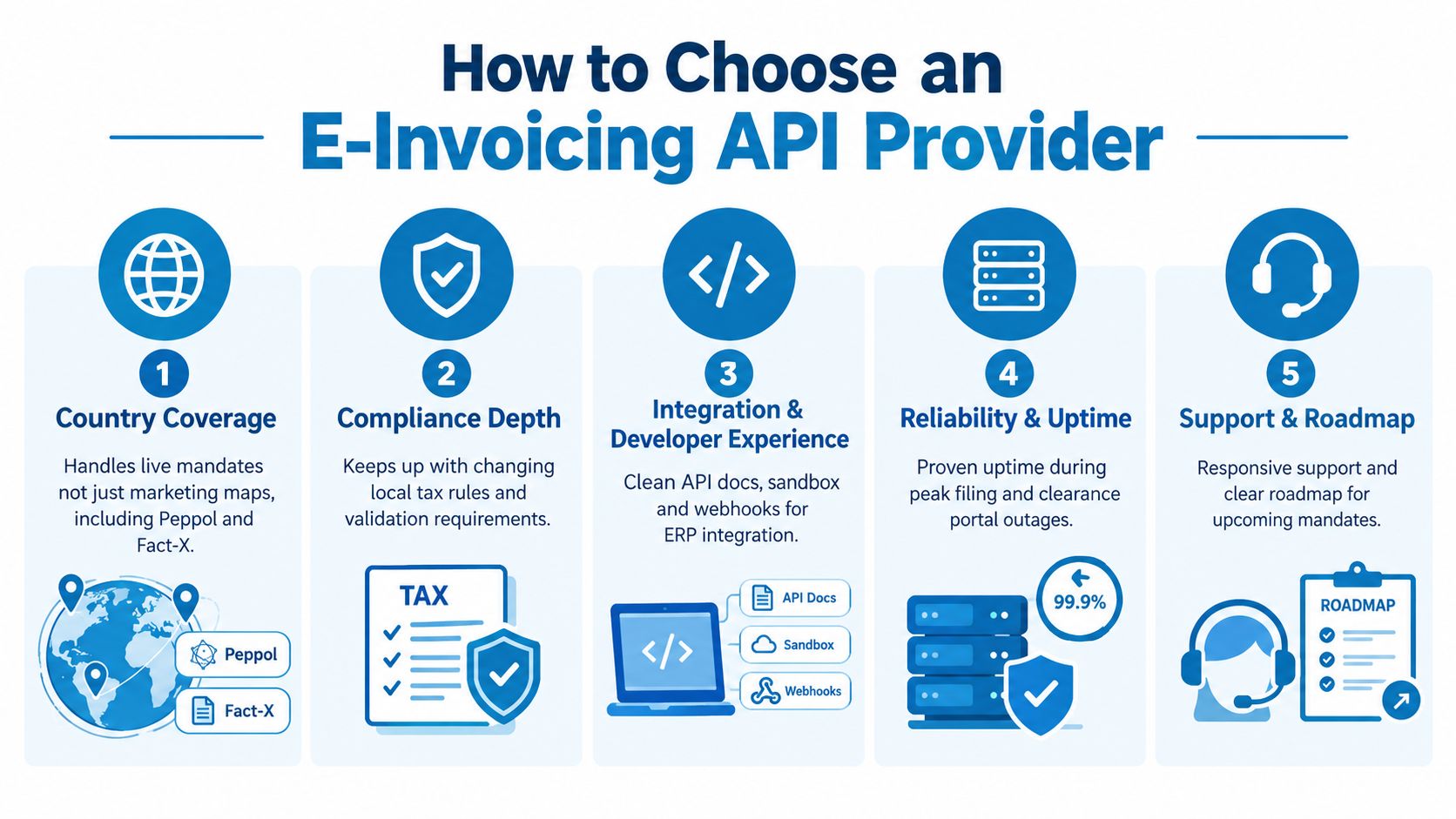
Mandate tracking can matter more than endpoint count. Independent guidance describes national regimes as fragmented and subject to continuing changes, including Germany's receive-only requirement beginning in 2025, France's rollout moving to September 2026, and Belgium and Poland moving into 2026. (OpenText global e-invoicing mandate guide) Require a change log, notice period, test environment, and migration instructions for every ruleset update.
Designing for Mandate Drift and Clearance Outages
A successful POST doesn't mean the invoice completed its legal journey. It may only mean that your provider placed a message in a queue.
Clearance portals can become unavailable, access-point endpoints can change, and national authorities can update submission interfaces. India's GSTN, for example, announced API endpoint changes effective August 2026, illustrating why integrations need an update process even when the application's own invoice model hasn't changed. (Recent e-invoicing API change coverage)
Build for an asynchronous outcome
Use an at-least-once delivery queue with a stable idempotency key. The worker should classify failures before retrying:
- Transient transport or provider failures, retry with exponential backoff and jitter.
- Authority maintenance responses, pause or slow the queue based on health signals.
- Business-rule rejections, stop retrying unchanged payloads and create a correction task.
- Unknown states, reconcile against the provider before submitting again.
- Expired or unresolved jobs, move them to a dead-letter queue with an operator workflow.
Health checks should inform retry timing, but they shouldn't replace reconciliation. A portal may accept a message and fail to return the acknowledgment. If the worker blindly retries, the customer can receive duplicate documents or the authority can reject a second submission as a duplicate.
Practical rule: Store evidence locally before you need it. Keep the canonical invoice, rendered copy, cleared XML, provider request ID, authority response code, timestamps, and callback payload together.
Reconciliation is more valuable than transmission speed. Build a job that compares your internal state with provider status, identifies invoices stuck in an intermediate state, and records the final outcome without relying on a live authority query during a customer call.
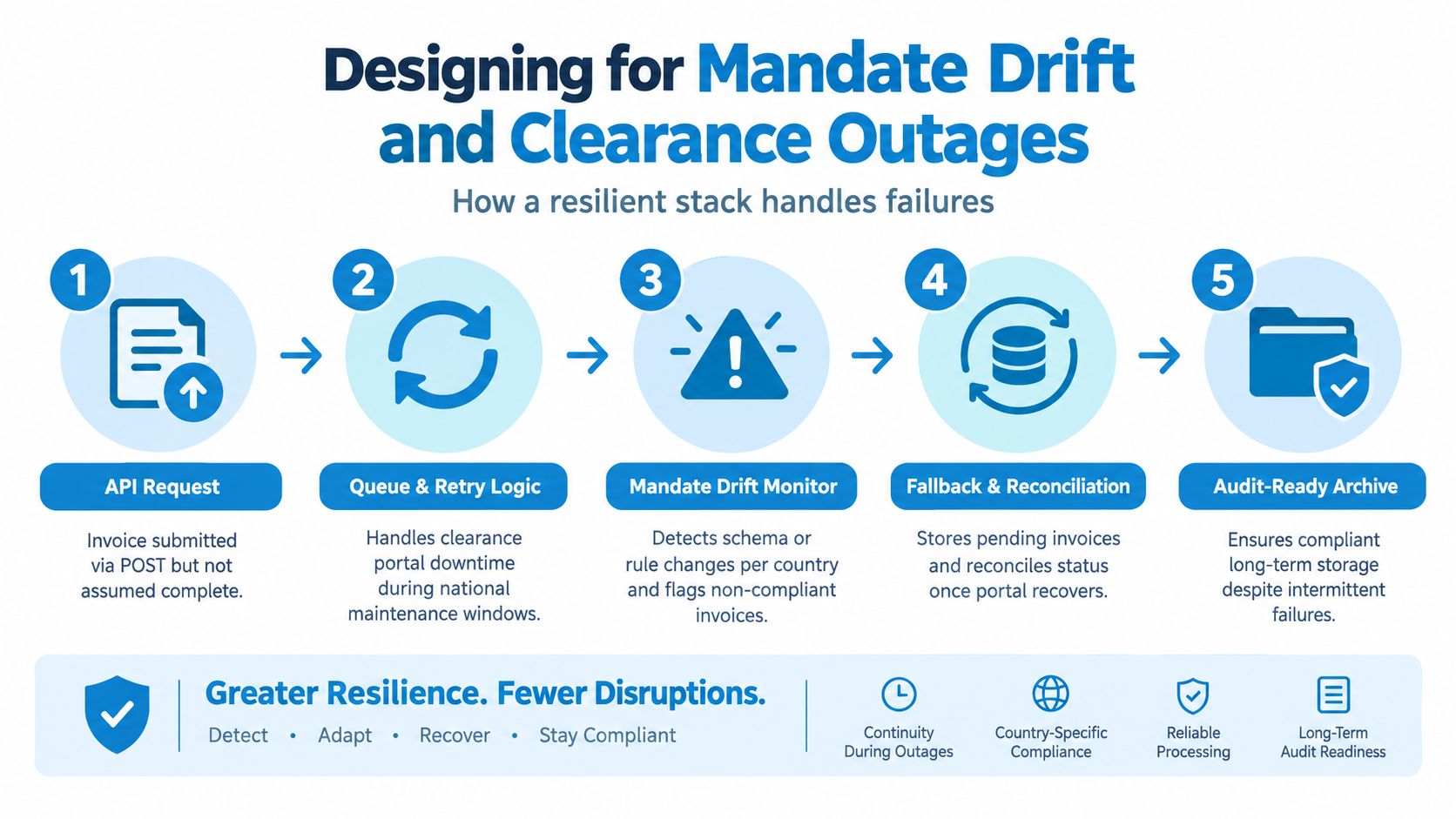
Monitor signals that expose operational degradation:
- Clearance latency, especially the upper tail rather than only the average.
- Rejection categories, grouped by jurisdiction, schema rule, and customer data field.
- Queue age, including invoices waiting for a portal to recover.
- Dead-letter inventory, with ownership and next action.
- Mandate deltas, including new rules, dates, code-list revisions, and endpoint changes.
The architecture should also support controlled replay. Never edit an already-submitted invoice in place. Create a corrected version, preserve the rejected artifact, link the two records, and make the correction visible to finance.
A 90-Day Rollout Plan for an E-Invoicing API
A rollout succeeds when the team proves failure handling, not when it sends one valid test invoice. Divide the work into four phases with explicit artifacts and promotion gates.
Days 1 through 15 for schema and gap analysis
Choose the canonical internal invoice model and map it against EN 16931 concepts and the profiles required by your first markets. Record every field that requires a source decision, including VAT category, exemption reason, payment terms, buyer endpoint, seller identifier, line allowances, and tax totals.
Deliverables should include a signed mapping document, versioned JSON schemas, a country routing matrix, and a list of fields that cannot be inferred safely. Finance must approve the tax and identity assumptions before engineering treats the mapping as complete.
Days 16 through 40 for validation
Wire local validation before the provider call. Add VAT and company-ID checks through VIES or a wrapper such as TaxID, normalize identifiers, persist the response, and define behavior for invalid versus unavailable services.
Implement idempotency keys, webhook signature verification, structured rejection storage, and a reconciliation report schema. Test arithmetic errors, missing scheme codes, invalid participant identifiers, and duplicate invoice requests.
Days 41 through 70 for end-to-end testing
Use the provider sandbox, then test with at least two real Peppol access points and one country-specific clearance portal. The objective is not to confirm delivery. Send deliberately invalid documents, delay callbacks, simulate 5xx responses, replay events, and exercise dead-letter recovery.
Test production-like data volume and permission boundaries. Confirm that support staff can locate the original invoice, provider request, authority response, and current state without asking an engineer to inspect logs.
Days 71 through 90 for cutover
Release behind a feature flag, start with controlled traffic, and define rollback criteria before enabling production issuance. Track the readiness metrics supplied by the rollout plan: clearance success rate above 99.2%, P95 latency under 4 seconds, and zero unresolved dead letters older than 24 hours. These targets are internal promotion gates, not universal regulatory standards, so adjust them only with an explicit risk decision.
Schedule a quarterly review for new jurisdictions, format and code-list updates, mandate changes, provider incidents, and failed-clearance post-mortems. Keep the routing matrix and schemas versioned in source control, and rehearse the rollback path before a deadline makes every decision urgent.
TaxID provides a developer-facing REST API for validating VAT and company identification numbers, returning structured status and company details that can feed checkout, customer onboarding, and pre-invoice checks. If VIES reliability and normalization are part of your e-invoicing design, visit TaxID to review the API and decide whether it fits your validation layer.