Your checkout accepts a European business's VAT number, your backend sends a validation request, and the customer waits. Then the request times out. You haven't learned whether the number is valid, but your billing code still has to decide what happens next.
That's where EU tax validation stops being a form-field feature and becomes a production workflow. The useful question isn't just whether a VAT number passes a check. It's what evidence you have, how confidently you can use it, and what your application should do when an upstream service can't answer.
Table of Contents
- The Day Your Checkout Meets VIES
- What EU Tax Validation Actually Means
- How VIES Works Under the Hood
- Real Workflows for SaaS Billing and B2B Invoicing
- Pitfalls That Catch Production Systems
- Where a Developer-First API Fits In
- Building a Validation Workflow That Lasts to 2030
The Day Your Checkout Meets VIES
Consider a Stripe-billing SaaS checkout. You collect a business name, billing address, country, and VAT number. The implementation looks straightforward: validate the number, update the customer's billing configuration, and continue.
Then a remote lookup fails while the customer's payment details are already on screen. Your exception handler converts the failure to false, the frontend displays “invalid VAT number,” and support receives a complaint from a customer whose registration may be perfectly legitimate.
This is an illustrative failure path, not a customer case study. It exposes the design mistake: the application has confused missing evidence with negative evidence.
The decision belongs outside the transport adapter
A SOAP client should handle request construction, response parsing, and transport errors. It shouldn't decide whether a customer qualifies for a particular tax treatment.
Keep those responsibilities separate:
- Validation adapter: Obtains and classifies the upstream result.
- Tax-policy layer: Evaluates the transaction using validation evidence and other relevant facts.
- Billing workflow: Applies the approved decision and records what happened.
- Customer interface: Explains whether the user needs to correct input, wait, or contact support.
This separation matters even if the first implementation lives in a single Node.js service. A small, explicit boundary is easier to maintain than a shared isVatExempt boolean that gradually accumulates unrelated meanings.
What a thin API layer should change
A useful wrapper absorbs protocol details and produces predictable outcomes. It doesn't make government infrastructure infallible, and it shouldn't hide uncertainty behind a successful HTTP response.
Practical rule: Never let a transport exception become a statement about a customer's tax registration.
For a production checkout, define the unavailable-service path before shipping the happy path. Depending on an approved tax policy, that might mean holding invoice finalization, collecting more evidence, or routing the transaction for review.
The important engineering decision is explicit ownership. Developers implement the fallback, finance approves its tax consequences, and support receives language that accurately describes the situation.
What EU Tax Validation Actually Means
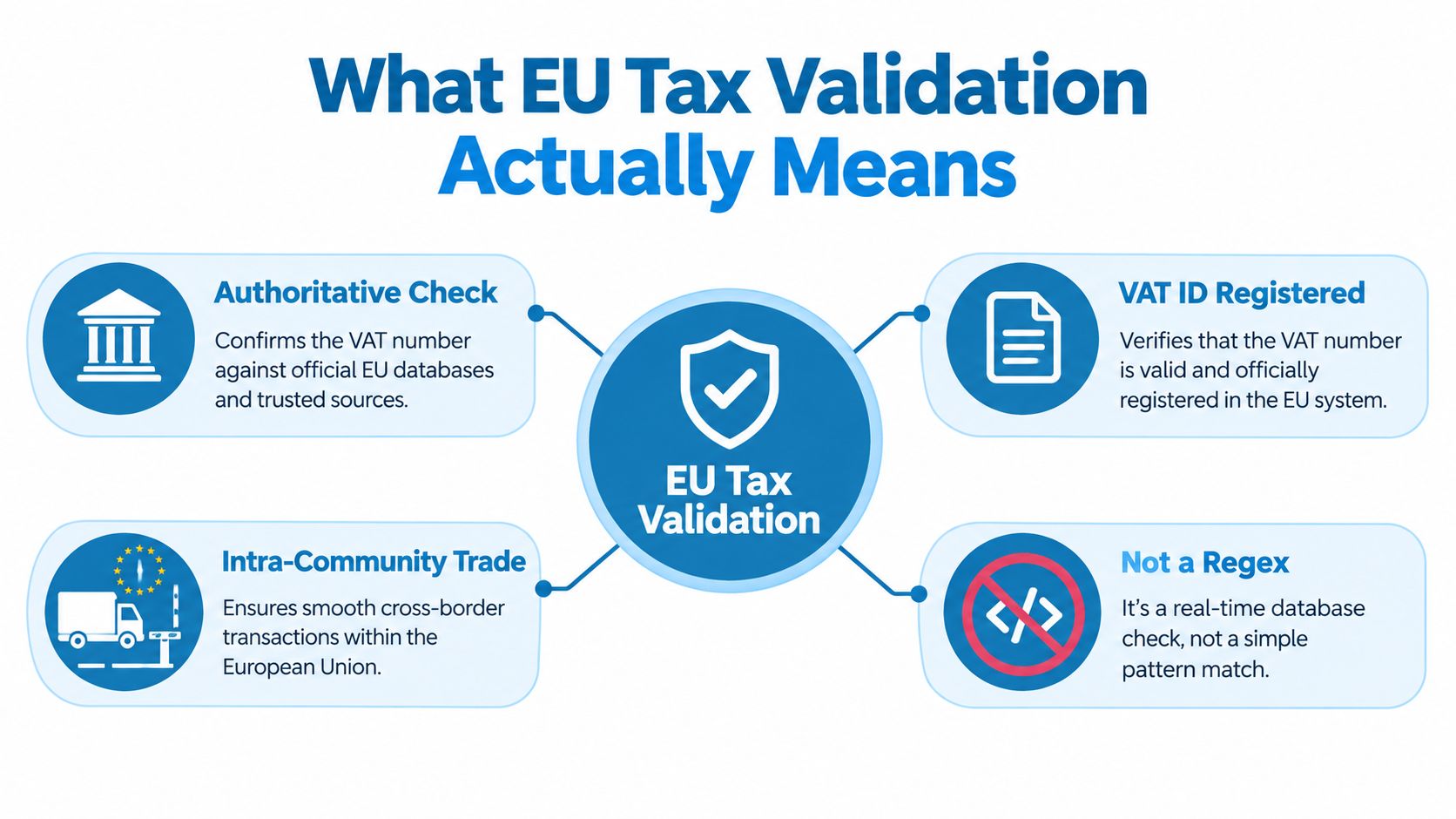
In this context, EU tax validation means checking whether a VAT identification number is registered for intra-Community transactions. It isn't just confirming that the input contains a plausible country prefix and sequence of characters.
The framework developed alongside the Single Market, which took effect on 1 January 1993. After internal fiscal customs controls were abolished, national tax administrations maintained electronic registration databases containing VAT identifiers, business names, and addresses, while VIES enabled businesses to check cross-border registration status through a shared interface. The EU's description of the VIES framework explains that foundation.
The distinctions below are useful when designing the data model.
Separate the checks your application performs
| Check | Question it answers | What it doesn't establish |
|---|---|---|
| Format validation | Is this identifier structurally plausible? | Whether it's registered |
| Database validation | Does the authoritative lookup recognize it for intra-Community transactions? | Whether the buyer represents that business |
| Transaction evidence | Do the facts support the proposed tax treatment? | Whether every customer statement is accurate |
| Identity matching | Does the buyer's information correspond to the registered entity? | Whether the supply itself qualifies |
Treat these as separate controls, not interchangeable confidence levels. A format check is useful before a remote request, but it cannot substitute for one. Equally, a recognized registration doesn't establish all the facts needed for an exemption or reverse-charge decision.
Registration supports a decision, not an automatic exemption
Under the framework, qualifying cross-border goods transactions can generally be exempt in the departure Member State when the taxable customer accounts for VAT in the destination Member State. Don't flatten that mechanism and every service transaction into the same unconditional rule.
For a SaaS billing implementation, the sound architectural choice is to let a tax-policy component evaluate the relevant supply, seller, customer, and location information. Validation contributes evidence to that evaluation.
A useful naming convention makes the distinction visible. Prefer fields such as registration_status, identity_review_status, and tax_treatment over a single verified flag.
That extra specificity pays off when someone asks why an invoice received its treatment. You can answer with the evidence and the applied policy rather than pointing to an unexplained green checkmark.
How VIES Works Under the Hood
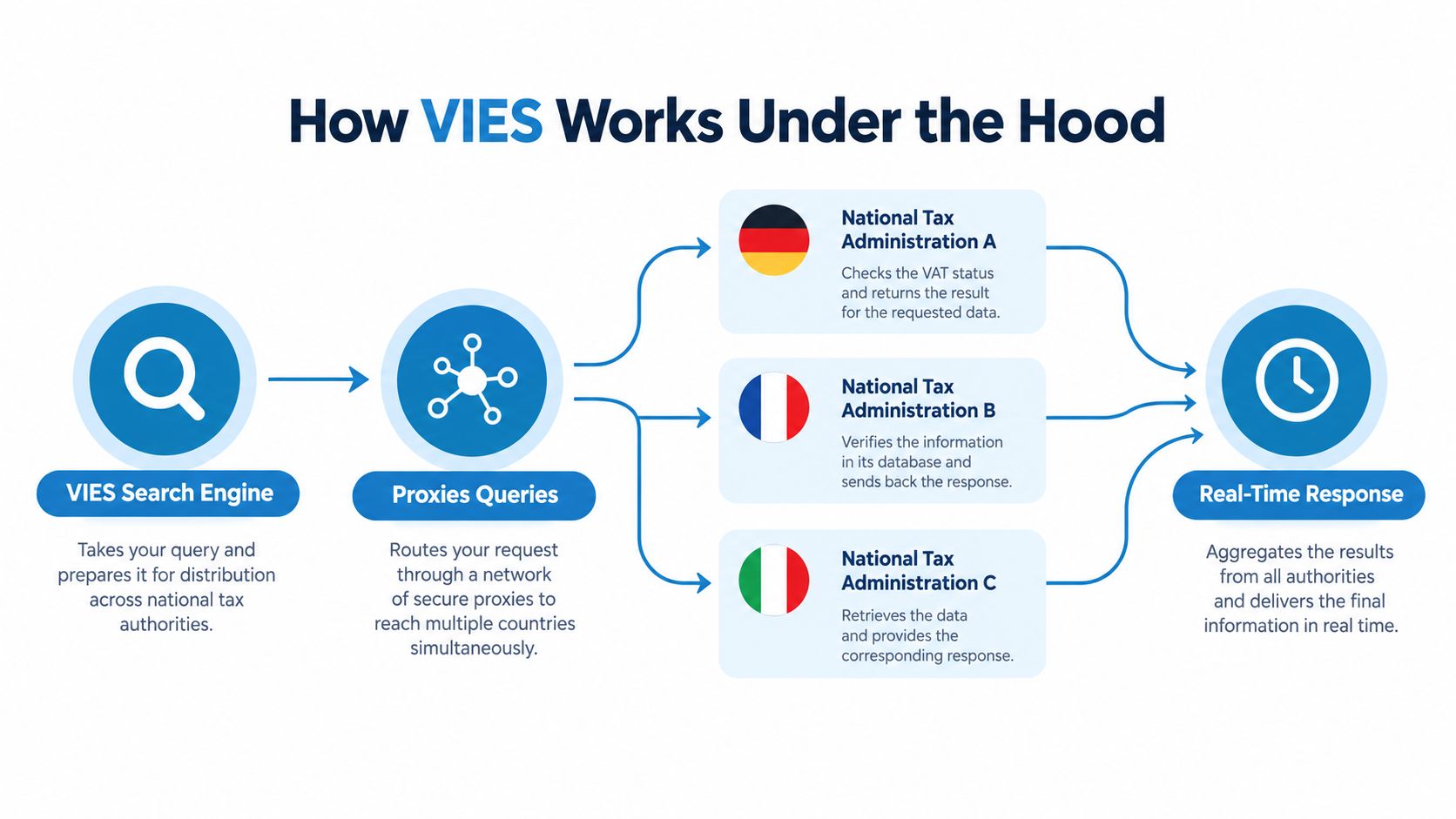
VIES is a search engine, not a centralized VAT-registration database. It retrieves information from national tax databases when a request is made. Your integration therefore depends on the shared service and the relevant national administration being able to answer.
The official interface requires a two-letter uppercase country code and a VAT-number field of 2–12 characters, accepting digits, letters, plus, asterisk, and period. The Commission's documentation also enumerates failures including INVALID_INPUT, SERVICE_UNAVAILABLE, MS_UNAVAILABLE, TIMEOUT, and global or Member State concurrency limits. Those constraints and service distinctions are described in the European Commission's VIES guidance.
The request path explains why your error model matters.
Keep SOAP at the boundary
At the wire level, your SOAP request wraps the validation operation inside an envelope and body. The operation receives the country code separately from the national identifier.
Normalize input before constructing that payload. Preserve the original customer submission separately, remove an explicitly recognized country prefix from the identifier field, and apply country-aware checks rather than deleting arbitrary characters until something passes.
Your application-facing adapter should return a domain result, not a SOAP response object. Otherwise, upstream field names and fault handling spread into checkout controllers, billing jobs, and support tooling.
Model these outcomes explicitly:
- Valid: The authoritative lookup returned a positive registration result.
- Invalid: The lookup completed and returned a negative result.
- Indeterminate: The system couldn't establish registration status because validation didn't complete reliably.
Keep the detailed error alongside that classification. MS_UNAVAILABLE and malformed input require different operational responses even when neither produces a positive validation.
Test behavior, not just successful parsing
Build adapter tests around captured or deliberately constructed response fixtures. Include positive and negative responses, SOAP faults, malformed payloads, slow responses, and concurrency-related failures.
For broader integration-test design, GoReplay best practices for testing is a useful companion when planning representative request coverage. Keep sensitive billing data out of shared fixtures and avoid making your ordinary test suite depend on live government-service availability.
A particularly valuable assertion is that an upstream timeout never reaches the UI as "your VAT number is invalid." Another is that an unavailable validation cannot take the same branch as an approved tax decision.
Bound remote-call time, preserve the failure category, and let the caller choose the next workflow step. That's a cleaner contract than returning false and asking every downstream developer to guess what happened.
Real Workflows for SaaS Billing and B2B Invoicing
The validation call is a small part of the billing workflow. The harder work is linking the result to the customer record and the transaction that relied on it.
A billing interface needs to expose both the customer's entered details and the validation state.

Checkout and recurring invoices
At signup, collect the identifier and relevant business details before committing the invoice's tax treatment. For implementation terminology, the reverse-charge VAT glossary provides a useful reference, but your application still needs an approved transaction policy.
A raw VIES operation has this shape inside the SOAP body. This is an illustrative fragment with placeholders, not an executable request:
<checkVat><countryCode>{country}</countryCode><vatNumber>{national_identifier}</vatNumber></checkVat>
A normalized application result might look like this. These are proposed fields, not a provider's documented response schema:
{ status: "valid", country: input.country, checked_at: clock.now(), legal_name: upstream.name, address: upstream.address, source: "VIES" }
For recurring billing, associate each finalized invoice with the evidence used. Don't let a later customer-profile update rewrite the historical explanation for an earlier invoice.
Marketplace carts and supplier payments
A marketplace should evaluate the transaction context before applying B2B treatment. A cart-level success indicator shouldn't automatically approve every supply or seller arrangement represented in that cart.
Supplier screening has a different purpose. Compare the returned registration details with the supplier record and invoice, then route unexplained differences to finance rather than treating the lookup as payment authorization.
The financial context is substantial: the Commission's 2022 estimate put the EU VAT compliance gap at EUR 89.3 billion, or 7% of VAT Total Tax Liability, with a median Member State gap of 6%, according to the VAT compliance-gap publication. That gap includes more than fraud, and identifier validation alone cannot close it.
The following video can accompany an implementation review.
Persist the evidence your decision used
Store a validation timestamp, internal request identifier, normalized VAT identifier, country, response status, and returned legal name and address when available. If the upstream response includes a reference identifier, preserve it separately from your own correlation ID.
Also record the associated customer, invoice, and policy version. Preserve missing fields as missing, not as invented business data or an inferred identity match.
Pitfalls That Catch Production Systems
The most dangerous bugs don't necessarily throw exceptions. Some produce a tidy success response that your application interprets too broadly.
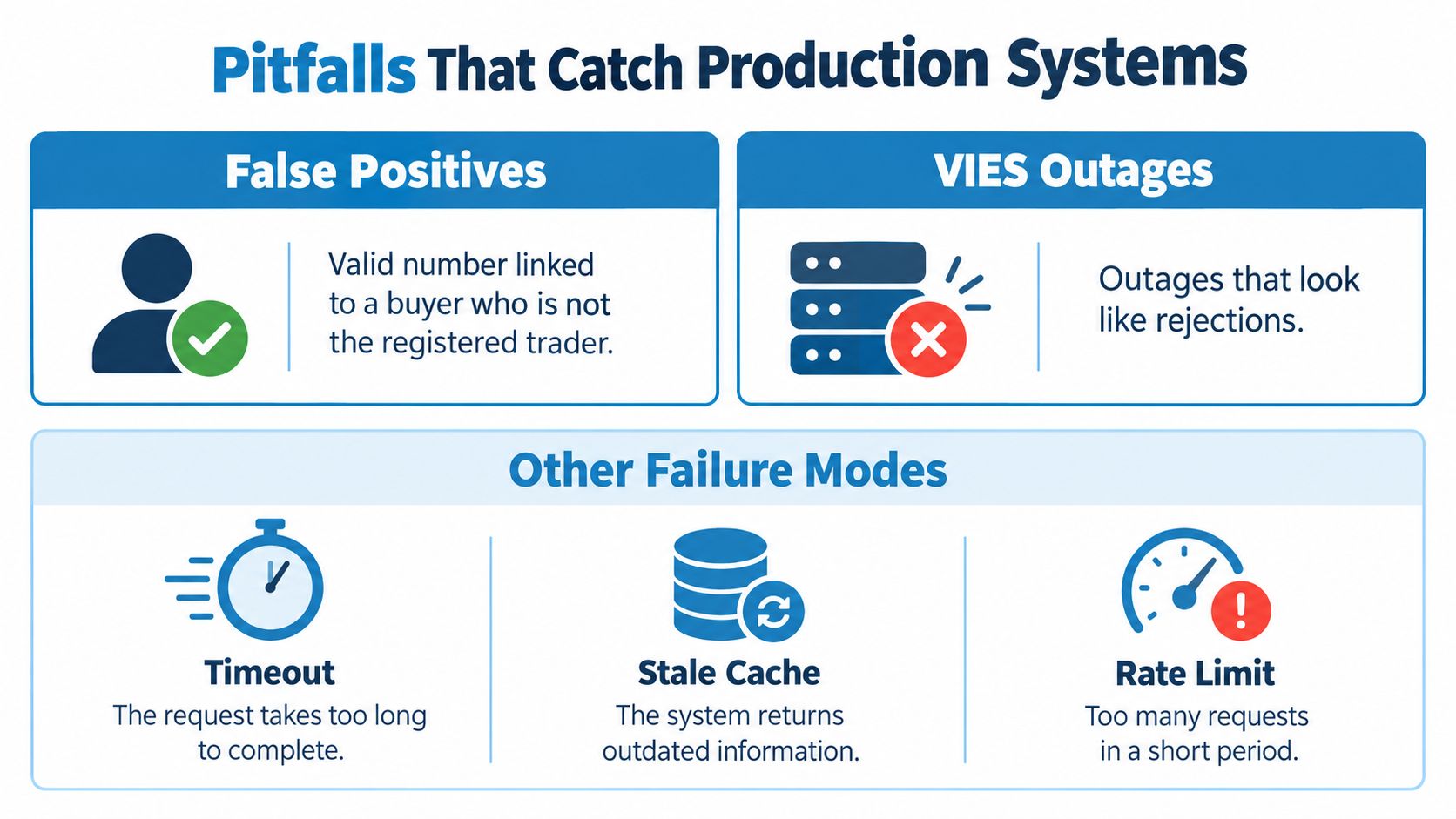
A valid registration can belong to a business other than the buyer. A cached result can be presented without its original observation time. A retry worker can update a customer record after the underlying VAT number has changed.
These are workflow failures, not merely API failures.
Match the remedy to the failure
- Borrowed registration details: Compare the registered entity with the buyer's information and investigate material inconsistencies. Code-shaped hint:
registration_valid && identity_unresolved => review. - Outage presented as rejection: Preserve the indeterminate outcome and show an accurate service message. Hint:
upstream_unavailable => pending_validation. - Stale evidence presented as fresh: Store
observed_atseparately fromserved_at. A cache hit must not reset the authoritative observation time. - Changed customer data: Bind asynchronous work to the identifier it validated. Hint:
result.input_hash === customer.current_input_hash. - Country-rule assumptions: Maintain explicit, versioned normalization rules. Don't assume every country selector value can be submitted unchanged as a VAT prefix.
The last point deserves restraint. Broad character stripping can transform a bad input into a different identifier, while a generic country-code conversion can conceal an unsupported mapping. Reject ambiguous transformations and ask the customer to clarify.
Design the recovery path deliberately
Retry transient failures with bounded backoff, but avoid replaying malformed requests unchanged. Queue deferred work with enough context to determine whether it still applies when a worker eventually runs.
The VIES downtime resilience guide is relevant when designing that recovery path. The application still needs its own rules for pending invoices, customer notifications, and escalation.
A cached positive result is historical evidence. It isn't proof that a fresh authoritative check succeeded during an outage.
Keep historical validation records separate from the current customer summary. The summary can change as new evidence arrives; the earlier record should continue to describe what your system observed.
Finally, make support tooling display the distinction between input failure, authoritative rejection, and upstream unavailability. Otherwise, a careful backend design can still end with support telling customers to “fix” a number the service never checked.
Where a Developer-First API Fits In
An in-house wrapper is reasonable when your team wants direct control over transport, storage, and operational behavior. It's less attractive when the wrapper becomes a miniature infrastructure product nobody has time to maintain.
The alternative is a managed REST adapter. Evaluate it on failure semantics, evidence quality, and cache transparency, not merely whether it removes XML from your code.
In-House VIES Wrapper vs TaxID API
The following comparison is a selection checklist, not a substitute for checking the provider's current contract. The REST integration guide is the appropriate starting point for evaluating the managed option.
| Capability | In-house wrapper | TaxID API |
|---|---|---|
| Application interface | Your team designs and maintains the adapter | REST interface for validation |
| Format checks | You maintain country-specific rules | Format checks are part of the managed approach |
| Result handling | You define the normalized domain model | Structured validation and company-data responses |
| Failure handling | You map SOAP faults and transport errors | Machine-readable error handling |
| Caching | You choose storage, expiry, and refresh behavior | Verify cache age and freshness behavior for your workflow |
| Evidence storage | You control the complete record | Persist the returned evidence in your own system |
| Operational ownership | Your team monitors the entire adapter | Provider operates the API; you retain billing-policy ownership |
What makes the managed option worthwhile
The wrapper earns its keep when it removes work your team would otherwise own: protocol handling, input prechecks, predictable error mapping, and operational visibility.
A Redis-backed cache can be useful in an in-house implementation, but choosing Redis doesn't answer the compliance questions. You still need an expiry policy, observation timestamps, and a distinction between cached evidence and a fresh lookup.
Likewise, application codes such as vat_invalid and service_unavailable are useful conventions only when their meanings are stable and documented. Test the mapping rather than assuming a Stripe-like naming style guarantees correct behavior.
Buying criterion: Pay for a clearer operational contract, not a promise that an upstream dependency can never fail.
Before integrating a provider, ask what happens on a cache miss during an outage, whether negative results are cached, and how response metadata exposes freshness. Check current pricing and free-tier terms directly instead of designing around remembered allowances.
A managed API can reduce your adapter workload. It cannot decide whether your transaction qualifies for a tax treatment, manufacture missing registration data, or replace your invoice evidence store.
Building a Validation Workflow That Lasts to 2030
Treat the validator as a replaceable component inside a durable tax-data workflow. Your application should retain normalized identifiers, evidence records, and invoice associations even if you later change providers or protocols.
The Council adopted the VAT in the Digital Age package on 11 March 2025. Cross-border digital reporting requirements are scheduled to affect intra-EU B2B transactions from 1 July 2030, with broader national-system alignment scheduled by 1 January 2035, according to the Commission's ViDA adoption update.
The European Parliament's description of the digital reporting framework outlines a future system in which cross-border B2B e-invoice data is automatically reported and shared between authorities. That makes clean identifiers and traceable transaction records a sensible engineering investment, without implying that today's validation response is itself a future reporting submission.
Keep evidence and reporting responsibilities separate
Store validation observations independently from invoice documents, then connect them through stable internal references. Version the normalization rules and decision policies so a later code change doesn't erase the explanation for an earlier outcome.
Avoid putting essential evidence only in application logs. Logs help diagnose requests; a structured evidence store supports retrieval by customer, identifier, invoice, and decision.
Production runbook checklist
- Prevalidate input: Apply explicit country-aware normalization before making remote calls.
- Classify outcomes: Keep authoritative rejection separate from unavailable or incomplete validation.
- Control retries: Bound transient retries and stop retrying unchanged invalid input.
- Expose freshness: Record cache expiry and the original authoritative observation time.
- Preserve evidence: Keep request references, returned entity details, status, and invoice associations.
- Revalidate deliberately: Define a recurring-billing policy with finance rather than relying indefinitely on signup data.
- Test recovery: Exercise deferred work, changed identifiers, and customer-facing outage messages.
- Prepare for reporting changes: Keep the evidence model extensible and review implementation requirements as official guidance develops.
TaxID offers a REST interface for VAT validation, giving your billing service a structured alternative to handling VIES SOAP directly. Visit TaxID to review the integration approach, then test how its response and failure handling fit your checkout, recurring invoices, and evidence-storage workflow.