You're usually not struggling with the HTTP call itself. You're struggling with what happens when a customer enters a VAT number during checkout, expects tax to drop off the invoice, and the upstream validation service picks that exact moment to wobble.
That's the part most articles skip. They show a clean request, a clean response, and none of the ugly parts: flaky country backends, SOAP envelopes you don't want in a Node.js service, inconsistent failures, and the product decision that matters most. Should you block checkout, or accept the order and validate later?
For integration using REST API in a SaaS billing flow, that decision matters more than the syntax. REST has stayed the dominant API style for years, with 86% of respondents in Postman's 2023 State of the API report using REST, following 89% the year before and 92% the year prior, while a later industry summary said the 2025 report showed 93% of API developer teams using REST (Postman State of the API). In practice, that means your stack already has the pieces you need: JSON parsing, HTTP middleware, observability, retries, and caching.
For VAT validation, the practical move isn't “just call VIES.” It's to put a REST-shaped reliability layer between your billing logic and a legacy dependency, then design your checkout around invalid, pending, and unavailable as separate states.
Table of Contents
- Why REST Wraps VAT Validation Better Than SOAP
- Authentication and Your First Validation Request
- SDK Integration with Node.js and Python
- Caching Behavior and Performance for Checkout Flows
- Error Handling and Embedding in Stripe Checkout and Billing
- Deployment Best Practices and Reliability Checklist
Why REST Wraps VAT Validation Better Than SOAP
At checkout, the failure mode is obvious. A German customer enters a VAT ID, your app tries to validate it against VIES, and the request hangs or comes back with a country-specific outage. If your billing logic assumes validation is always online, you either reject a legitimate sale or incorrectly grant an exemption.
That's why a REST wrapper is usually the sane choice. The EU Commission's VIES interface comes from a SOAP world. Most modern SaaS stacks don't want SOAP envelopes, XML parsing edge cases, or country-specific quirks leaking into their billing code. They want one endpoint, JSON in and JSON out, and errors that can be handled without brittle string matching.
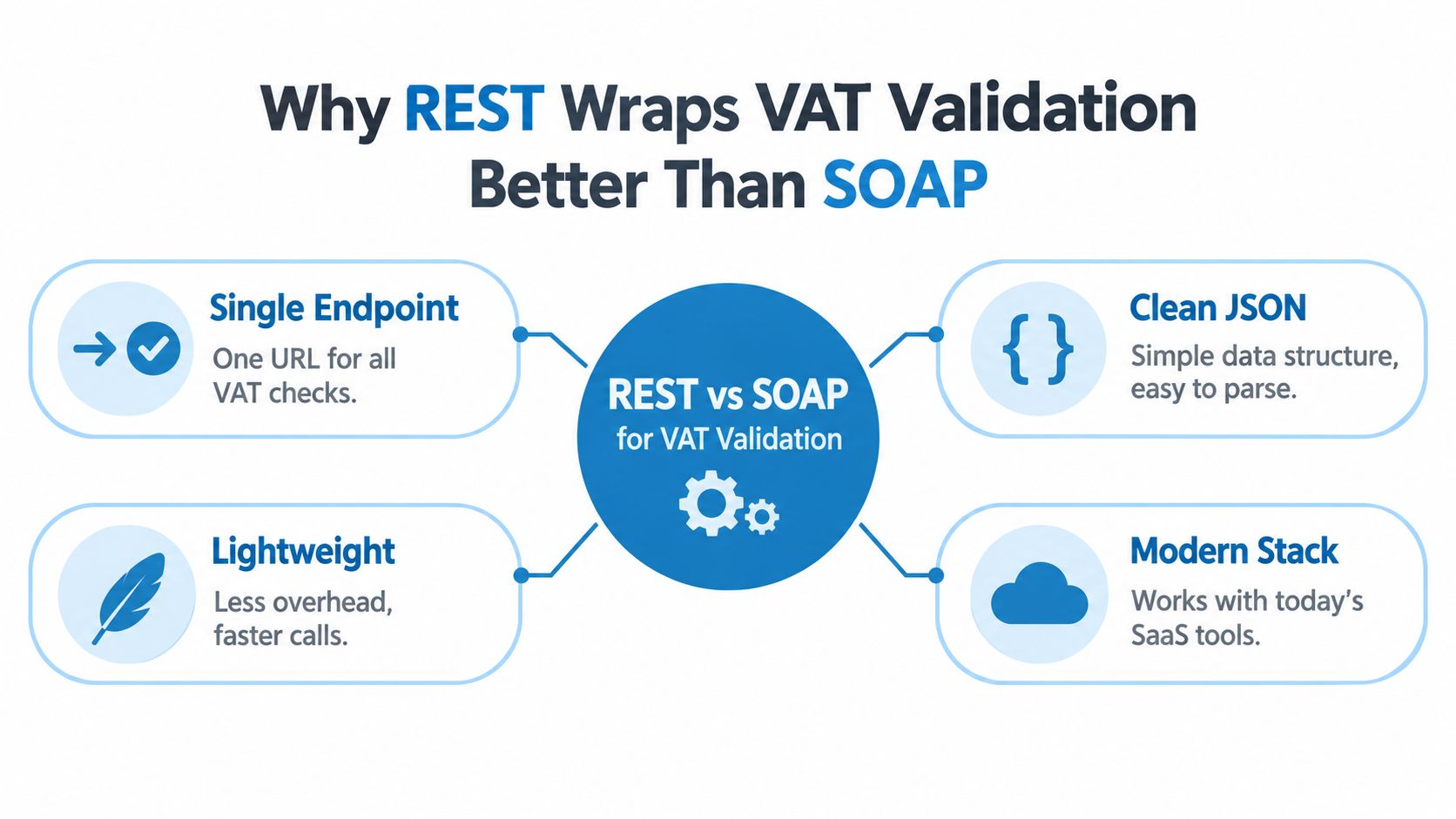
What changes in a modern billing stack
If you're already using Stripe, a Python worker, or a Node.js API layer, REST fits the machinery you already run. That matters because REST isn't niche. A 2026 industry summary projected the global API economy would grow from $8.3 billion in 2023 to $21.2 billion by 2028, a projected 18.7% CAGR, and another 2026 market snapshot estimated more than 100 billion API calls per day globally (API industry summary). VAT validation sits inside that same operational reality. Reliability, caching, and predictable contracts matter because these calls often happen in live product flows.
A practical wrapper also gives you cleaner output. Instead of exposing raw upstream behavior, it can return the fields your billing system cares about:
- Validation status for exemption logic
- Registered company name for invoice data
- Registered address for compliance records
One implementation pattern that fits this model is a single REST endpoint that validates tax IDs across 31 countries, including all 27 EU member states via VIES plus the UK, Switzerland, Norway, and Australia. That's the shape many teams want in production because it removes country routing logic from application code and keeps the contract stable. If you want a deeper walkthrough of VIES behavior itself, this VAT number VIES guide is useful background.
Why teams wrap instead of integrating raw VIES
SOAP itself isn't the only problem. The issue is that enterprise integrations often still depend on legacy mechanics that don't map neatly to modern app behavior. That gap between “REST integration” and “legacy dependency management” is where most production pain lives. One modernization analysis makes the point directly: wrappers become more valuable when availability is uneven and downstream systems need deterministic behavior. It also notes that outages can cluster around VAT filing deadlines, when finance teams batch-validate numbers and the underlying service is least convenient to trust directly (API integration modernization).
Practical rule: if checkout, invoicing, and audit logs need predictable outcomes, don't let a legacy SOAP dependency define your product behavior.
For broad architecture context, this overview of API connectivity is a decent companion read because it frames the integration problem as a systems problem, not just an endpoint problem.
Authentication and Your First Validation Request
The quick start should feel boring. That's a good sign. VAT validation becomes expensive when every call turns into a special case.
A straightforward REST integration usually starts with an API key in the Authorization header, a JSON response, and one validation endpoint. That's the main ergonomic win over SOAP. Your app makes a normal HTTPS request and gets back a payload your existing backend can consume without adapter code.
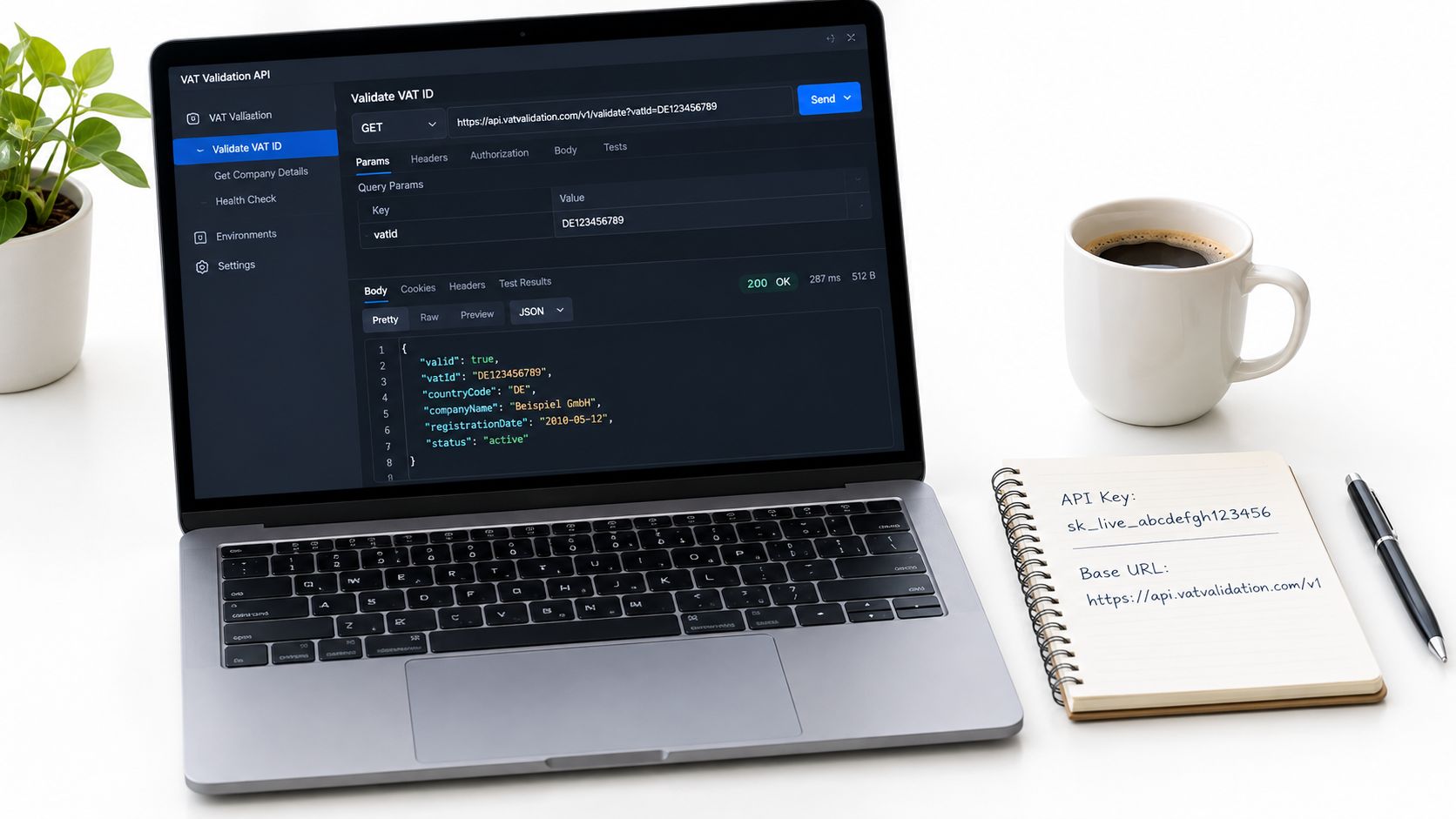
Start with local format checks
Before you make any remote call, check the VAT number format locally. That saves pointless roundtrips and helps you separate obvious user input errors from upstream availability issues.
A good request path looks like this:
- User enters country and VAT ID.
- Your frontend normalizes whitespace and casing.
- Your backend validates country-specific format rules locally.
- Only then does it call the remote validation endpoint.
That split matters because remote failures shouldn't be used as a proxy for malformed input.
Here's a simple curl example using a path-based validation endpoint:
curl -X GET "https://api.example.com/api/v1/validate/DE/123456789" \
  -H "Authorization: Bearer YOUR_API_KEY" \
  -H "Accept: application/json"
A JSON response in a developer-friendly contract should look something like this:
{
  "valid": true,
  "country": "DE",
  "vat_number": "123456789",
  "company_name": "Example GmbH",
  "company_address": "Berlin, Germany"
}
If you want a concrete implementation walkthrough in JavaScript, this VAT API Node.js quickstart is the right kind of reference because it stays close to actual app code rather than abstract API theory.
What to expect from the first successful response
For billing, the response only needs to answer three questions:
- Is the ID valid
- What legal entity name should go on the invoice
- What address record came back from the authority or upstream source
Everything else is secondary.
The first time you test this flow, verify behavior in three buckets:
| Scenario | What your app should do |
|---|---|
| Valid VAT ID | Mark customer as validation passed and store returned company details |
| Bad format | Fail fast locally and ask the user to correct the input |
| Upstream unavailable | Keep the result separate from “invalid” and decide whether to defer |
Teams get into trouble by collapsing the last two into the same branch.
After you've tested the raw request once, watch a live walkthrough before wiring it into checkout logic:
Don't let a timeout become a tax decision. A failed network call means you don't know yet. It does not mean the VAT ID is invalid.
SDK Integration with Node.js and Python
Raw HTTP is fine for proving the endpoint works. It's not how teams typically want to maintain billing code.
In production, I prefer a thin client layer that hides headers, normalizes errors, and returns a small typed object the rest of the app can trust. That keeps VAT validation from bleeding into every checkout handler and invoice worker.
Node.js and Python patterns that hold up
Here's the practical split I see most often:
| Criterion | Node.js Approach | Python Approach |
|---|---|---|
| Checkout API | Express, Fastify, or Next.js route validates during customer update | Django, Flask, or FastAPI endpoint validates before tax treatment is applied |
| Async model | async/await with a small service wrapper |
Sync or async depending on app style, usually behind a helper function |
| Best place to store result | Customer tax profile in your app database | Same, often alongside billing account metadata |
| Retry handling | Central HTTP client with bounded retry policy for transient failures | Session wrapper or shared client with explicit exception mapping |
| Best use case | Real-time validation during signup or cart review | Back-office invoice generation and periodic revalidation |
A minimal Node.js service wrapper might look like this:
async function validateVat(country, vatNumber, apiKey) {
  const res = await fetch(`https://api.example.com/api/v1/validate/${country}/${vatNumber}`, {
    method: 'GET',
    headers: {
      'Authorization': `Bearer ${apiKey}`,
      'Accept': 'application/json'
    }
  });

  const data = await res.json();

  if (!res.ok) {
    throw new Error(data.code || 'validation_failed');
  }

  return data;
}
And a Python equivalent stays just as small:
import requests

def validate_vat(country, vat_number, api_key):
    url = f"https://api.example.com/api/v1/validate/{country}/{vat_number}"
    headers = {
        "Authorization": f"Bearer {api_key}",
        "Accept": "application/json"
    }

    response = requests.get(url, headers=headers, timeout=3)
    data = response.json()

    if not response.ok:
        raise Exception(data.get("code", "validation_failed"))

    return data
Where to call validation in the app lifecycle
You don't need the same behavior everywhere. The call site should match the business risk.
- Signup form: Validate after the tax field loses focus, but don't treat that client-side response as authoritative on its own.
- Checkout confirmation: Use the backend result to decide whether tax exemption is applied now or deferred.
- Invoice generation: Recheck if the earlier result was pending or unavailable.
- Back-office cleanup: Revalidate records that were created during an upstream incident.
One platform in this space that fits this workflow is TaxID, which exposes a single REST endpoint, returns validation status plus company name and address in JSON, and offers a free tier of 100 monthly validations with no credit card for testing and early rollout. For teams comparing implementation options, its integration guides show how to place validation inside common billing flows without inheriting SOAP complexity.
Frontend and worker examples
A React checkout form usually validates on blur, but the actual tax decision belongs on the server. That gives you room to enforce timeouts, auth, and logging in one place.
A billing worker is different. It can tolerate delay, so it's the right place to retry pending validations and repair incomplete tax records before final invoice issuance.
If you're dealing with broader integration bottlenecks between systems, this piece on overcoming data silos and latency is worth reading because VAT validation often becomes just one part of a bigger data consistency problem across billing, CRM, and finance tools.
Caching Behavior and Performance for Checkout Flows
Checkout is where nice API design gets stress-tested. If the customer is waiting on a spinner, your architecture is already too chatty.
For VAT validation, caching changes the product decision. A fresh lookup may still depend on a flaky upstream service, but a recent known result doesn't need to. That's why a wrapper with Redis-backed 24-hour caching and sub-10ms responses for cached lookups is so useful in practice. It moves a lot of requests out of the danger zone entirely.
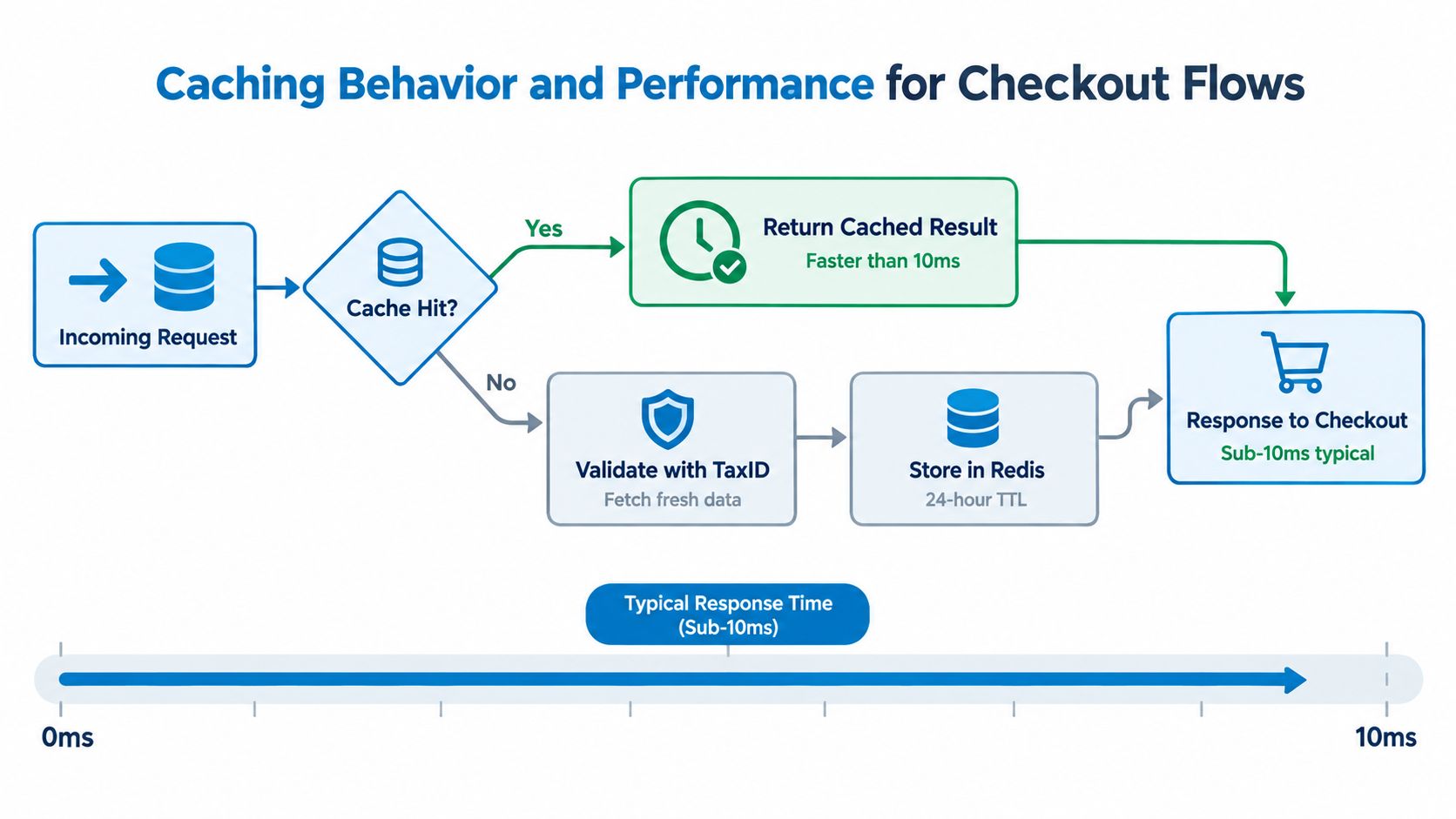
What to cache and what to log
The basic rule is simple. Cache successful validations for a bounded window, and treat the cached result as part of your reliability layer, not a shortcut around auditability.
What I log for each validation event:
- Lookup mode as cached or live
- Returned status as valid, invalid, pending, or unavailable
- Country and normalized tax ID in whatever redaction scheme your compliance policy allows
- Request timing so ops can spot latency spikes
- Invoice or checkout reference so finance can trace the decision later
That gives support and finance enough context to answer, “Why did this customer get reverse charge?” without recreating the request path from scattered logs.
Revalidation rules that don't annoy customers
A short-lived cache works well when the same business customer retries checkout, updates a subscription, or triggers invoice generation shortly after signup. It also helps with batch operations, where you don't want repeated identical checks hammering the upstream service.
Use a simple policy:
| Situation | Recommended behavior |
|---|---|
| Recent successful validation | Reuse cached result |
| New VAT number | Perform live validation |
| Prior unavailable result | Retry later, outside the checkout path |
| Compliance-sensitive document generation | Revalidate if your internal policy requires freshness |
Operational note: the cache is there to reduce customer-facing fragility. It is not a replacement for logging when the original validation occurred and whether it came from live data or cache.
The payoff is less about raw speed and more about fewer unnecessary dependencies inside the payment moment. In checkout, shaving off uncertainty usually matters more than squeezing another abstraction into the request path.
Error Handling and Embedding in Stripe Checkout and Billing
This is the part that separates a demo from a billing system.
In production REST integrations, you shouldn't optimize around “successful calls.” You should optimize around observable failure modes. A 2025 reliability study reported average API uptime fell from 99.66% to 99.46% year over year, which translated into 60% more downtime. It also found that APIs account for 67% of monitoring errors, while most incidents resolve in under 5 minutes MTTR (API failure modes and fixes). That's why strict timeouts, bounded retries, and clean state handling matter more than a happy-path response example.
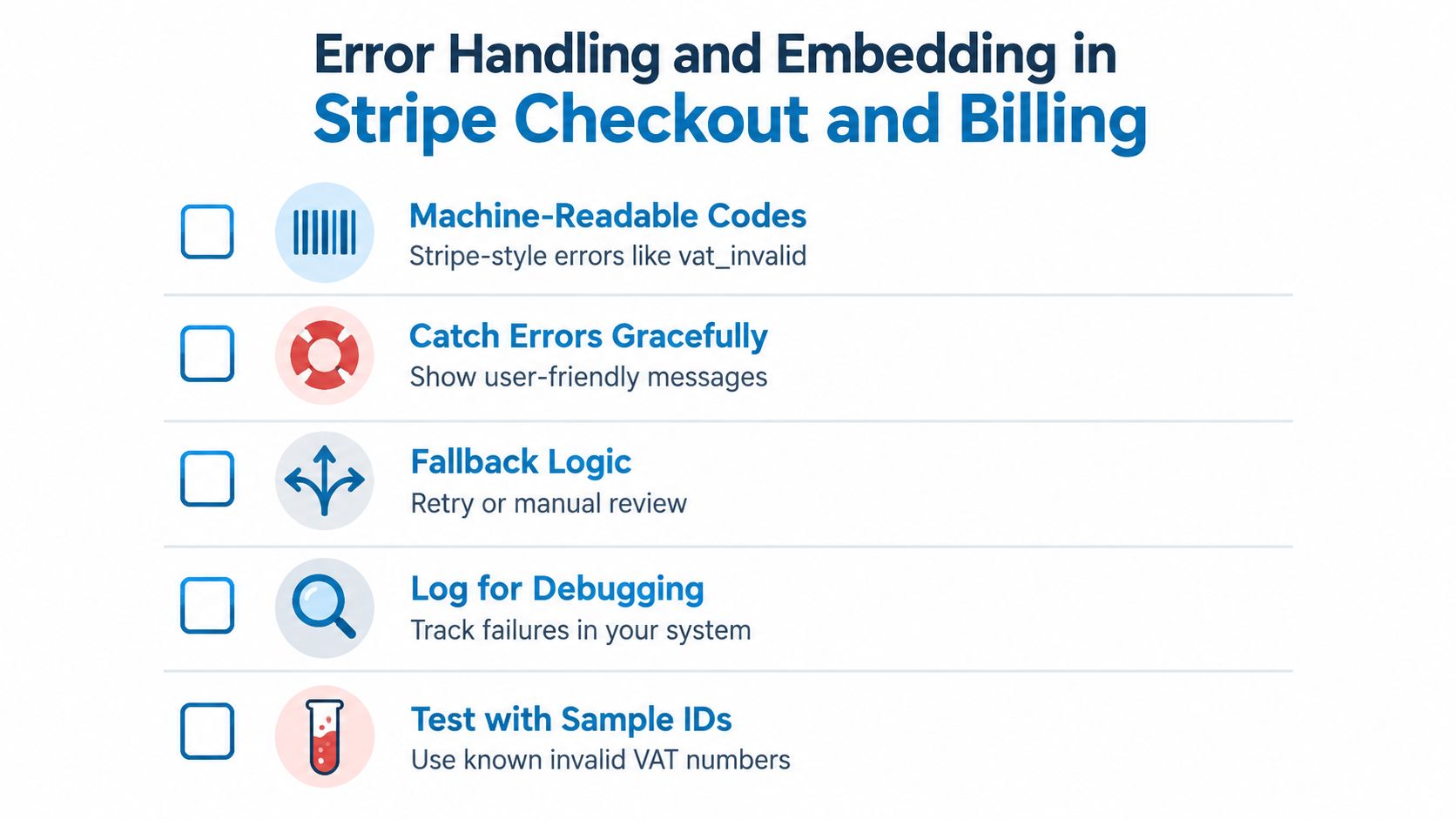
Use machine-readable states, not text parsing
For VAT validation in a Stripe billing flow, your app should distinguish at least these outcomes:
- Invalid means the format is wrong or the authority says the number doesn't validate.
- Pending means you don't have a final answer yet.
- Unavailable means the upstream service or gateway can't answer now.
That's why Stripe-style machine-readable codes are so much better than free-form text. If your integration returns codes like vat_invalid or service_unavailable, you can map them to deterministic product behavior.
A practical decision matrix looks like this:
| Validation result | Checkout action | Billing action |
|---|---|---|
| Valid | Apply exemption if your tax rules permit | Store evidence and use on invoice |
| Invalid | Don't grant exemption | Ask customer to correct tax details |
| Pending | Allow purchase, mark account for follow-up review | Delay exemption finalization until recheck |
| Unavailable | Usually allow checkout, avoid hard failure | Queue automatic revalidation |
When to block and when to defer
The mistake I see most often is blocking checkout on a live validation call every time. That feels compliant, but it creates a conversion problem without guaranteeing better records.
A better pattern is to tie the behavior to business risk:
- Block only when your product can't legally or operationally continue without an immediate determination.
- Defer when the core sale can proceed and you can correct tax treatment before final invoicing or through follow-up review.
- Never treat a transient upstream outage as proof the customer is wrong.
One analysis of REST integration challenges makes this point well. The hard parts at scale are authentication differences, rate limits, pagination mismatches, divergent error formats, and breaking API evolution. For VAT specifically, VIES acts as a gateway to national tax systems, so one member state can fail while others still work. The practical consequence is that systems should distinguish invalid, pending, and unavailable states instead of collapsing them into one generic error (REST API integration challenges and what breaks at scale).
If VIES is down for one country, your checkout doesn't need to pretend the customer entered a fake tax number. It needs to record uncertainty and recover cleanly.
Retry policy that won't make things worse
Retries should be narrow and intentional.
Use this pattern:
- Validate format locally first so you don't retry bad input.
- Set a strict client timeout because long waits are worse than fast uncertainty in checkout.
- Retry only transient failures such as gateway unavailability.
- Use bounded retries with exponential backoff and jitter so your app doesn't amplify an outage.
- Instrument latency, failure rate, and retry counts so ops can tell invalid data from upstream instability.
If you're embedding the result in Stripe-related workflows and want to think through adjacent operational tooling, this Stripe integration reference is useful as a systems view of what else touches the checkout path besides tax logic.
Deployment Best Practices and Reliability Checklist
A VAT validation integration is easy to ship and easy to operate badly.
The production question isn't whether your code can call an endpoint. It's whether billing still behaves predictably during upstream incidents, especially when finance is running batch validations and customers are still checking out.
When a wrapper is the right architecture
If the upstream service is uneven, exposes legacy behavior, or returns inconsistent failures, wrapping it is usually the better engineering choice. You want deterministic contracts downstream even when the upstream is anything but deterministic.
That matters even more around business-critical windows. Keep an eye on service health because outages can cluster around VAT filing deadlines, exactly when validation volume and finance sensitivity rise. In that situation, a resilient abstraction is worth more than a thin pass-through because your app needs stable product behavior, not faithful reproduction of a brittle dependency.
Reliability checklist for go-live
Use this as the minimum bar before you put VAT validation into checkout or invoice generation:
- Check format locally first: reject obvious bad input before any remote request.
- Keep API keys out of app code: store secrets in your normal environment and secret-management path.
- Set strict timeouts: don't let checkout wait indefinitely for a tax decision.
- Retry transient failures only: use bounded retries with backoff and jitter.
- Cache aggressively but transparently: reuse recent successful validations and log whether the result was cached or live.
- Separate invalid from unavailable: those states need different customer messaging and different compliance handling.
- Watch your status signals: alert on spikes in unavailability rather than waiting for support tickets.
- Revalidate after recovery: any pending or unavailable result should enter a recovery queue.
- Log enough for auditability: tie each validation outcome to a customer, invoice, or order event.
The strategic point is simple. For integration using REST API, success comes from treating VAT validation as an eventually consistent compliance workflow, not a single synchronous gate in front of revenue. When the upstream behaves, checkout stays clean. When it doesn't, your system still makes sensible decisions.
If you need that reliability layer without building and maintaining a SOAP wrapper yourself, TaxID provides a developer-first REST API for validating VAT and tax IDs across 31 countries, with machine-readable errors, caching, and responses shaped for billing flows. It fits the pattern in this guide: fast local format checks, predictable JSON, and a safer way to handle VIES quirks in checkout, invoicing, and revalidation jobs.