A request arrives at your Node.js API, then waits on a database query, a third-party SOAP service, or an expensive JSON transformation. The next request asks for the same result, but your application repeats the entire operation. Under load, that pattern turns a simple read into a queue of avoidable work.
Redis caching in Node.js gives repeated reads a faster path. Your application checks Redis first, returns a value on a hit, and calls the authoritative database or upstream service only after a miss. In a published HTTP caching evaluation, cache-hit latency reached 4.13 milliseconds on average, with a 14.59-millisecond 95th percentile in its strongest configuration, while miss latency remained tied to the origin path. These figures aren't universal benchmarks, but they show why a Redis hit can fit comfortably inside a latency-sensitive API request. The evaluation details its configurations and results.
The hard part isn't writing GET and SET. Production caching forces decisions about client choice, cache pattern, key design, freshness, invalidation, eviction, and failure behavior. A cache-aside layer can protect a slow tax-ID lookup, but a poorly designed key can mix tenants, a long TTL can serve stale compliance data, and an unbounded retry loop can make a Redis outage worse.
Table of Contents
- Why Redis Caching Matters in a Node.js App
- Connecting to Redis From Node.js
- Choosing Between ioredis and node-redis
- Implementing Cache-Aside and Write-Through Patterns
- Designing Cache Keys, TTLs, and Serialization
- Wiring Redis Into Express and Next.js
- Production Checklist and Failure Modes
Why Redis Caching Matters in a Node.js App
Redis helps when your Node.js API keeps reading the same data while the source changes less often than requests arrive. Product search results, feature flags, computed permissions, pricing metadata, and upstream validation responses fit that pattern. The application still owns the source of truth, while Redis holds a short-lived copy that cuts repeat work.
The default pattern is cache-aside.
- Build a stable key from the request.
- Check Redis.
- Return the cached value on a hit.
- Call the database or upstream API on a miss.
- Store the successful result with an expiration time.
- Return the result to the caller.
Redis's Node.js cache-aside guidance describes this flow. The TTL choice is a staleness-versus-hit-rate trade-off, covered in more detail below.
Practical rule: Treat Redis as an acceleration layer, not as the authority. If deleting the cache would make your service lose essential business data, that data belongs somewhere else.
Redis also plays different roles depending on the problem. A session store keeps user state your app expects to read back consistently. A queue coordinates asynchronous work. A cache is disposable by design. You can run all three on Redis, but each one needs separate keys, limits, monitoring, and failure assumptions.
For a SaaS billing flow, that distinction matters. A cached tax validation can avoid repeating an upstream lookup, but the final invoice still has to follow the service and business rules that define authoritative tax treatment. The overview of Redis cache benefits for API workloads is useful context when deciding which repeated reads deserve a cache.
Four choices decide whether the setup holds up under load:
- Client: Choose between
ioredisandnode-redisbased on topology and features, not habit. - Pattern: Use cache-aside for read-heavy access, and write-through when successful writes should warm the cache immediately.
- Keys: Include the tenant, resource, identifier, and representation or schema version where needed.
- Lifetime: Set TTL from tolerated staleness, not from an arbitrary round number.
The goal is not "Redis is fast." It is a controlled second path for repeated reads, with clear behavior for misses, stale values, outages, and invalidation.
Connecting to Redis From Node.js
Start with one shared client. Creating a Redis connection inside every Express handler or Next.js request creates unnecessary sockets and makes graceful shutdown harder. Install one library, configure the connection from environment variables, export the client from a module, and import that instance wherever the application needs cache access.
With ioredis, the setup is compact:
npm install ioredis
// redis.js
const Redis = require("ioredis");

const redis = new Redis({
  host: process.env.REDIS_HOST || "127.0.0.1",
  port: Number(process.env.REDIS_PORT || 6379),
  password: process.env.REDIS_PASSWORD || undefined,
  lazyConnect: true,
  enableOfflineQueue: false,
  maxRetriesPerRequest: 1,
});

redis.on("error", (error) => {
  console.error("Redis error", error);
});

async function connectRedis() {
  await redis.connect();
  console.log("Redis:", await redis.ping());
}

module.exports = { redis, connectRedis };
node-redis uses an explicit asynchronous connection:
npm install redis
// redis.js
const { createClient } = require("redis");

const redis = createClient({
  socket: {
    host: process.env.REDIS_HOST || "127.0.0.1",
    port: Number(process.env.REDIS_PORT || 6379),
    reconnectStrategy: (retries) => Math.min(retries * 100, 3000),
  },
  password: process.env.REDIS_PASSWORD || undefined,
});

redis.on("error", (error) => {
  console.error("Redis error", error);
});

async function connectRedis() {
  await redis.connect();
  console.log("Redis:", await redis.ping());
}

module.exports = { redis, connectRedis };
Call connectRedis() during application startup, then let your health checks distinguish “the process is alive” from “Redis is reachable.” During a network interruption, the client may reconnect, but your request code still needs a defined policy. A cache timeout should usually bypass Redis and continue to the authoritative path, provided that path can handle the additional load.
| Option | Why it matters |
|---|---|
host, port, and password |
Keeps deployment settings outside application code and makes environments explicit. |
| Connection timeout | Stops startup or reconnect attempts from hanging indefinitely. |
| Command timeout | Prevents a slow cache operation from holding a request open without a bound. |
| Retry limit | Avoids turning one failed command into a long request delay. |
| Error listener | Prevents connection errors from becoming invisible and unhandled. |
| Graceful shutdown | Closes sockets cleanly when the process receives SIGTERM. |
For shutdown, close the shared client once:
async function shutdown(signal) {
  console.log(`${signal} received`);
  try {
    if (redis.isOpen || redis.status === "ready") {
      await redis.quit();
    }
  } finally {
    process.exit(0);
  }
}

process.on("SIGTERM", () => shutdown("SIGTERM"));
process.on("SIGINT", () => shutdown("SIGINT"));
The exact readiness property differs between clients, so keep the shutdown adapter beside the client instead of scattering library-specific checks through route handlers. The important behavior is consistent: stop accepting work, finish what can finish, and release the shared connection.
Choosing Between ioredis and node-redis
Both clients can handle ordinary GET, SET, expiration, pipelines, and transactions. The decision becomes meaningful when your deployment uses clusters, Sentinel, high-volume batch work, TypeScript, or client-side caching.
| Concern | ioredis |
node-redis |
|---|---|---|
| Basic API | Mature, compact command-oriented API | Official client with a modern builder-style API |
| Cluster and Sentinel | Common default for applications that already use these topologies | Supports Redis deployment features, but verify the exact commands and topology behavior your version needs |
| TypeScript | Widely used and familiar in existing TypeScript services | Strong fit for teams that want official typings and a smaller dependency surface |
| Pipelining | Well suited to batch jobs and repeated command groups | Supports pipelining and transactions through its command API |
| RESP3 features | Possible, but feature usage can feel lower-level | Strong choice when RESP3 and client-side caching are central |
| Operational style | Familiar to teams with older Redis integrations | Attractive for a focused, official-client setup |
ioredis tends to be the practical choice for existing cluster or Sentinel deployments and for batch-heavy services where its pipeline ergonomics are already familiar. It also has a large installed base, which makes examples and operational fixes easy to find. That doesn't make it automatically faster. Serialization, network distance, command grouping, payload size, and Redis capacity usually matter more than the package name.
node-redis is a strong fit when you want the official Redis client, RESP3 support, and client-side caching. Its client-side cache can keep frequently read values in the Node.js process, but local memory must be bounded and invalidation must be tested across multiple application instances. Redis's Node.js prefetch and caching guidance specifically calls out bounded entries, explicit local TTLs, and the dangers of unlimited local memory or incorrect invalidation assumptions.
For high-throughput services, benchmark the complete request path. Use the production serialization format, network topology, connection pool behavior, payload sizes, and concurrency. A local benchmark that measures only a Redis command won't reveal the cost of JSON encoding, a remote network hop, an overloaded origin, or a stampede after expiration.
Decision heuristic: Choose
iorediswhen topology support and established pipeline behavior dominate; choosenode-rediswhen RESP3, client-side caching, and an official, focused API matter most.
Don't spend a week debating the clients before defining key ownership, TTL policy, and failure behavior. Those choices determine whether the cache is safe.
Implementing Cache-Aside and Write-Through Patterns
Assume an API validates a company tax ID against an upstream registry. The result is suitable for caching because repeated requests often ask about the same identifier, but the registry remains authoritative. A cache-aside wrapper keeps that dependency outside the request handler's main business logic.

const { redis } = require("./redis");

function validationKey(country, taxId) {
  const normalizedCountry = country.trim().toUpperCase();
  const normalizedTaxId = taxId.replace(/\s+/g, "").toUpperCase();
  return `tax:validation:${normalizedCountry}:${normalizedTaxId}:v1`;
}

async function getTaxValidation(country, taxId, fetchFromRegistry) {
  const key = validationKey(country, taxId);

  try {
    const cached = await redis.get(key);
    if (cached !== null) {
      return { ...JSON.parse(cached), source: "cache" };
    }
  } catch (error) {
    console.warn("Redis read failed", error);
  }

  const result = await fetchFromRegistry(country, taxId);

  try {
    await redis.set(key, JSON.stringify(result), "EX", 3600);
  } catch (error) {
    console.warn("Redis write failed", error);
  }

  return { ...result, source: "upstream" };
}
The wrapper deliberately treats Redis errors as cache errors, not validation errors. A timeout or connection failure bypasses the optimization and calls the upstream service. That fallback only works if the upstream path has its own timeout, rate protection, and error mapping.
A cache stampede appears when many requests miss the same key at once, often immediately after expiration. The basic wrapper allows every request to call the registry. A production version can add a short-lived lock, request coalescing in the process, or bounded stale serving. Use a lock only with an owner token and expiration, and make sure a stuck lock can't block future requests indefinitely.
Write-through changes where the cache is populated. The write path updates the authoritative system, then writes the resulting representation to Redis before returning:
async function updateTaxProfile(companyId, patch, saveToDatabase) {
  const saved = await saveToDatabase(companyId, patch);
  const key = `tax:company:${companyId}:v1`;

  try {
    await redis.set(key, JSON.stringify(saved), "EX", 3600);
  } catch (error) {
    console.warn("Redis warm write failed", error);
  }

  return saved;
}
This approach makes the next read warm after a successful update. It also adds a dependency to the write path. If the cache write fails, the database update has already succeeded, so the application needs a repair strategy, such as treating the cache as cold and allowing the next read to repopulate it.
Use cache-aside for read-heavy data and external responses where the application can tolerate a miss. Use write-through when your service controls the write operation and immediately warming the representation improves the next read. Neither pattern solves invalidation by itself. A write-through cache can still contain the wrong variant if the key omits a tenant, locale, permission scope, or schema version.
The video below reinforces the distinction visually, but the important implementation decision is the failure boundary: Redis should improve the request, not decide whether the authoritative write succeeded.
Designing Cache Keys, TTLs, and Serialization
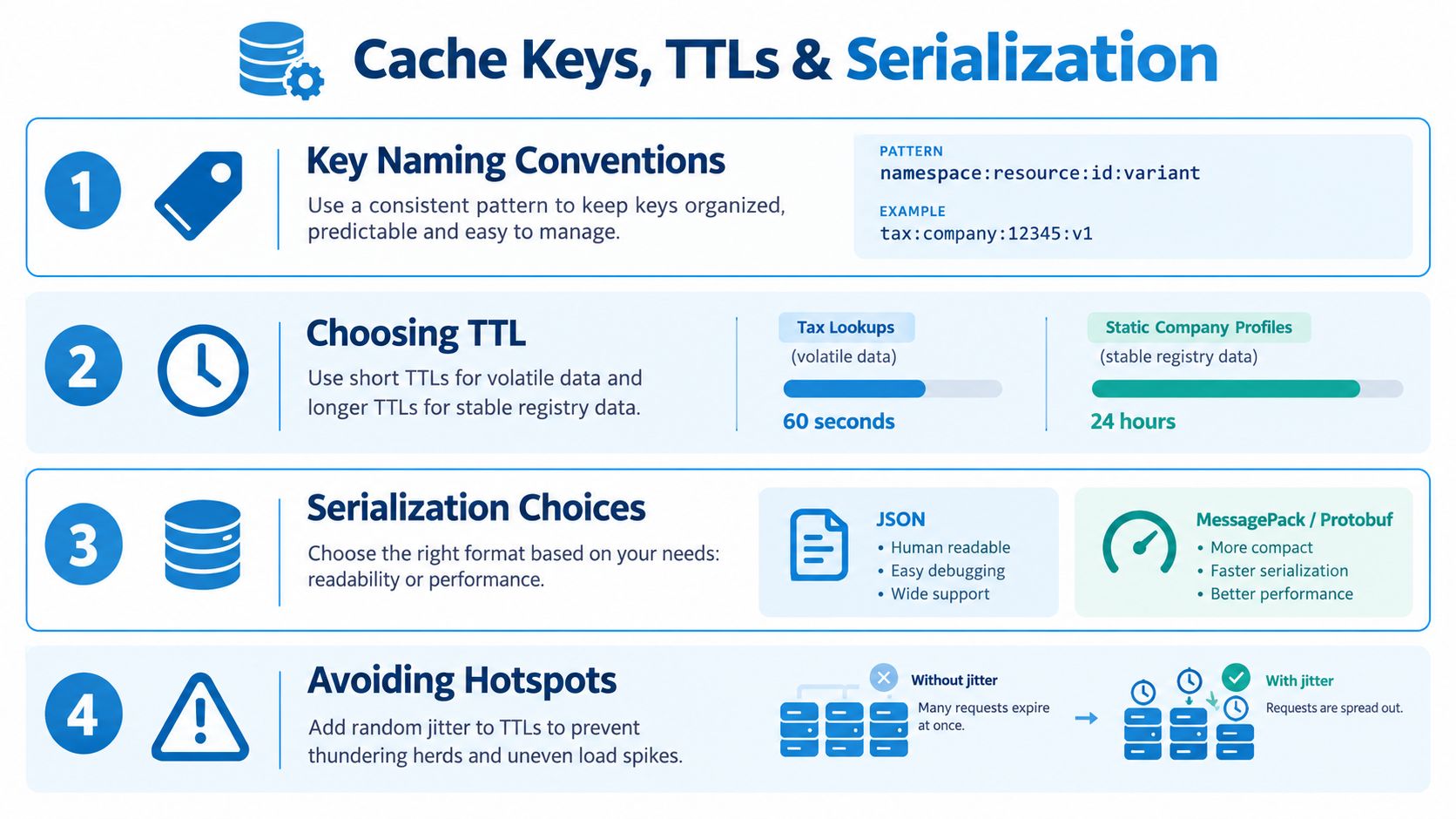
Most cache bugs start with a weak key. The key has to describe the full cached representation, not just the resource name. A practical pattern is:
namespace:resource:id:variant
For example:
billing:tax-validation:DE123456789:v1
Include the tenant or account boundary whenever two customers can request the same identifier. Normalize values before building the key, and keep query parameters in a stable order. If one request sends name=Acme&country=DE and another sends the reverse order, both should resolve to the same key when they represent the same lookup.
TTL should match how often the data changes. For tax-validation data, a longer window makes sense because registry status usually changes slowly. For billing prices or other fast-moving values, a shorter TTL keeps the cache closer to the source of truth, and the trade-off is more misses against fresher reads. The right choice depends on how much staleness the business can tolerate.
Serialization should match the payload
JSON is usually the right starting point. It is readable during incident response, supported natively by Node.js, and easy to inspect with Redis tooling. Compact binary formats such as MessagePack or Protocol Buffers make sense when payload size, serialization cost, or network transfer has become a measured bottleneck.
Keep the cached shape smaller than the source object if the consumer does not need everything. A narrower representation uses less memory and reduces parse work. If the schema changes, use a versioned key such as :v2 instead of assuming every reader can handle old values.
Invalidation needs an owner
TTL is a safety net, not a correctness policy. For mutable account, billing, or compliance data, delete or replace the relevant key after a successful authoritative write. For broad query caches, use a version namespace or a maintained index rather than scanning the whole keyspace during a request.
A VAT validation example might use:
- Key:
tax:validation:BE:0123456789:v1 - TTL: A freshness window chosen from the registry's behavior and the application's tolerance for stale status.
- Write behavior: Store only a normalized response, not the complete upstream envelope.
- Invalidation: Delete the key when an operator explicitly requires a fresh check, or bump the namespace version when the response schema changes.
Add TTL jitter when many related keys are created together. Small randomized differences reduce synchronized expiration and the burst of upstream requests that follows. For especially hot keys, combine jitter with request coalescing or bounded stale reads instead of relying on expiration alone.
Wiring Redis Into Express and Next.js
In Express, keep the handler focused on HTTP concerns and put cache behavior in a reusable function. The route should validate input, construct the upstream call, and map the result to a response.

const express = require("express");
const { getTaxValidation } = require("./tax-cache");

const app = express();

app.get("/api/tax/:country/:taxId", async (req, res, next) => {
  try {
    const { country, taxId } = req.params;

    const result = await getTaxValidation(
      country,
      taxId,
      (requestedCountry, requestedTaxId) =>
        validateWithRegistry(requestedCountry, requestedTaxId)
    );

    res.json(result);
  } catch (error) {
    next(error);
  }
});
Set an upstream timeout separately from the Redis timeout. Otherwise, a Redis miss can move the delay to the external service without giving the request a clear upper bound. Return a structured error when the authoritative service fails, and do not convert an unavailable validation into a valid result.
For a broader implementation example, this guide to Redis caching for a REST API shows how the same cache-first shape fits an API endpoint. The principle applies beyond tax data to any repeatable external lookup.
In a Next.js route handler, the code has the same shape:
// app/api/tax/[country]/[taxId]/route.js
import { NextResponse } from "next/server";
import { getTaxValidation } from "@/lib/tax-cache";

export async function GET(request, { params }) {
  try {
    const result = await getTaxValidation(
      params.country,
      params.taxId,
      validateWithRegistry
    );

    return NextResponse.json(result);
  } catch (error) {
    return NextResponse.json(
      { error: "validation_unavailable" },
      { status: 503 }
    );
  }
}
Keep the Redis client in a module such as lib/redis.js, not inside the route function. Long-lived Node.js processes reuse that module naturally. In serverless environments, module reuse can occur between invocations, but it isn't a guarantee, so the client must tolerate initialization races and connection reuse. Don't create a new client for every invocation if the runtime can reuse a warm process.
Server actions aren't a replacement for route handlers when external consumers need a stable HTTP contract. Keep cache keys and failure behavior in a server-only module, and never expose Redis credentials or administrative commands to browser code. For content-heavy Next.js pages, understanding how ISR improves digital experience delivery can also help you decide whether a framework-level revalidation layer belongs above your API cache. ISR and Redis solve different cache boundaries, so define which layer owns freshness before adding both.
Production Checklist and Failure Modes
A production-ready Redis integration defines failure behavior as clearly as its successful path. Set connection and command timeouts, then choose what a timeout does: bypass Redis, serve a bounded stale value, or fail fast when the request cannot safely continue. Miss traffic still needs origin capacity planning, because every expiration can produce a burst of full-latency requests.
Benchmark the complete path, keep cached values compact, and prefer single commands where they fit. Use pipelining for grouped operations, but measure whether the added coordination improves the endpoint under realistic load. Bound client-side cache entries with maxEntries, and set a non-zero local TTL so stale values cannot outlive the intended freshness window. The prefetch guidance covers pipelining and client-side cache controls.
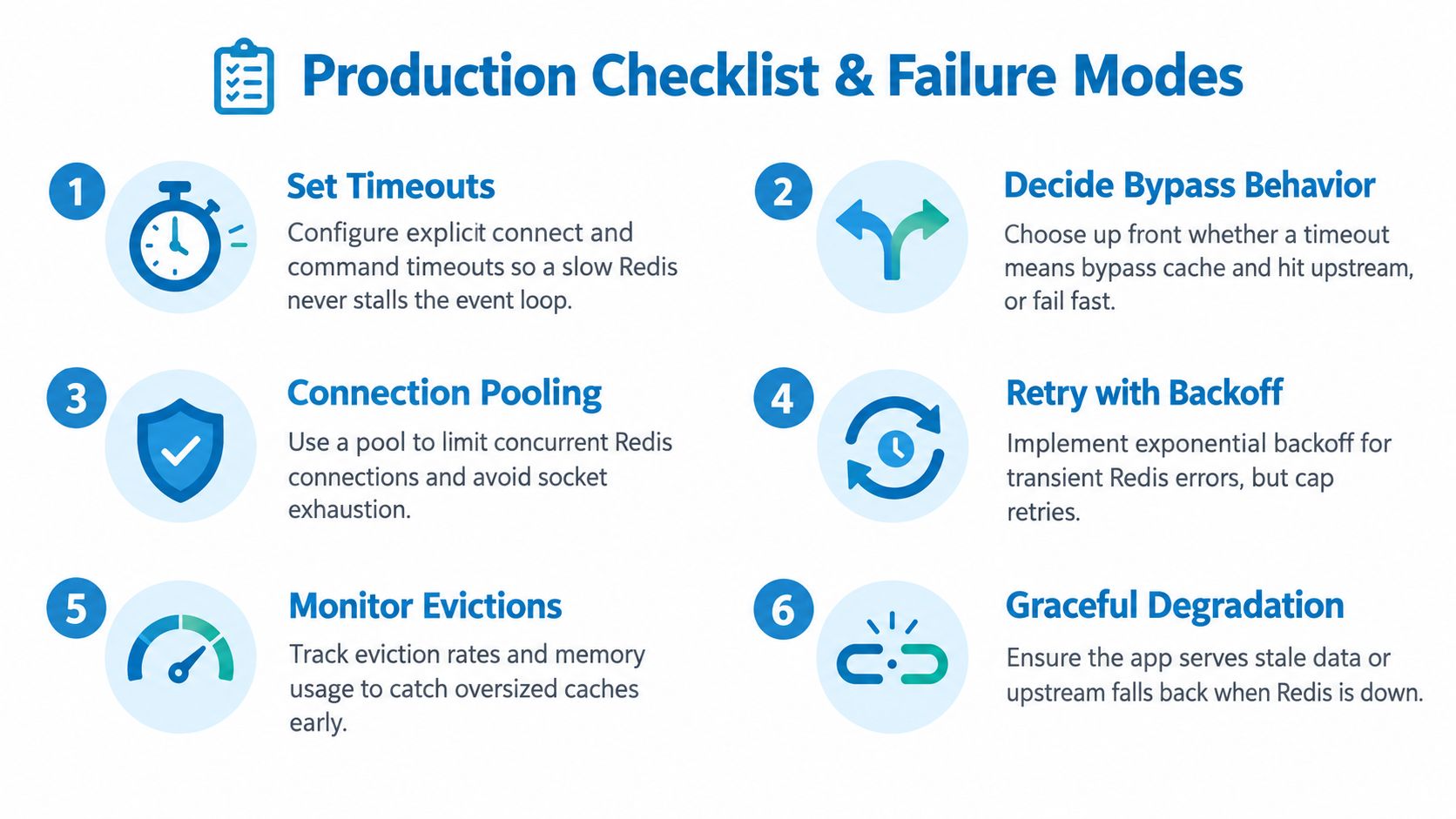
Use this checklist before enabling caching on a high-value endpoint:
- Set explicit timeouts: Redis must not stall the Node.js event loop or consume every request slot.
- Choose bypass behavior: Define whether a cache failure triggers an upstream call, a stale response, or an error.
- Configure memory and eviction: Set
maxmemoryand an eviction policy suited to disposable cached data. - Prevent stampedes: Use request coalescing, locks, stale serving, or TTL jitter for hot keys.
- Instrument the path: Track hit ratio, miss latency, cache P95 latency, errors, memory use, and evictions.
- Protect retries: Apply exponential backoff and circuit breaking so an outage does not create a retry storm.
Treat cache performance as an engineering reference, not a promise about your infrastructure. A cache improves the path only after a value exists, so model origin load during cold starts, expirations, and concentrated misses.
Redis should not be the only dependency for an operation that can safely use its authoritative source. Test cold starts, expired hot keys, partial outages, reconnects, evictions, malformed cached JSON, and a full cache restart. For reusable API-response caching, this Redis cache download guide provides additional implementation context.
TaxID provides a REST API for validating VAT and company identification numbers, returning normalized validation results for billing, checkout, and compliance workflows. A Node.js service can connect that validation call to the cache-aside pattern described above through TaxID.