REST API response codes best practices come down to one habit: let the HTTP status code tell the client what happened before it ever touches the response body. Get this right and integrations behave predictably — which matters most in checkout, billing, and validation workflows where a wrong guess costs money.
Table of Contents
- Build Predictable REST API Response Contracts
- Pick a Versioning Model and Commit to It
- Roll Out Changes Without Scaring Anyone
Build Predictable REST API Response Contracts
The status code is your API's first sentence. An SDK, a monitoring tool, a proxy, or a retry loop should classify the outcome instantly: success, client-side fix needed, redirect, or temporary server failure. Bury an error inside a 200 OK and every consumer now has to parse JSON just to learn what went wrong. That logic is brittle, and it shatters the first time someone changes a payload shape.
Concrete cases help. A clean VAT validation returns 200 OK. Malformed input belongs under 400 Bad Request. And when your validation provider goes dark for an hour, 503 Service Unavailable tells clients to back off and try again later. Postman's REST API best practices argues the same point: clients should respond to outcomes through proper HTTP semantics instead of ad-hoc conventions.
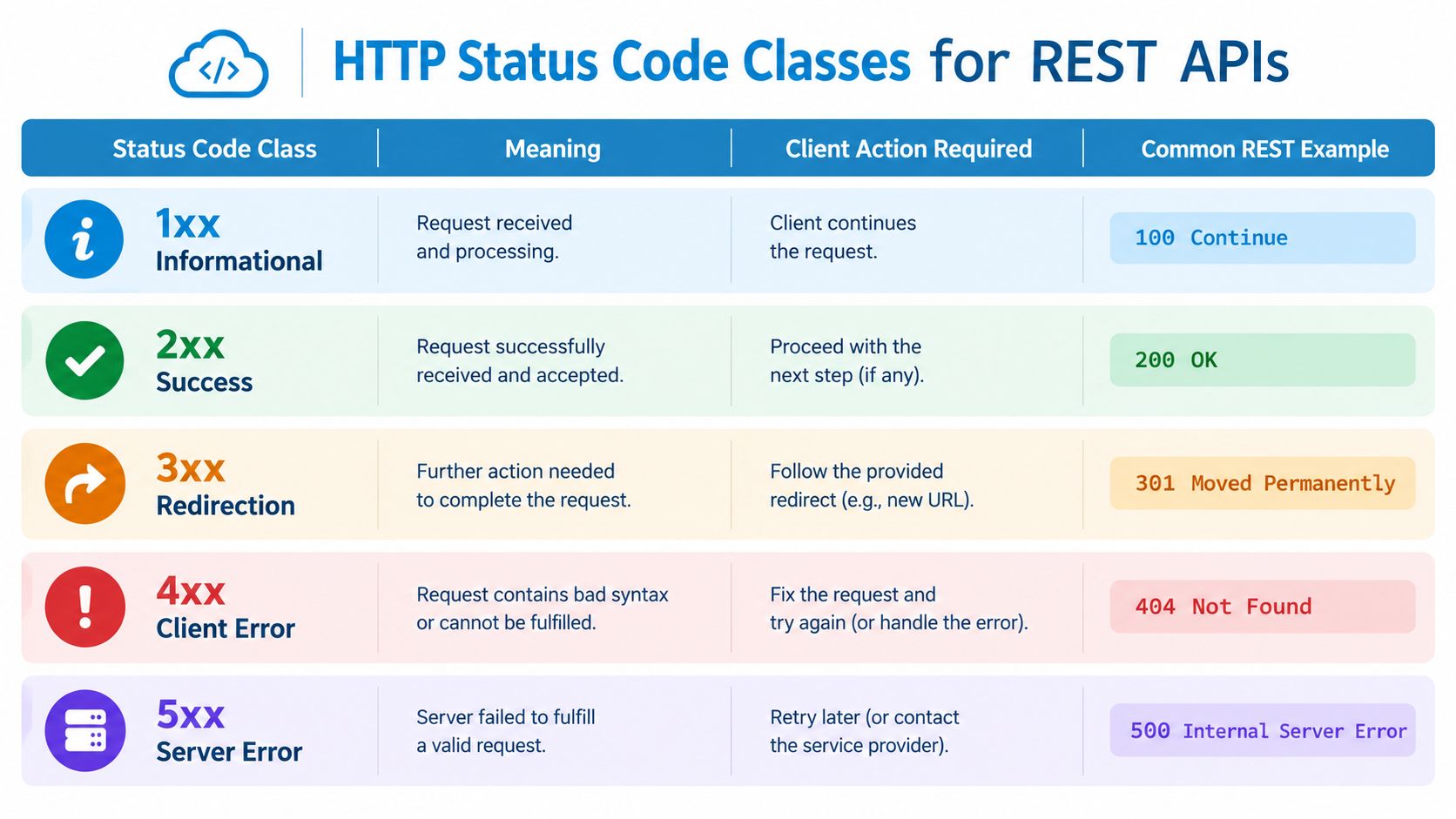
The chart above walks through the five status classes, what each one means, how a client should react, and the codes you'll actually meet in a REST API. The mental model is worth memorizing: the first digit sets the handling strategy, and the digits after it add precision.
Here is the same information in table form — handy to keep open during design reviews.
HTTP Status Code Classes for REST APIs
| Status Class | Meaning | Client Action Required | Common REST Example |
|---|---|---|---|
| 1xx | Processing information | Continue or wait | 100 Continue |
| 2xx | Successful request | Use the returned result | 200 OK, 201 Created |
| 3xx | Resource moved or unchanged | Follow the redirect or serve from cache | 301 Moved Permanently, 304 Not Modified |
| 4xx | Client request problem | Fix input, authentication, or permissions | 400 Bad Request, 401 Unauthorized |
| 5xx | Server or upstream failure | Retry selectively, with backoff | 503 Service Unavailable |
When a new endpoint lands in review, ask which row it belongs to. If the answer takes more than a sentence to explain, the design isn't finished yet.
Treat status codes as contract signals, not decorative labels.
Consistency matters as much as correctness. A few rules worth holding firm on:
- Pick one success pattern per operation type and never deviate from it.
- Never mix
204 No Contentand200 OKwith an empty body for the same action — downstream teams will write exceptions for endpoints that should behave identically. - Document every code an endpoint can return, including the rare ones.
For a worked example of these conventions in production, read how TaxID integrations use REST APIs.
Want wider architecture context? AppLighter's backend API guide pairs nicely with these response-code principles, particularly for teams shipping mobile backends.

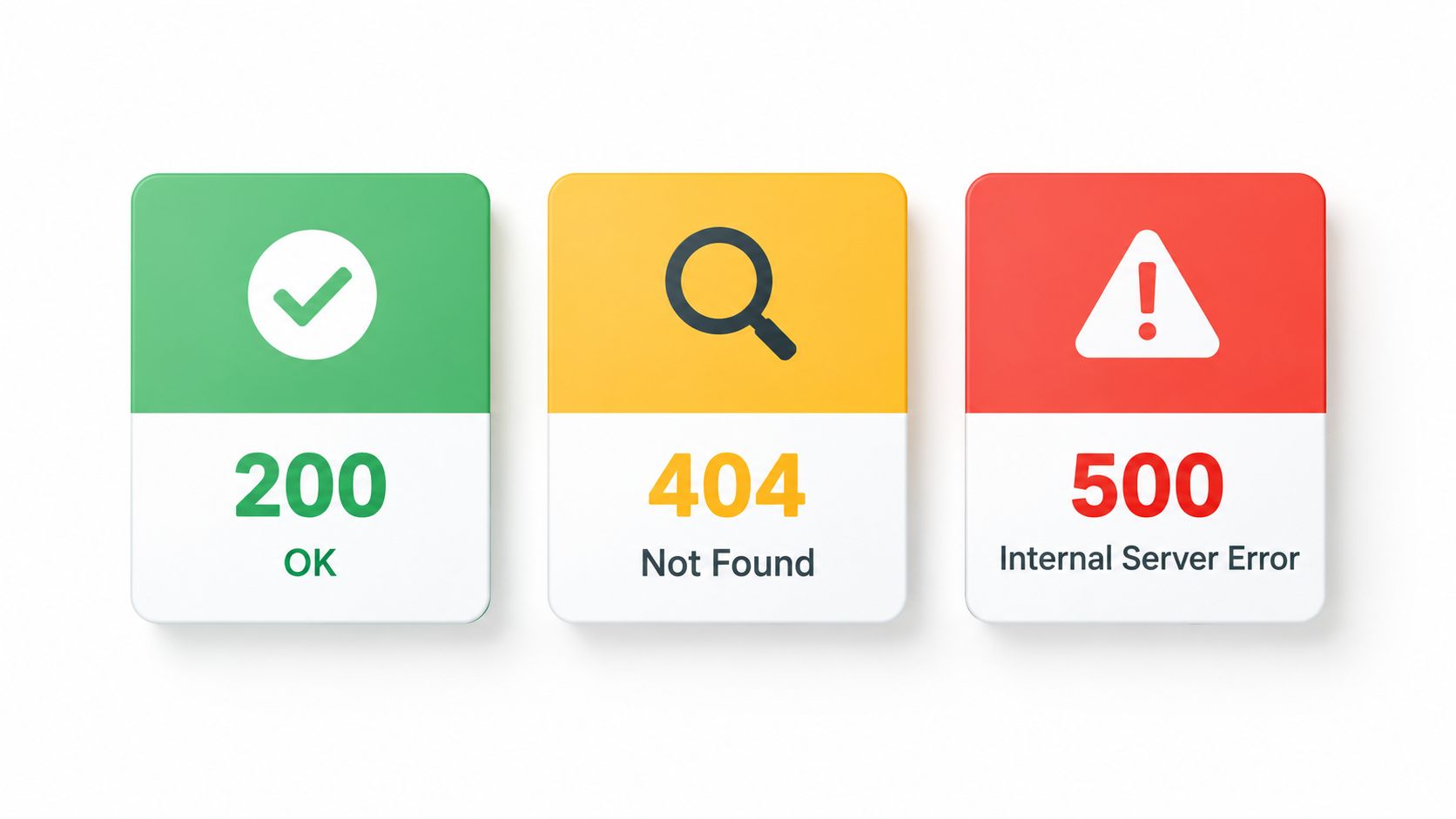
Good REST API response codes best practices start with one principle: return the status that actually describes what happened. Begin with a tight, consistent set — 200 OK, 404 Not Found, 500 Internal Server Error — and only add more precision when clients genuinely need to behave differently. Postman's API guidance backs this up: lean on HTTP semantics so consumers can react correctly without digging into the response body first.
A successful TaxID lookup returns 200 OK. A missing resource gets 404. An unexpected application failure produces 500. Creating a resource calls for 201 Created, and a successful operation with no body to return uses 204 No Content.
Match Codes to Client Actions
One of the most common mistakes is returning 200 OK for everything and burying failure details inside JSON. Monitoring tools log the request as successful, retry logic fires anyway, and checkout workflows keep chugging along when they shouldn't.
The status code should tell automated clients what to do next before they even look at the body.
Stick to a predictable policy across every endpoint:
400 Bad Request— the request is malformed: invalid JSON, broken syntax, or an unusable query parameter.401 Unauthorized— authentication is missing or invalid.403 Forbidden— the caller is authenticated but lacks permission.404 Not Found— the requested resource doesn't exist.500 Internal Server Error— something unexpected broke on the server side.503 Service Unavailable— a temporary dependency or capacity issue, safe for controlled retries.
The difference between 400 and 422 Unprocessable Entity trips people up, but it matters in validation-heavy APIs. Return 400 when a TaxID request can't be parsed or has structural problems. Use 422 when the JSON is syntactically valid but the value fails domain rules — like a correctly formatted VAT number that doesn't pass verification.
Keep Precision Consistent
Resist the urge to throw in every available status code just to look thorough. Each new response code creates documentation, testing, and support work that compounds over time.
Before you ship, nail down three things for each code:
- The exact outcome it represents.
- Whether clients should retry, fix their input, or stop entirely.
- A stable example for monitoring and integration tests.
For TaxID integrations specifically, consistent distinctions let billing systems apply reverse charge safely, surface actionable validation feedback, and avoid retrying errors that will never succeed. Teams mapping out broader conventions can dig into TaxID's REST API integration guide for a fuller picture.
An HTTP status code tells the client what happened. The response body should explain why, without forcing anyone to interpret prose. This two-layer approach sits at the heart of reliable REST API response codes best practices.
Resist the urge to return something like "VAT check failed" as your only signal. A developer will inevitably rewrite that text, translate it, or tweak the punctuation — and suddenly every client that does string matching breaks. Give them a stable machine-readable code instead, paired with a helpful human message.
Define a Stable Error Contract
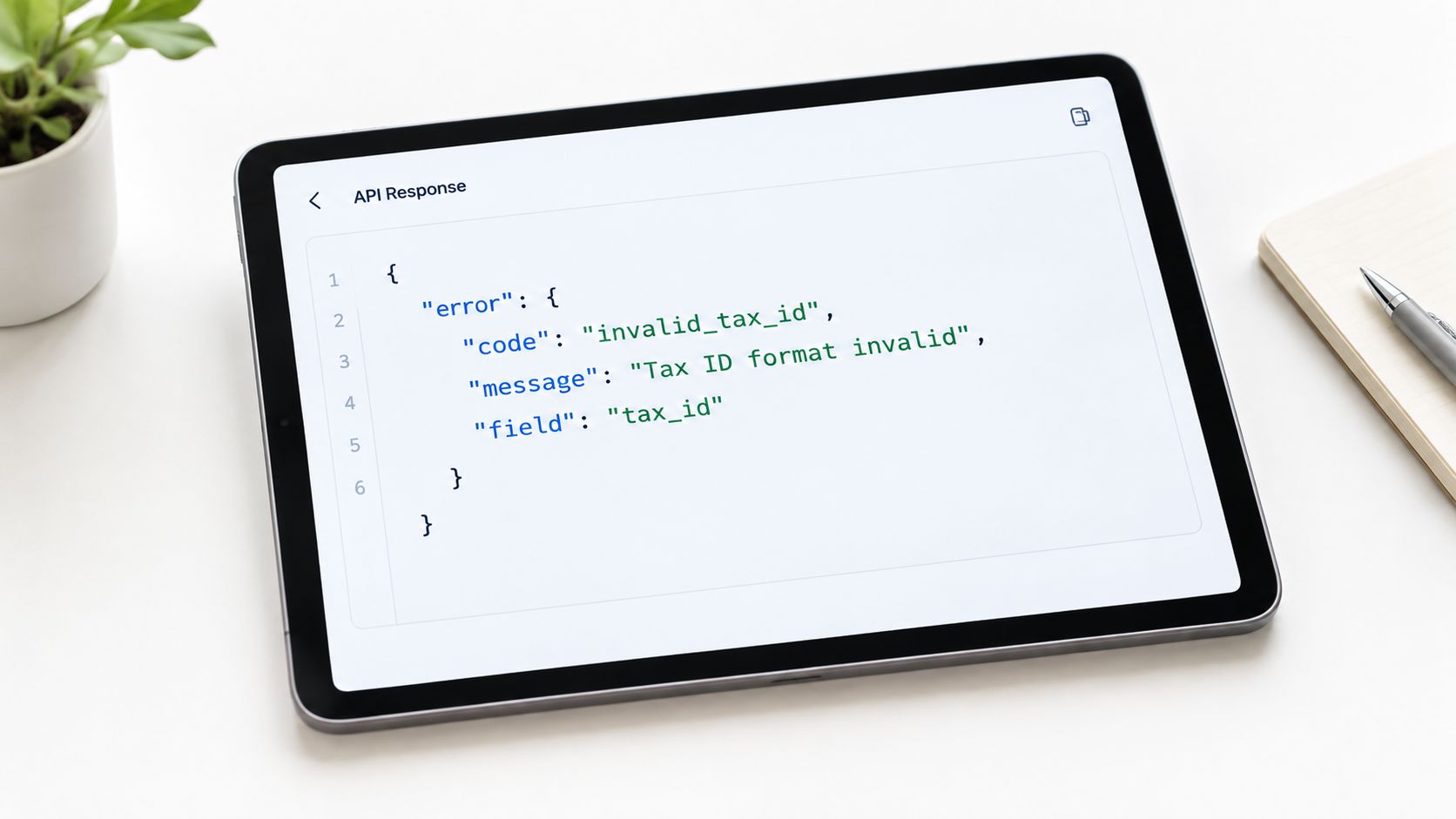
A well-designed error object should carry:
code— a permanent identifier likevat_invalidorservice_unavailablemessage— written for developers and support teamsfield— pinpoints the specific input that triggered the failure, such astax_iddetails— optional context, especially useful when multiple validations fail at oncerequest_id— invaluable for tracing production incidents without leaking internals
Picture this: a syntactically valid request that contains an invalid VAT number. Return 422 Unprocessable Entity with an error code of vat_invalid. A temporary outage at the verification provider? That's 503 Service Unavailable with service_unavailable, giving callers a clear signal they can retry selectively.
Parse stable codes, not human-readable messages.
Consistency matters enormously here. If one endpoint returns error.code and another returns failure.reason, every SDK and integration ends up with special handling scattered throughout. Pick a single structure and stick with it everywhere.
For validation-heavy workflows, return all known field errors in a single response. This lets a checkout form correct several values at once instead of playing whack-a-mole with one error per request.
TaxID follows this pattern with Stripe-style codes built for predictable integrations. Check out their VAT validation response design breakdown for a concrete example of this done well.
Separate Debugging From Public Output
Your messages should help developers diagnose staging failures, but production responses have no business revealing stack traces, database details, provider credentials, or internal hostnames. Include safe context, a request identifier, and documented remediation guidance instead.
Before you ship, test every status and payload combination you can think of — malformed JSON, invalid credentials, missing resources, domain validation failures, rate limits, upstream outages. Covering these upfront makes your contract dependable for both automated clients and the humans supporting them at 2 AM.
Caching and retries turn response codes into operational controls, not just documentation. Picture a high-volume VAT lookup firing during checkout. You return an ETag alongside the response, then honor If-None-Match on follow-up calls. When nothing has changed, a 304 Not Modified tells the client to reuse its cached copy without sending another payload.
That trick alone can bring cached lookups in at under 10 ms while dramatically cutting calls to the upstream verification service. For TaxID-style validation, Redis-backed caching with a 24-hour lifetime is a lifesaver during traffic spikes — it protects VIES from overload — but you still need sensible freshness rules so stale data doesn't slip through.
Signal Cache Behavior Clearly
Define cache policy per endpoint based on what the data actually is. A public validation result might sit fine in a cache for a few minutes. Account-specific billing data? That's a different story.
Here's what to nail down:
- Set
Cache-Controlheaders to declare freshness and whether shared intermediary caches can store the response. - Include an
ETagso clients validate a cached representation cheaply, without re-fetching the whole body. - Return a
304with no body when the resource hasn't changed — save bandwidth, skip the payload entirely. - Invalidate or shorten TTLs aggressively when authoritative data can shift on short notice.
For a deeper dive on Redis-backed approaches, see our guide on Redis caching for REST APIs.
Handle Idempotency for State-Changing Requests
Networks fail after the server has already done the work more often than you'd like. That's where idempotency saves you. Require an Idempotency-Key header on any payment, order, or billing operation. Store the key alongside the original response, then replay that exact same response if a duplicate request shows up with the same key.
A timeout doesn't prove the server failed. Idempotency lets clients safely retry without triggering a second charge or a duplicate order.
Classify Retryable Failures
Blind retries make things worse. Clients should automatically retry 503 Service Unavailable, 502 Bad Gateway, 504 Gateway Timeout, and typically 429 Too Many Requests — always with exponential backoff and a Retry-After header if you provide one.
But fail fast on 400, 401, 403, 404, and 422. No amount of retrying fixes malformed input, a missing access token, or an invalid TaxID. And if someone reuses an idempotency key with different request data, return 409 Conflict and tell them to use a fresh key.
Finally, instrument everything: cache hit rates, 304 response counts, duplicate idempotency key hits, and retry outcomes. These metrics let you spot overload and stale-data problems while there's still time to fix them — not after checkout failures start piling up.
Treat every response code and error field as a promise. Clients may branch on 422, parse vat_invalid, or surface field-specific messages to end users — so changing any of those details can break production workflows, even when the endpoint URL stays untouched.
When you need a breaking change — removing a field, swapping a data type, changing authentication, or reworking error semantics — spin up a new API version. Additive fields, on the other hand, can usually live in the existing version, as long as clients are free to ignore them. Postman's API guidance makes a good case for planning versioning early and supporting both old and new contracts during the migration window.
Pick a Versioning Model and Commit to It
URI versioning (/v1/validations vs. /v2/validations) puts the contract right there in logs, docs, and support tickets. That visibility alone has saved me more debugging sessions than I can count. Header versioning (Accept: application/vnd.api.v2+json) keeps URLs clean, but it assumes every consumer configures their headers correctly — and that assumption doesn't always hold.
Either way, consistency matters more than the specific model:
- Document every status code and error code per version — not just the happy path.
- Publish migration examples, not just a changelog of renamed fields.
- Keep testing old clients against the old contract until the retirement date actually arrives.
- Signal deprecation clearly with
DeprecationandSunsetheaders where it makes sense.
Never let a partner discover a breaking change because their checkout or invoice request suddenly failed.
Roll Out Changes Without Scaring Anyone
Feature flags let you ship the new error format to internal users or a small partner group before anyone else sees it. Header-based opt-in works too, when you have a handful of clients ready to test v2 while everyone else stays on v1.
Take TaxID as a real example. Say you're replacing a generic validation_failed with something sharper like vat_invalid, plus a structured field value that pinpoints the problem. During migration, keep the old code around, publish a clear mapping between old and new, and give partners both a deadline and a tested upgrade path. Watch your status-code distributions and error-code usage so you know who has migrated and who is still relying on legacy behavior.
Document deprecated codes, what replaces them, and the exact retirement date. A few lines of honest documentation now prevents a panicked integration rewrite later.
Should You Use 400 or 422 for Validation Errors
This question comes up in almost every API design review I've sat in on. The distinction that holds up in practice: 400 Bad Request means the server couldn't parse the request at all — broken JSON, a malformed query parameter, anything the parser rejects outright. 422 Unprocessable Entity means the syntax was fine but a business rule failed, like a VAT number with the wrong format.
Pick one distinction and document it consistently across every endpoint. Nothing burns debugging time like an API that returns 400 for some validation failures and 422 for others, with no discernible pattern.
A concrete example helps. A TaxID request missing its tax_id field might return a 422 with field: "tax_id" and code: "vat_invalid". The client can highlight the right form input immediately — no fragile scraping of your message text, which will change over time even when your codes don't.
A short walkthrough of these distinctions in practice:
How Should Upstream Timeouts Appear
Keep provider names, stack traces, and internal architecture out of your error responses. Outside developers don't need to know which vendor failed, and you certainly don't want attackers mapping your stack from a rejected request.
Map upstream failures to standard codes instead:
- 502 Bad Gateway — the upstream answered, but incorrectly
- 504 Gateway Timeout — the upstream never answered in time
- 503 Service Unavailable — your own service can't accept work right now
Add a Retry-After header whenever you want clients to back off rather than hammering you. A stable code like service_unavailable, paired with a request_id, gives developers enough context to file a useful report while your infrastructure stays private.
Are Custom Codes Above 599 Acceptable
No. Status codes outside the standard 100–599 range aren't registered anywhere, and they confuse clients, proxies, monitoring systems, and SDKs alike. I've watched a homegrown 6xx code turn a minor incident into a long evening because a load balancer silently rewrote it.
Put application-specific detail in the response body's machine-readable code field instead. That keeps you aligned with REST API response codes best practices while still allowing precise, domain-specific errors.
TaxID helps teams validate VAT numbers reliably with clean JSON and stable error codes. Start validating tax IDs with TaxID.