A buyer reaches your SaaS checkout, selects their EU country, and enters a VAT number. The field accepts it, the cart removes VAT, and the invoice goes out. Later, finance discovers the number was never checked against a registry, or the lookup failed and the application treated that failure as approval. The payment succeeded, but your team can't show why it applied reverse-charge treatment.
That's not just a tax-team problem. It's a product and engineering decision embedded in onboarding, billing, invoicing, and marketplace payouts. Tax ID number validation needs to tell your application what it knows, how it knows it, and when it knew it.
Table of Contents
- Why Tax ID Number Validation Is Now a Billing Problem
- What Tax ID Number Validation Actually Does
- How VIES and the National Registries Fit Together
- Common Failure Modes and What They Really Mean
- Validation as a Compliance Signal, Not a Boolean
- Integrating Validation Into a SaaS Stack
- Build vs Buy and Where TaxID Fits
Why Tax ID Number Validation Is Now a Billing Problem
A VAT field that looks finished can still be unfinished where it matters. If your checkout accepts a plausible-looking number and immediately grants a tax exemption, the application has made a tax decision without establishing that the buyer's registration supports it. A failed check can create the opposite problem, too: a legitimate business gets charged VAT because the system treats an unavailable registry as proof that the ID is invalid.
For a SaaS company, those choices affect invoices, customer trust, and the evidence finance can produce later. Marketplaces have an additional concern: they process transactions between parties they may not know well, making counterparty checks part of a broader effort to limit cross-border non-compliance. The European Commission's estimate of the EU VAT compliance gap was approximately €89 billion in 2022, or 7.0% of total VAT liability. That figure includes several kinds of non-compliance and isn't a measure of losses caused by bad VAT-number checks, but it shows the scale of the wider control problem (European Commission analysis of the VAT compliance gap).
The checkout decision has consequences
A tax ID check isn't a complete tax determination. A valid registry result doesn't establish that the transaction qualifies for an exemption, that the submitting user is the contracting party, or that the relevant place-of-supply rules support the treatment. But skipping validation removes an important check from the chain, and makes it harder to explain why your system applied a particular tax outcome.
The payment flow matters here because a VAT decision often sits beside payment authorization, customer creation, and invoice generation. If you're mapping that wider checkout sequence, this guide to checkout payment integrations can help put the validation step in context.
A sound billing system should keep two decisions separate: whether the buyer can continue checkout, and whether the evidence is strong enough to apply the intended tax treatment. That separation lets you avoid turning every registry hiccup into a failed sale without treating silence as approval. The distinction becomes easier to implement once you know what each kind of validation establishes.
What Tax ID Number Validation Actually Does
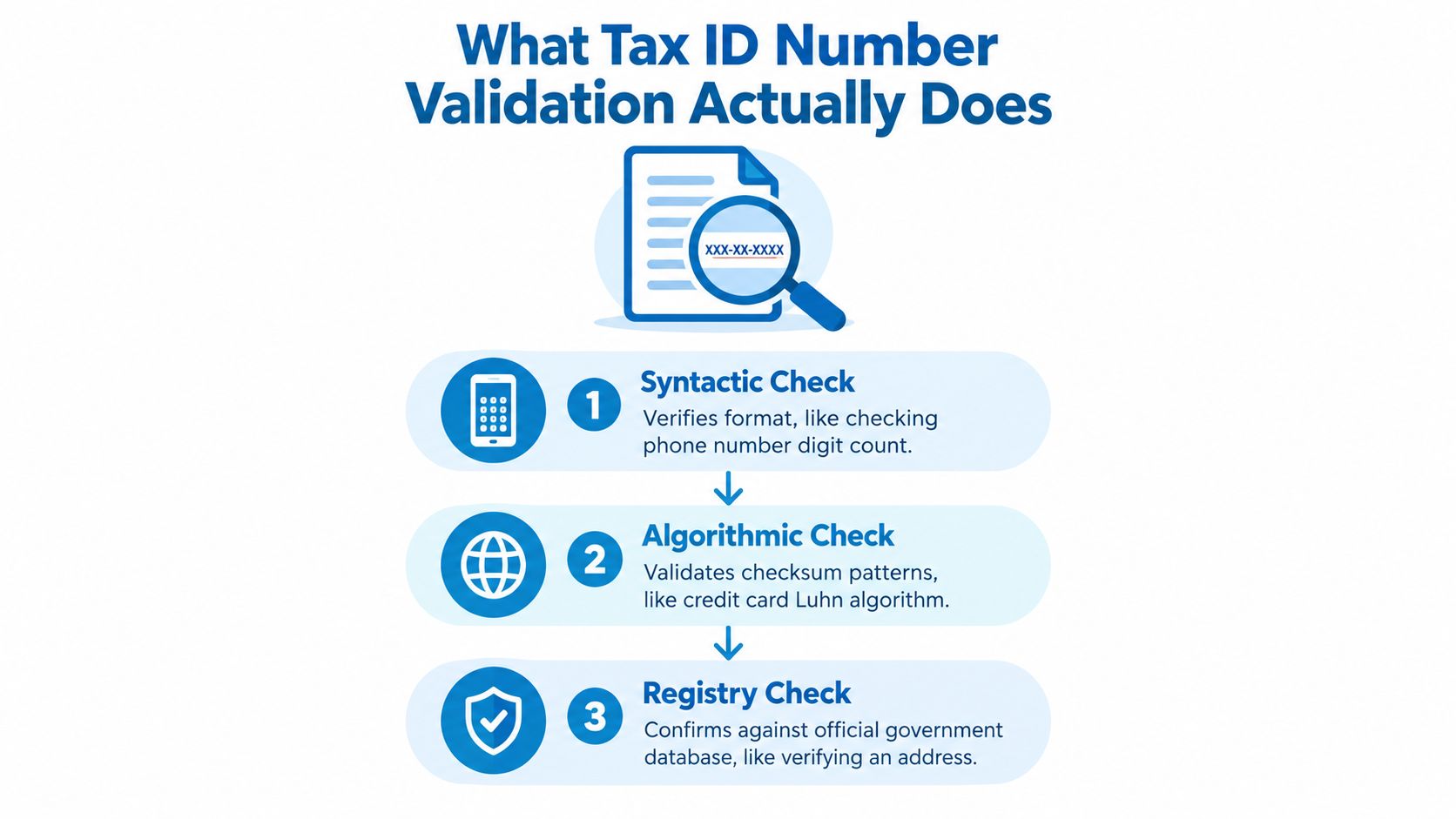
A tax ID can look right without being registered, and a registry response can confirm a number without deciding how a specific transaction should be taxed. A dependable implementation treats validation as layers of evidence, rather than one yes-or-no test.
First check syntax
A syntactic check tests whether the input follows the expected country-specific pattern. Think of checking whether a phone number has the expected arrangement of characters. It's fast and local, so you can return a useful correction before making a network request.
But a number can match a pattern and still be mistyped. Syntax says the input is shaped plausibly, not that an authority issued it or that it's currently active. Avoid treating a regular-expression match as evidence of registration.
Then apply country-specific rules
An algorithmic check can apply a country's structural rules, including a checksum where one exists. It can catch some errors that a simple pattern won't, much like a checksum can detect certain mistyped characters.
This step still doesn't prove that the number belongs to a real, current business. A structurally valid identifier may never have been issued, may no longer be active, or may not be registered for the kind of cross-border transaction you're evaluating.
Finally, ask the registry
A registry check sends the identifier to an authoritative service, such as VIES for relevant EU VAT checks. This is the layer that can answer whether the number is recognized in the connected administrative records at the time of inquiry. Even that answer has a defined scope: it doesn't make the full tax decision for your transaction.
The layers work together. Syntax gives immediate feedback, structural rules catch some input errors, and the registry supplies administrative status. No one layer can substitute for all the others, and none should be presented to users or finance staff as more conclusive than it is.
How VIES and the National Registries Fit Together
VIES is easy to picture as a single EU-wide VAT database. That mental model causes trouble in production. The European Commission describes it as a search engine that retrieves information from Member States' national VAT databases, not a centralized store of every registration (European Commission VIES service description).
The system's purpose is to let businesses involved in intra-Community supplies check whether a customer's VAT identification number is valid for that context. Its legal basis includes Article 31 of Council Regulation (EC) No. 904/2010. For engineers, the important architectural detail is that a request depends on the national system behind the lookup, as well as the service that brokers the request.
What federation means in practice
A response can be affected by national registration processes, record synchronization, or service availability. A negative response may mean the number isn't registered in the corresponding national database at the time of the inquiry. It can also occur when registration is incomplete or the national authority hasn't updated its records yet. A timeout, meanwhile, tells you that the check didn't complete, not that the number is invalid.
When VIES does return a result, treat it as authoritative for the question it answers, not as a permanent guarantee about the customer or a ruling on the transaction. The Commission notes that associated company details may be obtainable through national authorities, but it doesn't guarantee the accuracy of information sourced from national records. That limitation matters when your billing system compares registry details with buyer-submitted details.
Engineering rule: Keep “invalid,” “valid,” and “couldn't verify” as separate states. Collapsing them turns an infrastructure problem into a tax decision.
If you're comparing tax identifiers across jurisdictions, remember that the surrounding obligations aren't interchangeable. For a different national context, this practical overview of Australian Business Number obligations is a useful reminder that each system has its own rules. For the EU mechanism itself, see the VIES glossary entry.
Common Failure Modes and What They Really Mean
Production failures tend to look like customer problems in the checkout, but they don't all call for the same response. The useful question isn't just whether validation failed. It's what the failure tells you, and which action your application should take next.
The input doesn't match the expected format
A buyer pastes a number without its country prefix, includes spaces your normalizer doesn't handle, or swaps characters. Your local check can catch this before a registry call. Return a clear message that identifies the country or format issue and lets the buyer correct the entry. Don't label the business unregistered when the input never reached a meaningful registry check.
Normalization should preserve the distinction between what the user submitted and what your system sends to the registry. That gives support and finance a way to inspect the original input while keeping lookups consistent.
The registry says valid, but that doesn't settle eligibility
A successful response confirms a registration status within the registry's scope. It doesn't confirm that the buyer's submitted legal details match, that the buyer is the contracting entity, or that the transaction qualifies for the tax treatment you plan to apply. If the returned identity is missing or doesn't align with the buyer's details, route the case to manual review rather than granting an exemption without review.
It's also possible for a number to be formatted correctly while not being active for intra-EU trade. Keep the status clear in the user interface and don't translate “format looks right” into “reverse charge approved.”
The service doesn't answer
A timeout or service error is not a negative registration result. You can block an exemption pending review, or let checkout proceed with a visible pending-validation state and a queued re-check. Which choice fits depends on your risk policy and customer experience, but the system should persist a fallback marker either way.
If you allow the customer to continue, make sure invoice generation and downstream reporting can see that the lookup was unavailable. A resilient design for handling VIES downtime should make recovery explicit: retry the check, update the record, and surface unresolved cases to the team responsible for tax decisions.
Validation as a Compliance Signal, Not a Boolean
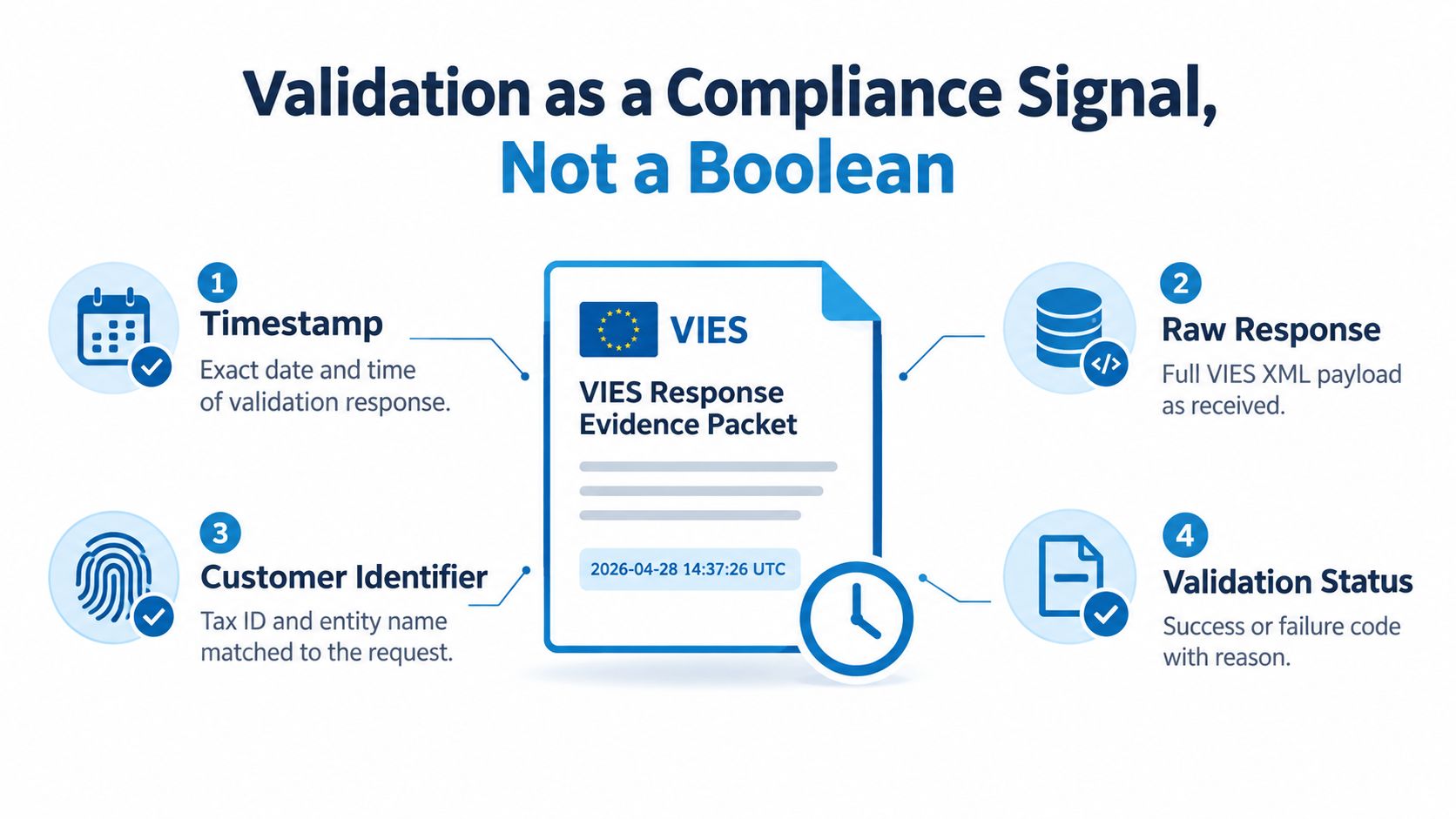
A customer record that says vat_valid: true hides the most important question: valid when? Registration details can change, and the result only describes what the service returned for a particular inquiry. Store it as a timestamped evidence packet tied to the transaction, not as a permanent customer property.
What to persist for a useful audit trail
A durable validation record should let another person reconstruct what the application checked and what decision followed. Include the raw submitted ID so the original customer input isn't lost, plus the normalized ID sent to the registry so the request can be understood and, where appropriate, repeated.
Store the result and returned legal name and address when available. Keep the source and response timestamp, along with the invoice or transaction context that explains why the check was performed. If a registry call failed or your application used a fallback, record the reason. Those details distinguish a valid response from an unavailable service and show what evidence informed the billing decision.
A raw response can help with later investigation, but don't retain data indiscriminately. Define access, retention, and security controls for validation records, and make sure the fields you keep are useful to finance and auditors. A durable record should be queryable by customer and invoice, not buried in application logs that expire before anyone needs them.
“Valid” describes a response at a point in time. It isn't a lifetime attribute of the customer.
That design also prepares billing systems for more automated reporting. The EU's VAT in the Digital Age package, adopted on 11 March 2025, introduces a phased move toward structured e-invoicing and digital reporting for cross-border transactions through 2035. Under the emerging framework, certain self-billing scenarios may require reporting within five days, and the VAT identification number is a required invoice data element (overview of EU digital reporting and e-invoicing).
For teams serving founders and distributed businesses, a practical guide for remote entrepreneurs targeting EU markets can help frame the broader operating context. Your own system still needs to show what it knew when it issued an invoice, and how it handled uncertainty.
Integrating Validation Into a SaaS Stack
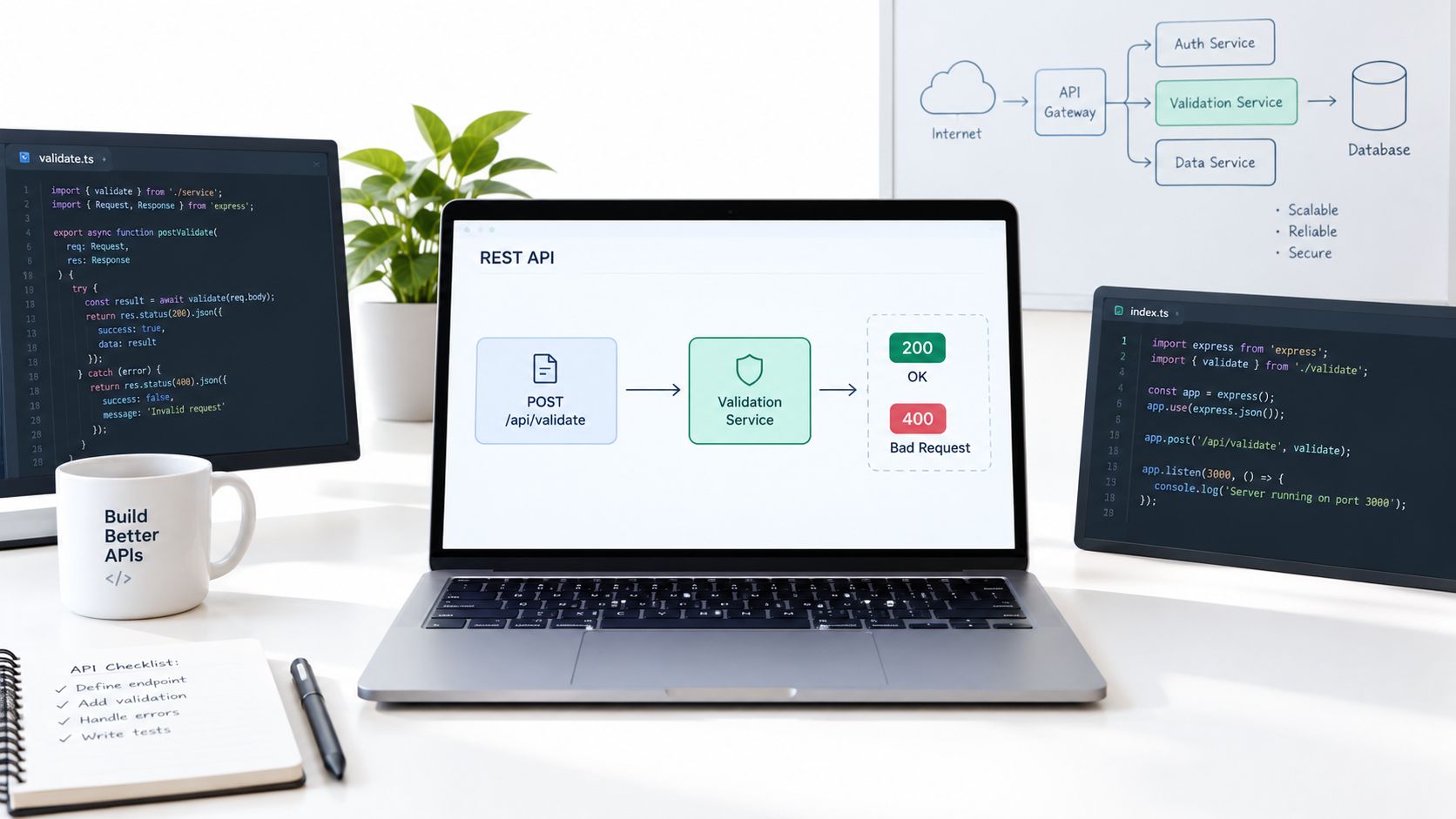
The right integration keeps checkout responsive without confusing speed with proof. Start by giving your application one predictable call surface. A REST endpoint that accepts a country and tax ID and returns structured JSON is usually easier to use in checkout code than a SOAP response that each service has to parse and translate.
Keep checkout decisions separate from evidence
Caching can reduce repeated upstream calls and improve response time, but cached status is still time-bound. Build cache keys from the country and normalized number, and make the cache age visible to the systems that govern tax decisions. Don't let a cache hit look like a fresh registry response if it isn't one.
Your checkout can use a fast response for a user-facing decision while the billing service stores a durable record for the invoice. Keep raw input, normalized input, result, returned identity details, timestamps, and fallback reason together. That division means you don't need to choose between responsive checkout and an audit trail.
Make errors usable at the callsite
Return machine-readable error categories, not just text that frontend code must parse. A client should be able to distinguish an invalid input from a registry outage, then show the buyer an appropriate message or place the case into manual review.
A practical UI should explain what the customer can do next. For a format error, ask them to check the number and country. For an unavailable service, say the check couldn't be completed and tell them whether checkout can continue pending review. In either case, keep the reason in your internal record.
Don't make a registry timeout freeze the entire cart by default. Decide in advance which transactions may proceed with a pending marker, which must wait for review, and how the system will retry and resolve open cases. That policy belongs in the product and finance workflow, not in an improvised catch block.
Build vs Buy and Where TaxID Fits
There are three practical routes: call VIES directly, use an open-source wrapper, or use a managed validation API. The trade-off isn't only how quickly the first request works. It's how much registry behavior your team must maintain and whether the resulting records make sense to finance later.
| Approach | Reliability during outages | Integration effort | Auditability |
|---|---|---|---|
| Direct VIES | Depends on VIES and connected national registries; your application handles failures | Higher, including SOAP handling and your own error mapping | You design and maintain the evidence record |
| Open-source wrapper | Simplifies the interface but doesn't remove upstream outages | Lower than direct SOAP, with ongoing maintenance | Depends on what the wrapper exposes and what you store |
| Managed API | May add caching and standardized failure handling, while still depending on upstream registry data | Lower for teams that want a REST interface | Can provide structured results, but you still need to retain transaction evidence |
For a small team with tax-engineering capacity and a narrow integration need, direct VIES can be a reasonable choice if you're prepared to own its failure handling and logs. An open-source wrapper reduces some plumbing, but it won't make the national registries more available or automatically create an audit record.
A managed API fits teams that would rather maintain billing logic than a SOAP integration. TaxID provides a REST endpoint for VAT and company identification checks, including EU checks through VIES, with structured responses and machine-readable errors. The choice should follow your team's appetite for maintenance, your review process, and how much evidence your finance team needs. For a wider view of the systems involved, see this overview of VAT compliance software.
If you're building EU billing, decide now how your system distinguishes an invalid number from an unavailable registry, then make that decision auditable. TaxID provides a REST API for validation with structured results and machine-readable errors. Visit TaxID to review whether its integration fits your checkout and invoicing workflow.