A UK VAT ID is normally a nine-digit HMRC registration number, commonly written with an optional GB prefix. Since Brexit, GB numbers are validated through HMRC rather than VIES, while the XI prefix is used for Northern Ireland activity involving EU VAT processes.
A customer enters a number at a SaaS checkout, the billing system rejects it, and the payment stalls. Finance checks the invoice, finds a GB prefix, and assumes the EU VIES service should confirm it. The number still fails, not necessarily because the customer's registration is invalid, but because the request went to the wrong validation network.
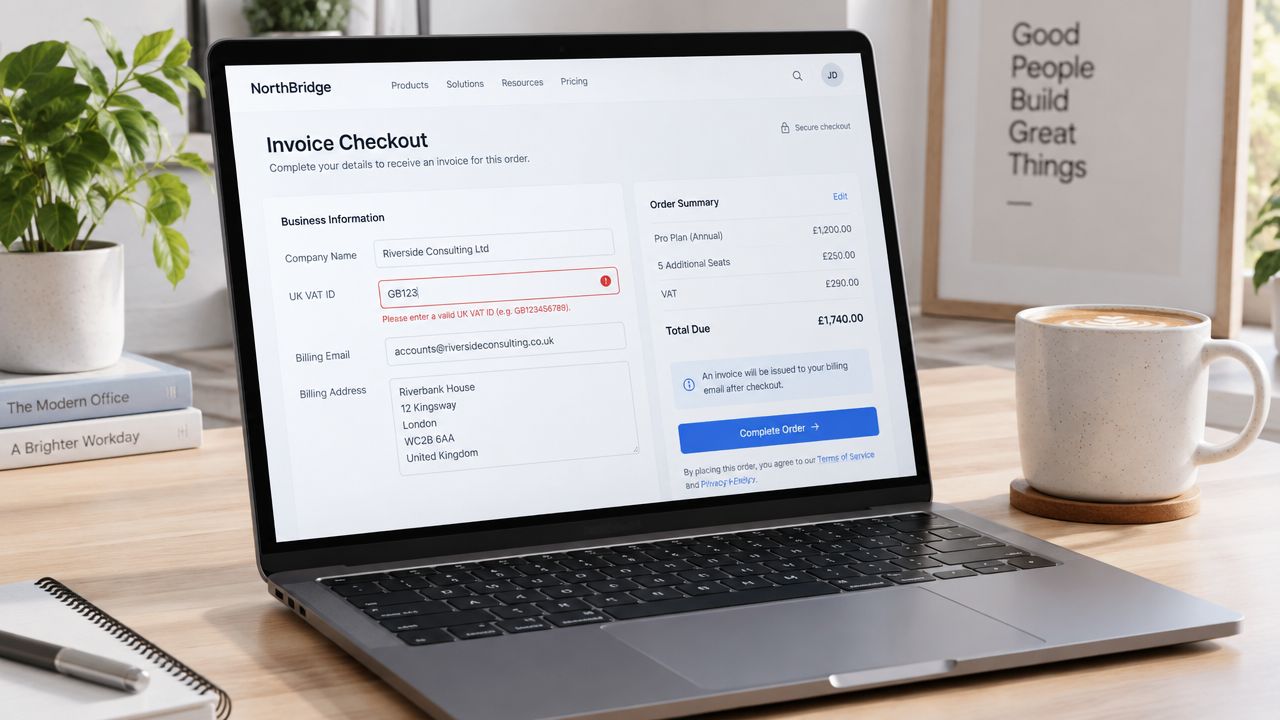
That situation exposes the challenge with a UK VAT ID. It isn't only a number to copy onto an invoice. It acts as a compliance key for registration checks, customer records, invoicing, reverse-charge workflows, and controls designed to reduce fraud. A format check can catch obvious input errors, but it can't decide whether a transaction qualifies for a particular tax treatment.
This guide builds the subject progressively. It starts with what a UK VAT ID represents and who needs one, then explains standard and exceptional formats, practical ways to find a registration number, and the post-Brexit split between HMRC and VIES. It finishes with an implementation pattern for SaaS billing, marketplaces, supplier onboarding, and cross-border invoices.
Businesses dealing with UK customers may also need help with wider regulatory responsibilities. For example, an overseas organisation assessing its UK obligations may need to appoint a UK representative for certain data protection matters. VAT identification is one part of a broader compliance operating model.
Table of Contents
- Introduction to UK VAT ID and Why It Matters
- What a UK VAT ID Is and Who Needs One
- UK VAT ID Format and Examples That Clarify the Rules
- Where to Find Your UK VAT ID Quickly
- Post Brexit Validation and Why HMRC and VIES Differ
- Practical Ways to Validate a UK VAT ID Today
- Putting UK VAT ID Validation Into Practice With Confidence
Introduction to UK VAT ID and Why It Matters
The number behind the invoice
A UK VAT ID is the reference attached to a business's VAT registration. HMRC issues it after registration. A standard domestic identifier contains nine digits, and it may appear with a GB prefix, without the prefix, or with spaces for readability. The HMRC's official UK VAT checker can confirm whether the registration is valid and return the associated business name and address.
That makes the number useful across several workflows. A supplier can check a customer's registration, an accounts team can place the ID on a VAT invoice, and a billing system can pass the result into its tax rules. The ID identifies a VAT registration. It does not, by itself, prove that a transaction qualifies for an exemption or reverse charge.
An overseas organisation reviewing its UK obligations may also need to appoint a UK representative for certain data protection matters. VAT identification is one component of a wider compliance process.
Why a failed check needs investigation
A failed result does not always mean the customer is unregistered. Spaces, an incorrect prefix, or a group number can cause input or format problems. The validation route can also be wrong. A GB number sent to VIES may fail because GB registrations are checked through HMRC after Brexit, while VIES serves the EU route.
The distinction is operational. The UK prefix identifies the route for a domestic GB registration, whereas an XI prefix points to the Northern Ireland arrangement and may require VIES handling. Group registrations can also use a different number pattern, so a validator that accepts only the standard format may reject a genuine ID.
Practical rule: Treat a VAT ID as both a value to validate and a routing signal.
A dependable process keeps four questions separate: does the input look structurally plausible, which authority should receive the request, does that authority confirm the registration, and do the transaction facts support the intended tax treatment? This prevents a checkout field from turning a valid identifier into an automatic reverse-charge decision.
What a UK VAT ID Is and Who Needs One
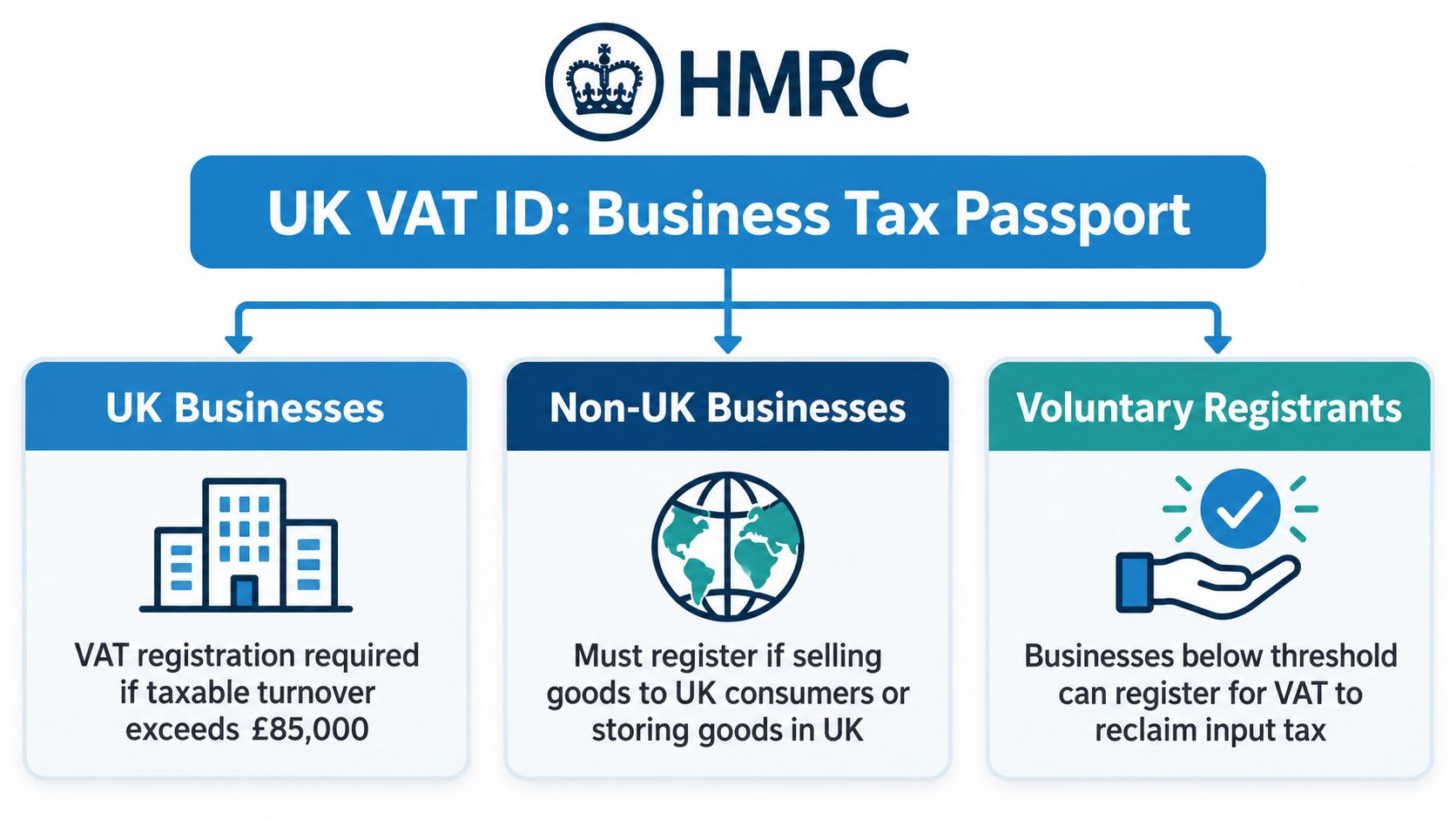
A UK VAT ID works like a business tax passport. It shows that a business is registered for Value Added Tax and supports VAT invoicing, reporting, and record-keeping. It is separate from a company registration number, a Unique Taxpayer Reference, and a bank identifier.
A valid registration number confirms a VAT registration. It does not, on its own, decide the tax treatment of a transaction.
Registration based on taxable turnover
The current compulsory UK VAT registration threshold is £90,000 of taxable turnover, according to HMRC VAT registration guidance. The threshold was £85,000 from 1 April 2017 to 31 March 2024. Earlier thresholds included £5,000 when UK VAT began in April 1973, £10,000 in 1978, £25,400 in the 1990 Budget, and £35,000 by 1991.
The threshold helps determine when a UK business must apply for VAT registration. A business below the compulsory threshold may register voluntarily, depending on its commercial and tax circumstances. Registration can then affect customer invoices, VAT reporting, and recovery of input tax.
The visual below introduces the registration concept for non-tax colleagues. Teams should confirm threshold details against current HMRC guidance before building them into a process.
Why customers request the number
A VAT-registered supplier normally places its registration number on relevant VAT invoices. During onboarding, a business customer may request the buyer's number because registration status can affect invoicing and tax records. Finance teams also connect the identifier to evidence supporting the customer's tax treatment.
For developers, the field should collect a country-aware tax identifier rather than accept every value as a generic string. Country and prefix can determine the validation route, while registration status alone does not establish reverse-charge eligibility. The broader distinction between VAT IDs and other sales-tax identifiers appears in this United Kingdom sales tax guide.
UK VAT ID Format and Examples That Clarify the Rules
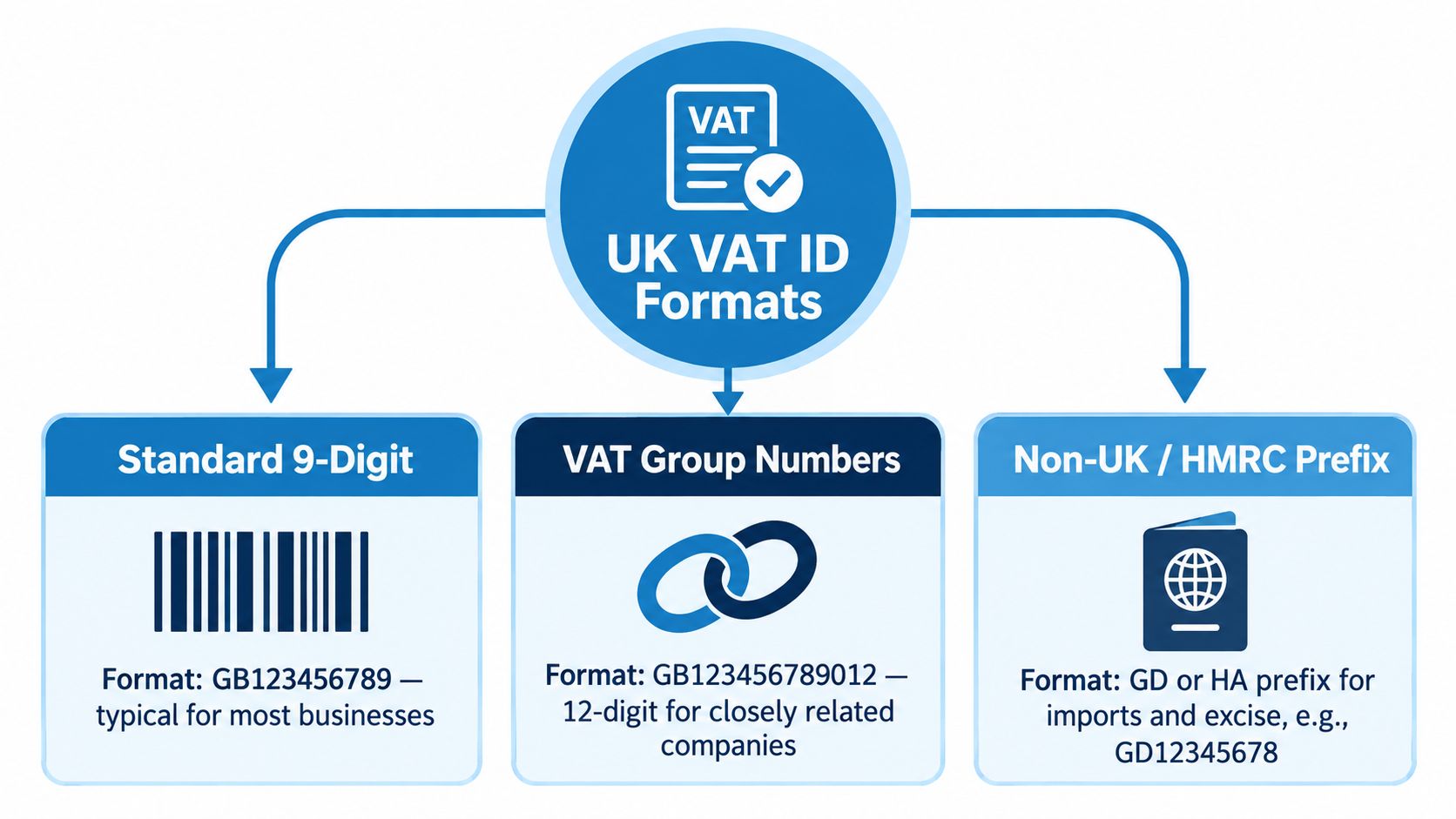
The standard domestic pattern is simple: nine digits, often presented with GB at the front. A system should normally normalize the value before validating it, which means removing spaces and handling the optional GB prefix consistently. HMRC guidance allows entry with or without spaces and with or without the GB prefix, so formatting should not determine whether a user can proceed to a legitimate check.
The standard pattern is only the starting point
For example, these inputs represent the same basic normalized value:
- With prefix:
GB123456789 - Without prefix:
123456789 - With spacing:
GB 123 456 789
The examples above illustrate presentation, not confirmed registrations. A number that matches the pattern still needs an official lookup before a system treats it as valid.
Validation becomes more complicated when the input isn't a typical domestic registration. Systems may encounter 12-digit VAT group numbers, as well as special HMRC-prefixed forms associated with government departments and health authorities. Northern Ireland can use the XI prefix for EU-facing VAT activity, which requires different routing from an ordinary GB number. UK VAT number format guidance describes these operational variations and the need to normalize inputs before applying country-specific rules.
Examples of format-first handling
A validator can handle values in this order:
- Normalize the text. Remove spaces and other presentation characters that HMRC accepts.
- Inspect the prefix. Distinguish GB, XI, and special HMRC-prefixed forms.
- Apply the relevant pattern. Don't force every input through a nine-digit-only rule.
- Call the correct authority. A plausible shape isn't evidence of an active registration.
A value such as GB123456789 is structurally consistent with the standard domestic pattern. A 12-digit value may be a VAT group number rather than a malformed ordinary number. An XI-prefixed value should be treated as an EU-facing Northern Ireland case, not automatically as an ordinary GB lookup.
The wider principles of country-specific parsing and normalization are also relevant when a platform handles several jurisdictions. A technical overview of VAT number formats can help teams avoid building a single rigid pattern that rejects legitimate country variants.
Where to Find Your UK VAT ID Quickly
If your business is already registered, the fastest route is usually an official document or account rather than a search through old email threads. Start with the VAT registration certificate and look for the registration number issued by HMRC. The number may appear beside registration details, effective-date information, or business identity information.
The certificate is particularly useful when a supplier, accountant, or customer asks for evidence during onboarding. Copy the value carefully, but don't preserve spaces as part of the stored identifier. Keep the original presentation available for human review while storing a normalized version for searches and integrations.
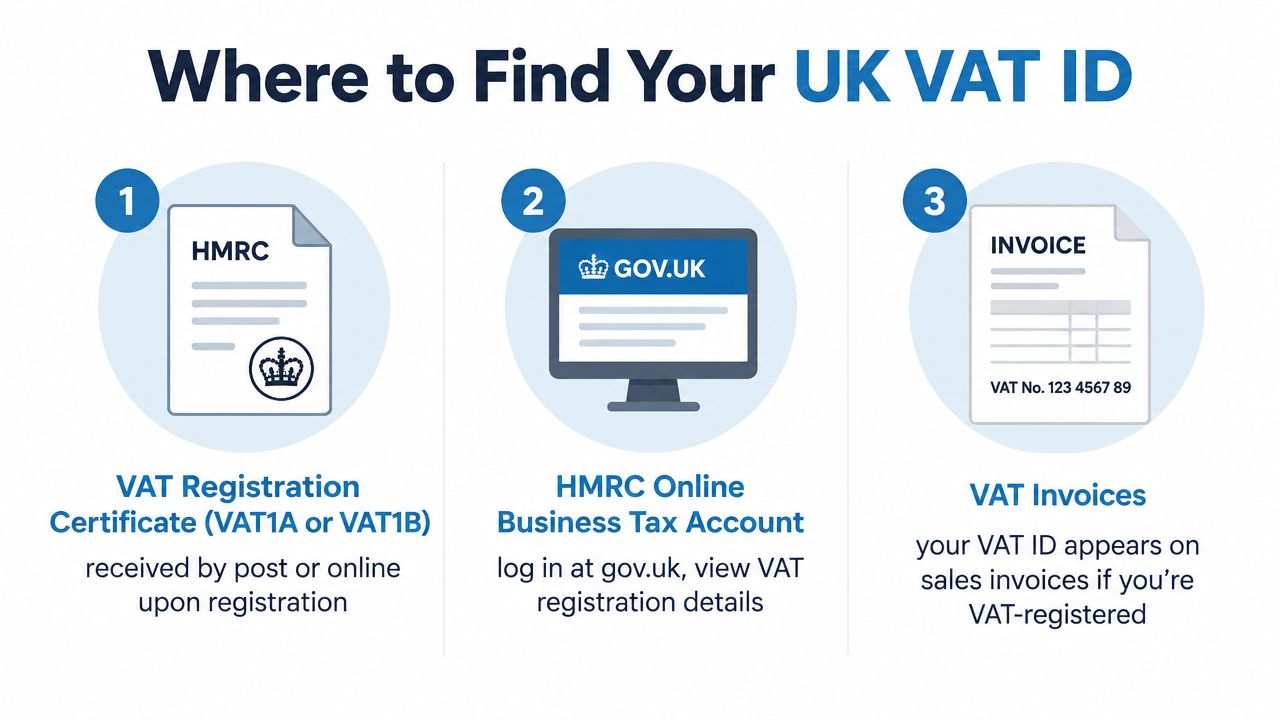
Three reliable places to check
- VAT registration certificate: Find the HMRC-issued certificate received after registration. Use the VAT registration number, not a separate reference printed elsewhere on the document.
- HMRC online business tax account: Sign in through the relevant government service and open the VAT registration details. This is useful when the paper certificate isn't available.
- VAT invoices and returns: A VAT-registered business commonly includes its registration number on sales invoices and uses it in VAT reporting records.
Avoiding number mix-ups
HMRC correspondence can contain several identifiers. A company number, Corporation Tax reference, PAYE reference, and VAT registration number serve different purposes. The VAT ID is the value associated specifically with VAT registration, so don't substitute another HMRC number because it has a similar length or appears near the business name.
If registration has been submitted but the number hasn't been issued, don't invent a temporary value or copy a pending application reference into a customer-facing VAT field. Ask HMRC or your tax adviser how to handle invoices during the waiting period, and keep the registration status visible to the finance team.
Suppliers asking a customer for a VAT ID should request the value exactly as recorded, including the country context when relevant. A checkout can accept spaces and an optional GB prefix, normalize the input internally, and preserve the submitted form in an audit record. That approach reduces avoidable rejection without treating formatting alone as proof of registration.
Post Brexit Validation and Why HMRC and VIES Differ
The post-Brexit rule is straightforward once the prefix is treated as a routing instruction. GB VAT numbers are validated through HMRC, while XI numbers used for Northern Ireland EU-facing activity follow the appropriate EU and VIES logic. The European Commission's VIES validation service states that traders seeking to validate UK GB numbers should contact the UK tax administration.
Route the request before making a tax decision
A system that sends every UK-looking value to VIES can create systematic false negatives for GB registrations. That doesn't necessarily mean the business is unregistered. It may mean the lookup was sent to a service that no longer handles that category of UK number.
| VAT Prefix | Validation Network | Typical Use Case |
|---|---|---|
| GB | HMRC | Domestic UK registration checks and Great Britain invoicing workflows |
| XI | Appropriate EU or VIES route | Northern Ireland activity involving EU-facing VAT processes |
| No prefix | Normalize, then infer the intended UK route from context | User-entered domestic number where the GB prefix was omitted |
A routing layer should run before a remote lookup. It can remove spaces, recognize a GB or XI prefix, preserve the original input for review, and send the normalized value to the relevant service. It should also avoid assuming that a nine-digit shape is sufficient for every UK registration, because group and special HMRC-prefixed forms need separate handling.
Routing rule: GB versus XI is a service-selection decision, not merely a display preference.
This distinction matters outside VAT too. Teams building customer data workflows often maintain related privacy controls, so an email marketing GDPR checklist can be useful when customer records and communications are handled together. The compliance process should still keep VAT validation and data protection decisions separate.
Practical Ways to Validate a UK VAT ID Today
The right validation method depends on volume, timing, and how much control your team needs. A finance employee checking a supplier before paying an invoice has different requirements from a checkout system that must respond while a customer is submitting payment details.
Manual checks for occasional work
For a one-off check, use the official HMRC checker. Enter the number after removing unnecessary spaces, review the returned validity result, and save the result with the date, input value, and transaction or supplier record. The result can support an audit trail, but it shouldn't replace judgment about the supply itself.
Manual validation works well for small queues and exception handling. It becomes fragile when several people copy values into spreadsheets, repeat checks inconsistently, or need results inside a billing workflow.
Direct integration for controlled systems
A finance or engineering team can integrate with HMRC directly when it needs full control over request handling, data storage, retries, and monitoring. The integration should distinguish a confirmed invalid result from a technical failure. A service outage or timeout isn't the same thing as proof that a customer lacks a valid registration.
A practical record can include:
- Submitted value: Preserve what the user or operator entered.
- Normalized value: Store the cleaned identifier used for lookup.
- Authority route: Record whether the request went to HMRC or the EU-facing route.
- Result and timestamp: Keep the response and when the check occurred.
- Decision context: Record how the result affected invoicing, without claiming that the ID alone settled tax treatment.
API wrappers for billing and checkout
An API wrapper can provide a common interface for teams that don't want each application to manage authority-specific behavior. TaxID offers a UK VAT validation API that sends requests through HMRC and returns registration status, company name, and address. Its GB VAT validation endpoint is relevant when a product needs a developer-facing workflow rather than manual checking.
Whether you use direct HMRC integration or a wrapper, design for uncertainty. Handle service_unavailable or equivalent technical failures separately from vat_invalid, avoid blocking a legitimate customer solely because an authority is temporarily unavailable, and queue a follow-up check where your tax policy permits it. Cache and audit behavior should be documented so finance can explain which result supported an invoice decision.
Putting UK VAT ID Validation Into Practice With Confidence
A valid UK VAT ID answers one narrow question: does the relevant authority recognize the registration number? It doesn't, by itself, prove that a transaction qualifies for reverse charge, exemption, or any other preferred invoice treatment.
HMRC guidance says the cross-border services reverse charge applies only when the supplier belongs outside the UK, the customer belongs in the UK, the place of supply is the UK, and the customer is VAT-registered in the UK. If the customer isn't VAT-registered or isn't liable to be registered, the reverse charge doesn't apply. HMRC's place-of-supply guidance also explains that businesses may need to account for VAT on services received from abroad and should use reverse-charge notes only in the scenarios where the rules require them.
A dependable decision sequence
Use the identifier as one input in a broader transaction workflow:
- Normalize the input. Remove spaces and recognize the optional GB prefix.
- Classify the prefix. Route GB to HMRC and XI to the relevant EU-facing process.
- Validate the registration. Store the response, timestamp, and company details returned by the authority.
- Check the transaction. Identify the supplier location, customer location, supply type, and place-of-supply rule.
- Apply the invoice logic. Decide whether UK VAT, reverse charge, or another treatment applies.
- Escalate uncertainty. A technical failure or unusual registration type should go to a human or a documented exception queue.
For SaaS billing, this sequence can run when a business customer enters its tax details, with a later recheck when the invoice is finalized. Marketplaces can use the same model during seller onboarding, while procurement teams can attach the validation evidence to supplier records. None of these workflows should convert an authority outage into a tax conclusion.
Correct routing prevents avoidable false negatives. Format-aware intake reduces input mistakes, and retained evidence gives finance teams a defensible record when they review an invoice later. The strongest design treats validation as a controlled compliance step, not as a single boolean attached to a checkout field.
TaxID helps developers validate UK VAT IDs through a single API workflow connected to the relevant authority route, with registration status and business details returned in structured responses. Visit TaxID to review the documentation and connect VAT validation to your checkout, supplier onboarding, or B2B invoicing process.