A developer may start with a simple requirement, such as routing a new account, pre-filling onboarding, scoring a lead, validating a supplier, or applying the correct tax treatment. Then the vendor search reveals a problem: a company data enrichment API can mean a sales intelligence database, a technology detector, a public registry interface, a funding database, or a tax-ID validator. These products don't return the same kind of truth.
Evaluate each option against the job your system must complete. Check the input keys, returned fields, entity and geographic coverage, freshness signals, pricing visibility, credit behavior, authentication, documentation, rate limits, provenance, and failure states. API-first delivery matters because Postman's 2025 survey found that 82% of organizations had adopted at least some API-first practices, while 25% identified as fully API-first (Postman State of the API 2025). The same survey reported that 65% of organizations generate revenue from APIs, which makes reliability and backward compatibility part of the product, not an engineering afterthought.
This list separates broad firmographic platforms from focused sources for technology, funding, legal entities, and validation. TaxID belongs in the focused validation category, not as a replacement for broad firmographic enrichment. It supports tax and company identification numbers across 31 countries through a single REST endpoint, returning structured validation data for billing, checkout, invoicing, and compliance workflows. Use the list by starting with your input and required decision, then shortlist the smallest combination that can return defensible data. A broader data integration solutions overview can help if you're designing the surrounding pipeline rather than selecting one endpoint.
Table of Contents
- 1. Clearbit by HubSpot for Enrichment API
- 2. People Data Labs for Company Enrichment
- 3. Apollo for REST-Based Company Enrichment
- 4. ZoomInfo for Enterprise Company Enrichment
- 5. Crunchbase for Funding and Investor Context
- 6. Dun and Bradstreet Direct Plus for Governed Identity
- 7. Coresignal for Fresh Workforce and Company Signals
- 8. BuiltWith for Technographic Enrichment
- 9. Wappalyzer for Lightweight Technology Lookup
- 10. OpenCorporates for Registry-Backed Company Data
- Top 10 Company Enrichment APIs, Quick Comparison
- Build the Smallest Reliable Enrichment Stack
1. Clearbit by HubSpot for Enrichment API
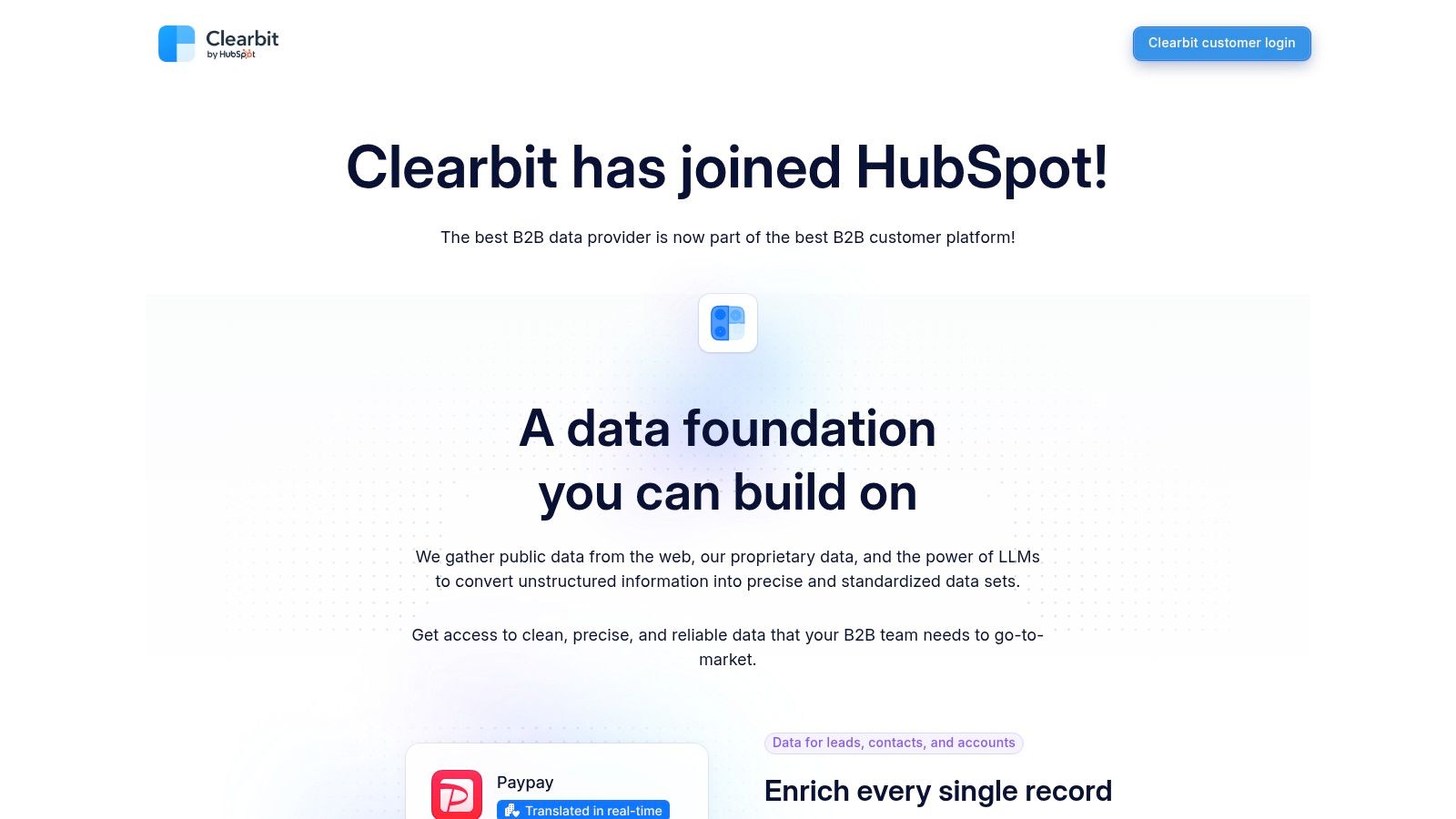
Clearbit is a practical choice when the starting key is a company domain, professional email, or visitor IP and the destination is a CRM or marketing workflow. Its enrichment products cover company and person records, while Reveal connects anonymous website activity to a potential company context. That makes it useful for lead routing, form handling, account qualification, and HubSpot-centered automation.
Best job for Clearbit
Choose Clearbit when your team wants a mature enrichment pattern rather than a registry lookup. Typical returned attributes include firmographic and technographic context, company location, industry, size, social profiles, and related person information. The value is less about legal identity and more about turning a thin lead record into something a go-to-market system can route.
Clearbit also fits teams that want established documentation, integration guidance, and HubSpot distribution. Its weakness is commercial visibility. Public standalone pricing is no longer clearly published, and access is generally connected to HubSpot plans or a sales-led arrangement. That makes cost modeling harder than a simple per-request API.
Practical rule: Treat Clearbit as a CRM enrichment layer, not as evidence that a company legally exists or that a VAT number is valid.
For a fast HubSpot workflow, that trade-off may be acceptable. For a custom SaaS product, compare authentication, credits, quotas, and field availability before you commit your data model. Clearbit is strongest when the surrounding workflow already lives in the HubSpot ecosystem. It's less compelling if you only need a narrow company-number validation response.
2. People Data Labs for Company Enrichment
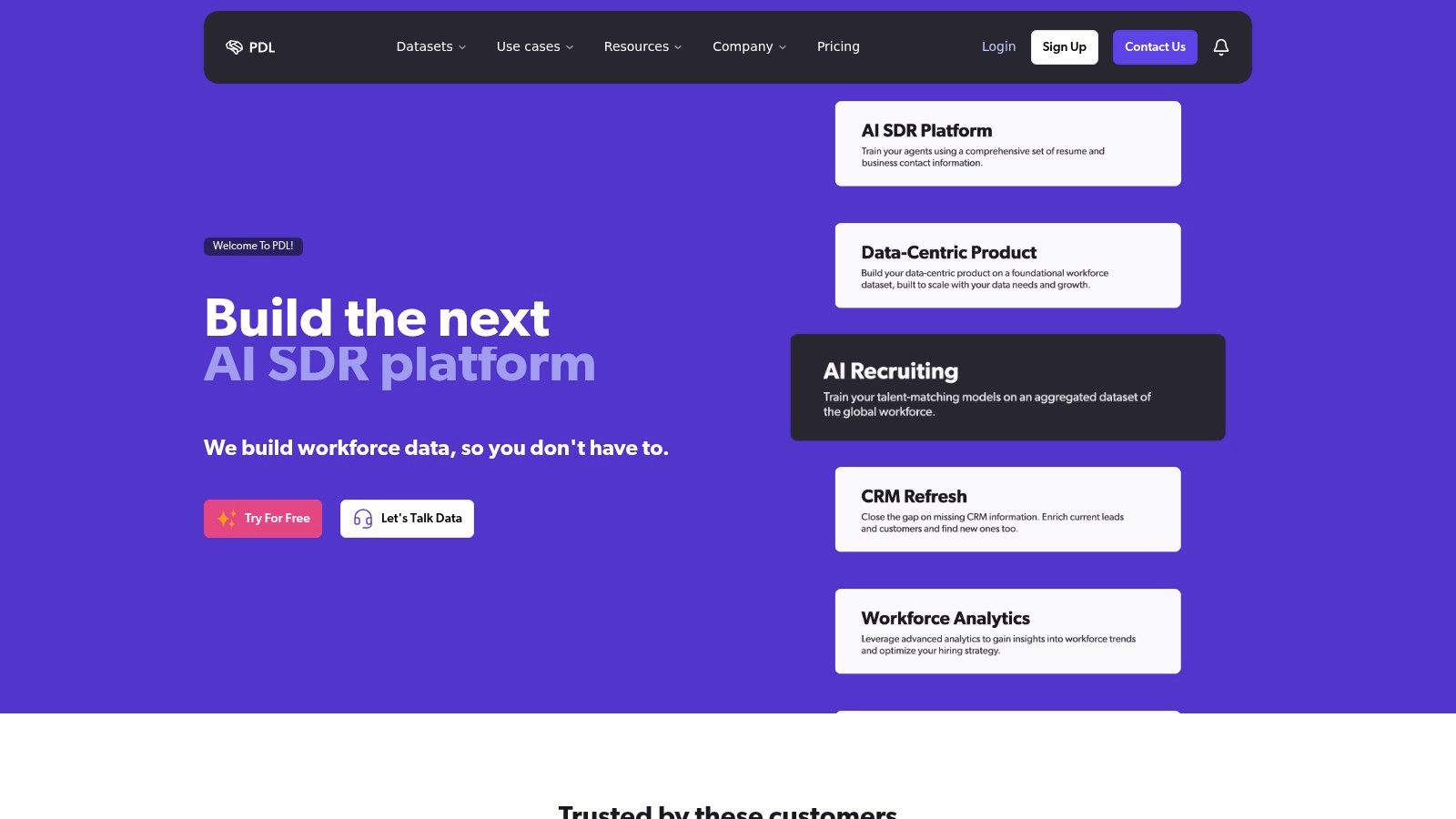
People Data Labs is built for developers who need to query company records programmatically and combine them with person, IP, or search workflows. The company API accepts identifiers such as a domain or company name, with additional matching through location and related search parameters. It suits back-end services, automated enrichment jobs, analytics pipelines, and products that need more control than a sales interface provides.
Where it reduces integration effort
The developer experience is a major part of the product. Official SDKs, including Python and Go tooling, plus Postman collections, help engineers test requests before wiring them into a production service. A credit and volume model also gives teams a recognizable way to estimate consumption, although premium fields and broader access can depend on the selected plan.
People Data Labs is a broad firmographic enrichment option. It's appropriate when the system needs company identity, industry, location, workforce context, or associated people. It isn't the right sole source when the business decision depends on an official legal register, a current tax authority response, or an evidentiary consultation record.
The trade-off to test
A large dataset can still contain missing, conflicting, or stale fields. The broader B2B data-services market illustrates why this matters: one estimate valued that market at $52.26 billion in 2022 and projected a 13.5% compound annual growth rate from 2023 through 2030, while 65% of B2B marketers identified data quality as their biggest lead-generation challenge (B2B data-solutions market estimate). Those figures concern the wider market, not People Data Labs specifically, but they explain why match quality should be measured field by field.
Use representative domains and names, then record match rate, missing fields, response errors, and the cost of successful matches. People Data Labs is a strong candidate for a developer-owned enrichment pipeline, provided you keep legal-entity validation separate.
3. Apollo for REST-Based Company Enrichment
Apollo is designed for teams that want company enrichment close to prospecting, CRM synchronization, and sales operations. Its REST workflows can return common firmographic attributes such as industry, headcount, headquarters, LinkedIn URL, and technology information. The platform also supports CSV and bulk workflows, which can be more useful than real-time requests when a team is cleaning an existing account list.
Select Apollo for the operational workflow
Apollo's advantage is convenience. A sales or revenue team can discover accounts, enrich records, synchronize them with a CRM, and use operational playbooks without assembling every component from separate vendors. That makes it a reasonable fit for common B2B routing and segmentation jobs where the input is a domain or account record and the output is a usable sales profile.
The important limitation is that API use draws from plan credits. Credits may be connected to the broader user-interface subscription, so a team should verify entitlements before building a product around the endpoint. An apparently affordable UI plan doesn't automatically establish predictable API economics.
What developers should verify
Apollo is better suited to standard firmographics and GTM enrichment than authoritative registry work. Ask for the exact fields your application needs, how a failed match is charged, whether bulk and synchronous calls behave differently, and what happens when an account is merged or acquired.
If the enrichment runs during lead submission, test latency and timeout behavior under realistic traffic. If it runs as a nightly or scheduled job, test bulk limits, retries, duplicate handling, and whether returned changes include timestamps or provenance. Apollo can shorten the path from account input to sales action, but it shouldn't be treated as a tax or legal-entity authority.
4. ZoomInfo for Enterprise Company Enrichment
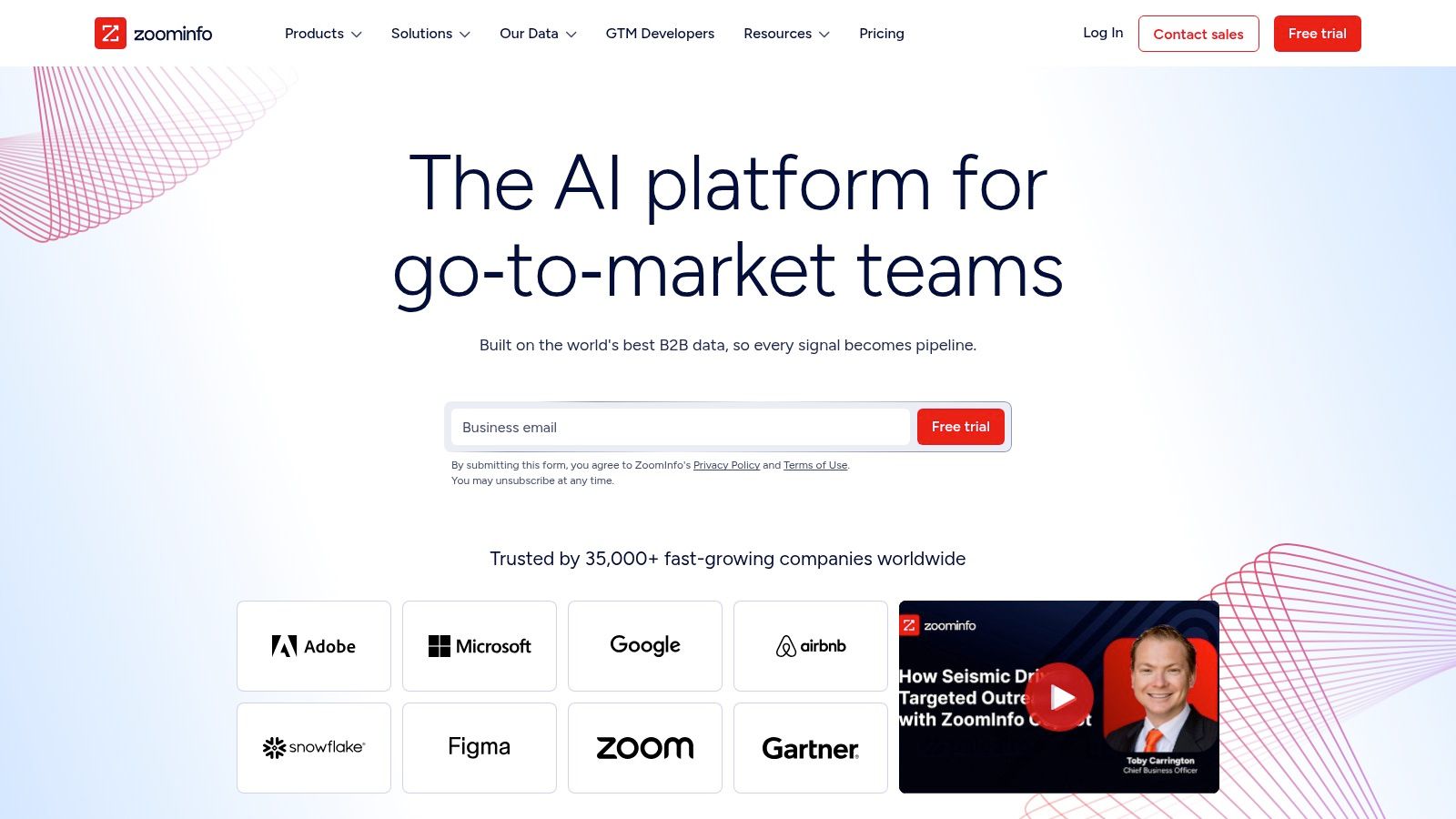
ZoomInfo is aimed at organizations that need managed, high-volume B2B enrichment across CRM, marketing automation, account-based marketing, routing, scoring, and intent workflows. Its company-by-domain enrichment focuses on firmographics, social and web data, and related enterprise datasets. The product makes most sense when the enrichment layer is part of a governed commercial data program rather than a small application feature.
The enterprise trade-off
ZoomInfo's strength is breadth around sales operations and managed integrations. A large CRM deployment may value connectors, account governance, support, and the ability to standardize enrichment across multiple teams. Enterprise support can also matter when incorrect routing or incomplete account data affects several downstream systems.
The cost is evaluation friction. Pricing is sales-led, and API access is generally provisioned through an enterprise agreement. Smaller teams may find that the buying process, contract structure, and minimum commitment matter more than individual field coverage.
A large field catalog does not replace a clear answer to one question: can this API identify the entity your workflow actually needs?
Use ZoomInfo when you need broad commercial enrichment and have procurement, data governance, and integration resources. Don't select it because it returns more fields than a focused source. If the task is identifying a registered company number or validating a VAT identifier, a registry or tax-validation API will usually be a more direct fit.
5. Crunchbase for Funding and Investor Context
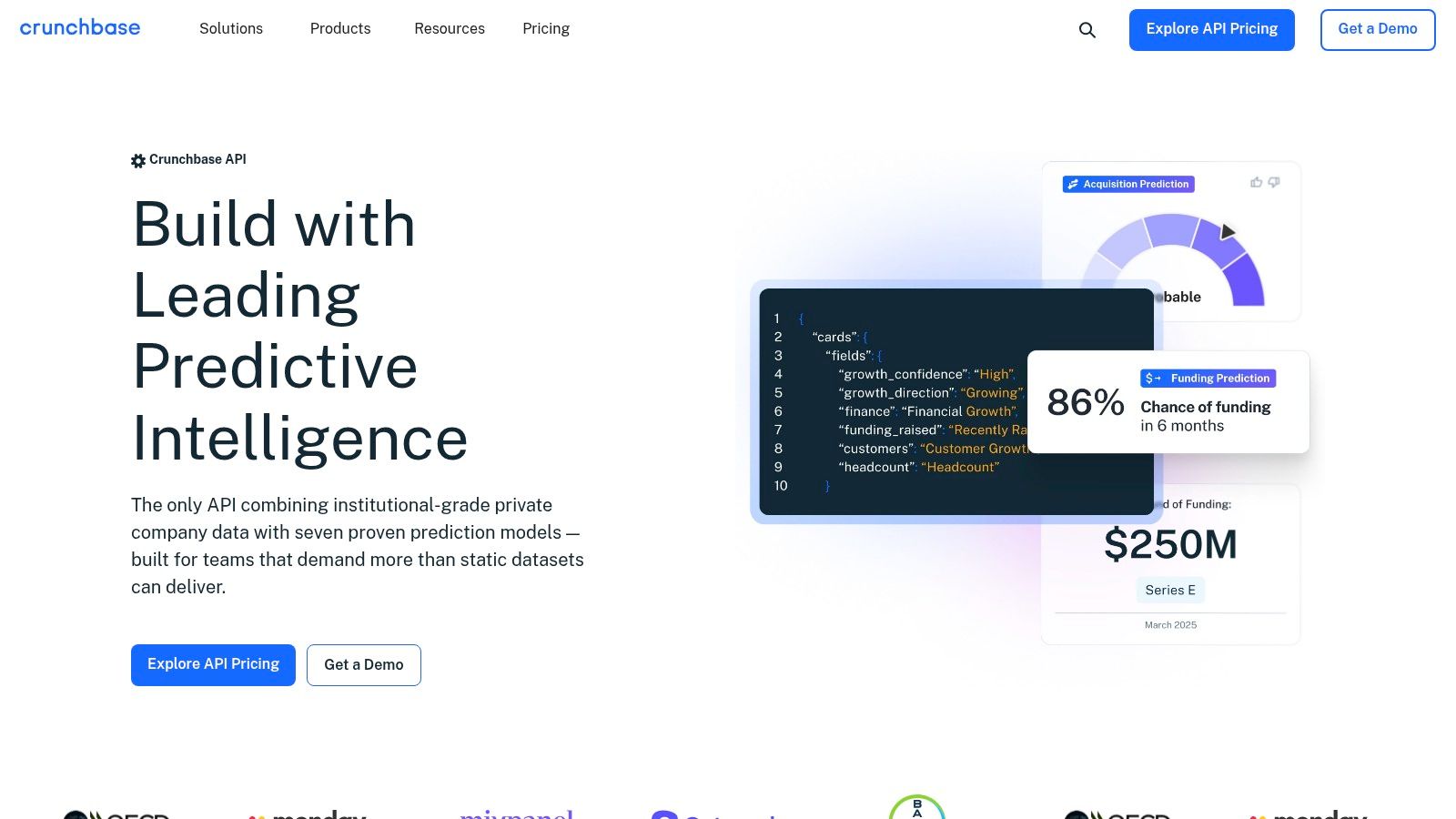
Crunchbase solves a different problem from a standard firmographic provider. Its company profiles, funding rounds, investors, and acquisition relationships add financial and momentum signals to an account record. Those signals can help a team prioritize accounts, segment startups, identify investment context, or distinguish a recently funded company from an otherwise similar organization.
Best job for Crunchbase
Use Crunchbase when the decision depends on stage, funding history, investor relationships, or acquisition activity. A sales scoring system might use those attributes to prioritize account research. An investment workflow might use them to augment a company profile. A market-mapping product could use the company and investor graph to understand relationships that firmographic APIs don't expose.
The V4 API supports targeted field retrieval, which can help engineers avoid requesting a larger profile than the workflow needs. That matters when pricing or usage is tied to returned data, although API access and commercial terms are generally sales-assisted rather than fully self-serve.
Don't confuse momentum with identity
Funding data is contextual, not authoritative proof of a legal entity. Names can vary between a startup's public brand, its operating company, and a registered subsidiary. If a billing or compliance system needs the correct registered name, jurisdiction, company number, or tax status, pair a funding source with registry-backed or validation data.
Crunchbase is therefore a specialist enrichment source. It complements firmographic data rather than replacing it. Before adopting it, define whether the application needs a current funding signal, a historical relationship graph, or a simple company profile. Those jobs can require different endpoints, refresh policies, and evidence standards.
6. Dun and Bradstreet Direct Plus for Governed Identity
Dun & Bradstreet Direct+ is built around identity resolution, corporate linkage, ownership, risk, and financial information. Its D‑U‑N‑S identifiers and Commercial Graph are particularly relevant when a company record must connect to a corporate hierarchy rather than remain a flat account object. Modular Data Blocks let an enterprise license the categories it needs through the Direct+ REST API.
Choose D&B for identity and hierarchy
D&B is a better match for legal-entity resolution, corporate family mapping, supplier risk, governance, and compliance than for lightweight lead enrichment. OAuth, structured documentation, and modular fields support enterprise implementation, but the integration usually demands more data modeling than a simple domain-to-profile endpoint.
The key question is whether your system needs to know that two records belong to the same corporate group, which entity owns a subsidiary, or how a supplier connects to a broader hierarchy. Those relationships can affect procurement, credit decisions, account ownership, and compliance review.
For a broader explanation of how a company data API can support enrichment and identity workflows, see this company data API guide.
The cost of authority
D&B generally involves enterprise contracts and custom pricing. That reduces price transparency, but it can be justified where governance, corporate linkage, and risk controls are more important than rapid self-serve experimentation. Expect more implementation work around identifiers, field licensing, response interpretation, and audit requirements.
D&B should still be tested against your own entities. Ask how it handles branches, subsidiaries, inactive companies, mergers, and records with incomplete identifiers. It's a strong candidate when the business needs a governed identity layer, but it may be excessive for a checkout form that only needs to validate a tax number.
7. Coresignal for Fresh Workforce and Company Signals
Coresignal takes a multi-source approach to company, employee, and job data. Developers can match companies using domains or social URLs, then combine firmographics and technographics with workforce or hiring signals. That makes it useful for products where a company's recent activity matters more than a static profile.
Select Coresignal for change-sensitive scoring
A hiring signal can help a product identify expansion, workforce movement, or changing technology needs. Employee and job datasets can also support internal research tools, talent products, and dynamic account scoring. Coresignal's API-first presentation suits teams building those signals into their own application instead of working only inside a vendor dashboard.
The trade-off is modeling effort. Multi-source records often need normalization, field precedence rules, duplicate handling, and explicit confidence states. A packaged sales platform may hide that work. An API intended for data products gives your engineers more control, but it also gives them more responsibility.
Integration test: Store the response timestamp and source status with each high-value field. A current hiring signal and an old firmographic field shouldn't look equally fresh.
Data decay makes this operational discipline necessary. A 2026 industry summary citing Cognism reports that 22.5% of a B2B database becomes stale within one year, while technology companies may experience annual decay rates of 35–45% (B2B data-enrichment statistics). These figures aren't universal benchmarks, but they support different refresh policies for stable suppliers, sales prospects, and fast-growing technology accounts.
For a practical distinction between discovering a company and validating its identity, read this company lookup API guide. Coresignal is strongest for evolving commercial signals, not authoritative tax status.
8. BuiltWith for Technographic Enrichment
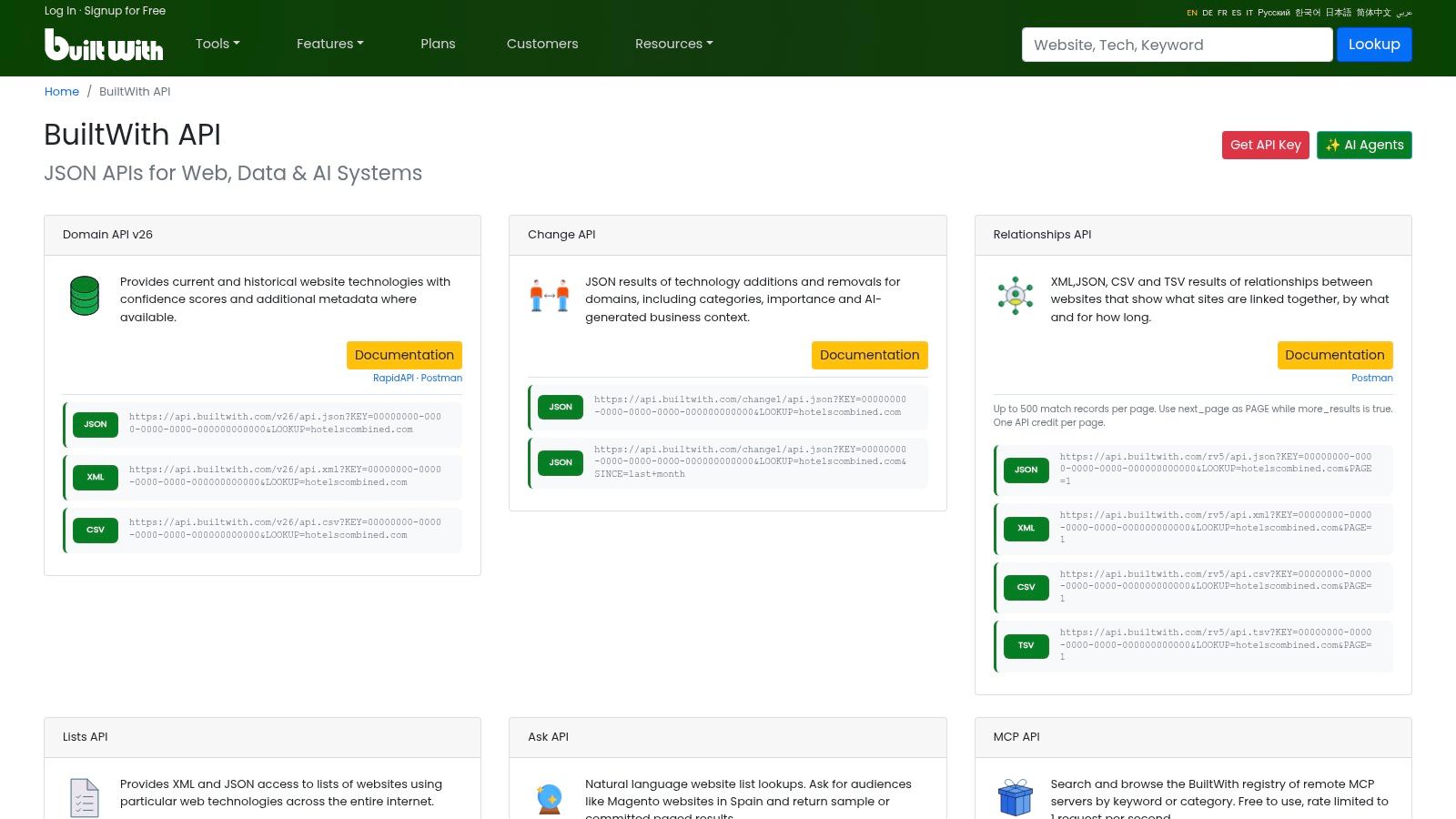
BuiltWith is a focused technographic API. Give it a domain, and it can return website technology profiles covering categories such as content management, analytics, e-commerce, and marketing tools. Responses are available in machine-readable and file-oriented formats, which supports both real-time qualification and larger list-processing workflows.
Best job for BuiltWith
Use BuiltWith when the question is “What technology does this website appear to use?” That answer can support ICP filtering, partner discovery, sales routing, migration campaigns, and product compatibility checks. A software vendor might prioritize domains using a competing platform. An agency might qualify an account based on its commerce or analytics stack before a human reviews the company.
BuiltWith's depth is also its boundary. It describes website technology rather than proving a legal entity, ownership structure, financial condition, or tax status. A domain can represent a brand, a product, a regional site, or a parent company, so technology detection should not become the sole identity key.
Use it before expensive enrichment
A sensible architecture can call BuiltWith first, discard accounts that clearly don't match the technical ICP, and send the remaining domains to a broader firmographic provider. That can reduce unnecessary enrichment requests, although the financial benefit depends on each provider's credit rules and the quality of your filtering logic.
Pricing is credit-based, with high-volume and bulk options. Test technology detection against sites with redirects, multiple domains, regional subdomains, and limited public scripts. BuiltWith is a specialist source to pair with firmographic or registry data, not a complete company graph. Teams comparing alternatives can also review this guide on switching from BuiltWith.
9. Wappalyzer for Lightweight Technology Lookup
Wappalyzer is another technographic API, but its appeal is a simple request model. It can inspect individual URLs or larger lists, with asynchronous processing for bigger jobs. The returned result answers a narrow but useful question: which technologies can the service detect on a website?
When a smaller endpoint is better
Wappalyzer fits a lead qualification or routing step that needs a quick technology signal before calling a broader company enrichment API. A custom checkout, marketplace, or sales application can submit known URLs and use detected technologies to decide which workflow should run next. Self-serve plans and metered API access also make it easier to test without beginning with a large enterprise contract.
The result is not a full company record. It doesn't establish registered name, company number, corporate hierarchy, revenue, ownership, or VAT validity. Treat the domain as a web property and retain the distinction between site technology and organization identity.
Real-time and bulk are different jobs
For a form submission, a synchronous lookup may be enough. For an existing account list, asynchronous bulk processing is usually a better operational shape because the system can queue work, retry failures, and store results without blocking the user interface. Engineers should verify request limits, asynchronous completion behavior, duplicate URLs, redirects, and technology confidence or version fields before production use.
Wappalyzer is a good complement when the next decision depends on the software stack. It's not a substitute for a company data enrichment API that returns firmographics, and it shouldn't be used as a tax or legal validation layer.
10. OpenCorporates for Registry-Backed Company Data
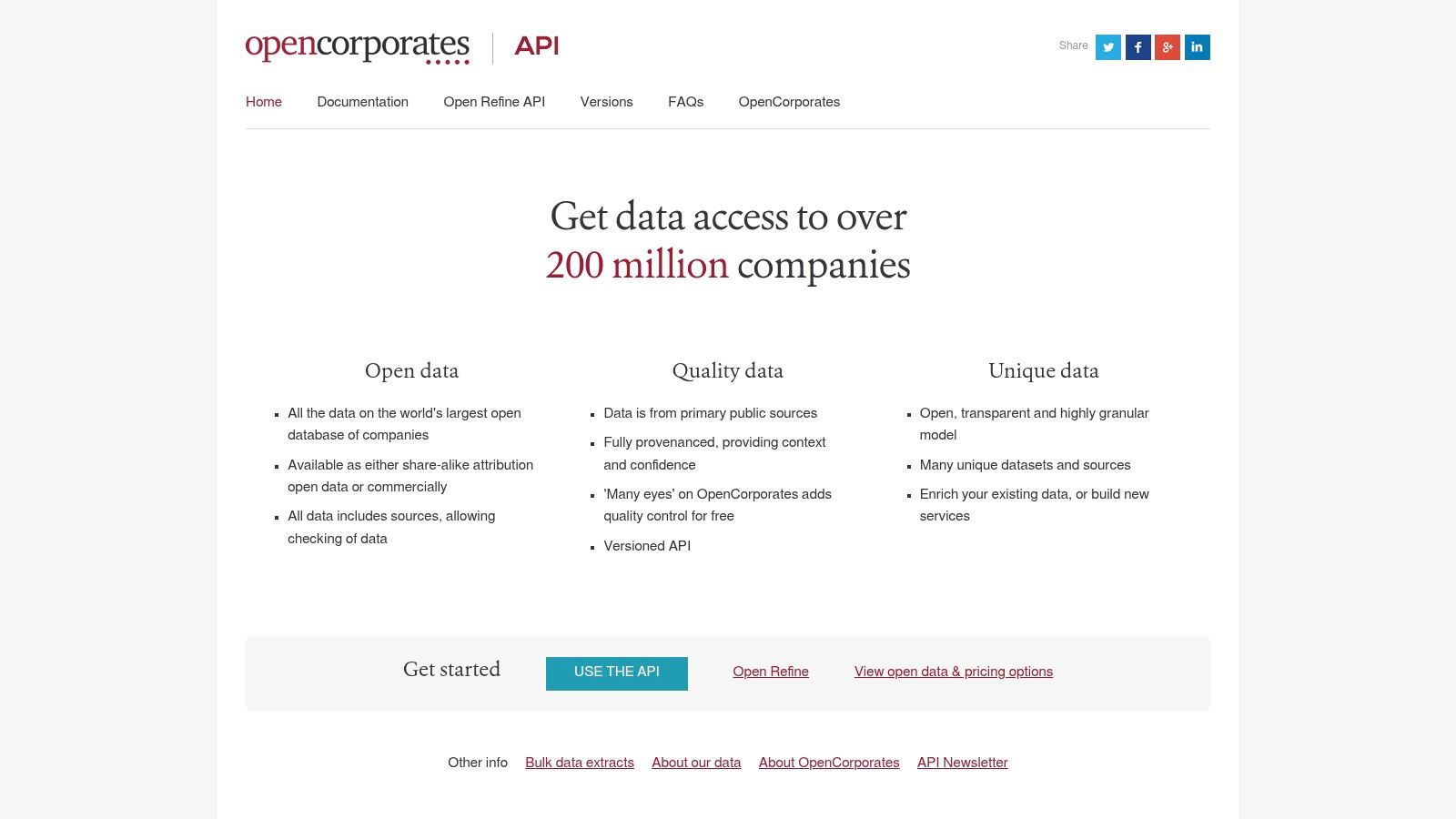
OpenCorporates is designed for a different standard of evidence. Its API focuses on company and officer records linked to public registers, with searches based on jurisdiction, company number, and company name. It can also connect records to external identifiers, including LEIs through collaboration with GLEIF.
Choose OpenCorporates for legal-entity work
Use OpenCorporates when the workflow needs a registered name, jurisdiction, company number, officer relationship, or transparent public-record provenance. That makes it relevant to KYC, compliance, supplier onboarding, entity resolution, and legal-entity enrichment. Its public data dictionaries and REST interface can be easier to inspect than a sales intelligence schema.
Registry data is also structurally fragmented. One provider describes an aggregation model covering more than 374 million companies and 605 million officers across over 190 countries, sourced from more than 1,200 official registers (company registry API documentation). That is a provider claim, not an independent census, but it shows why developers need normalization, identifier mapping, source monitoring, and historical-change handling.
Know what it doesn't provide
OpenCorporates is not intended to replace commercial GTM enrichment. Employee counts, technology profiles, buying signals, and sales contacts may be limited compared with firmographic platforms. Commercial extracts and large datasets can also involve sales-assisted terms.
For address and entity workflows, this business address lookup API resource provides a useful adjacent perspective. Keep the source's provenance, jurisdiction, retrieval time, and match logic in your record. Registry-backed evidence is valuable precisely because another person may need to understand how the system reached its conclusion.
Top 10 Company Enrichment APIs, Quick Comparison
| Provider | Core Features | Quality / UX | Price & Value | Target Audience | Unique Selling Points |
|---|---|---|---|---|---|
| Clearbit (by HubSpot), Enrichment API | Company & person enrichment; IP-to-company Reveal | ★★★★; mature docs & SDKs | 💰 HubSpot-tiered / sales-led (no public pricing) | 👥 CRM/SaaS teams, prototyping | ✨ IP Reveal; easy CRM drop‑in; 🏆 HubSpot distribution |
| People Data Labs, Company Enrichment API | Company + person + IP endpoints; SDKs & Postman | ★★★★; developer-first tooling | 💰 Credit-based (Free / Pro / Enterprise) | 👥 Dev teams, automated enrichment pipelines | ✨ Large maintained dataset; transparent credits |
| Apollo.io, Company Enrichment via REST API | Firmographics, CSV/bulk enrichment, CRM sync | ★★★★; clear playbooks & docs | 💰 Credits tied to UI plans (verify entitlements) | 👥 Sales/marketing teams, SaaS operations | ✨ CSV & CRM workflows; LinkedIn links |
| ZoomInfo, Enterprise API | Domain firmographics + contacts & intent; connectors | ★★★★★; enterprise SLAs & governance | 💰 Sales-led; expensive for small teams | 👥 Enterprises doing ABM, routing & scoring | ✨ Deep dataset + connectors; 🏆 enterprise-grade support |
| Crunchbase, REST API | Company profiles, funding rounds, investors | ★★★★; targeted field retrieval (V4) | 💰 Sales-assisted / packaged plans | 👥 GTM, BD, VC/finance teams | ✨ Funding & investor graph for scoring |
| Dun & Bradstreet, Direct+ Enrich | D‑U‑N‑S, corporate linkage, risk & financials | ★★★★★; authoritative enterprise API | 💰 Enterprise licenses / custom pricing | 👥 Compliance, risk, governance teams | ✨ D‑U‑N‑S & corporate hierarchies; 🏆 gold‑standard identity |
| Coresignal, Company Enrichment API | Multi-source company, employee & jobs signals | ★★★★; API-first, fresh signals | 💰 Dataset/volume-based pricing (varies) | 👥 Data teams, scoring/AI systems | ✨ Real-time hiring & workforce signals; multi-source |
| BuiltWith, Technology Lookup API | Domain technographic profiles; bulk processing | ★★★★; high-volume APIs & exports | 💰 Credit plans; bulk pricing | 👥 ICP targeting, pre-filtering teams | ✨ Deep tech taxonomy; good for pre-filtering |
| Wappalyzer, Technology Lookup API | Tech detection API with bulk/async options | ★★★★; simple & predictable API | 💰 Metered self-serve plans | 👥 Lightweight teams, quick ICP qualification | ✨ Cost-effective tech lookups; self-serve metering |
| OpenCorporates, Company Registry API | Official registry data: names, officers, numbers | ★★★★; transparent provenance & REST | 💰 Self-serve for small queries; sales for bulk | 👥 Compliance, KYC, legal-entity enrichment | ✨ Public-register provenance; LEI mapping; 🏆 authoritative registry |
Build the Smallest Reliable Enrichment Stack
The best company data enrichment API is the one that completes the required job without forcing unrelated data into the workflow. Choose a broad firmographic provider when account routing, segmentation, CRM enrichment, or lead scoring needs company context from domains, emails, or names. Clearbit, People Data Labs, Apollo, and ZoomInfo occupy that broad commercial category, with different trade-offs around ecosystem fit, API access, pricing visibility, and enterprise commitment.
Choose technographic data when the decision depends on a website's software stack. BuiltWith and Wappalyzer are more direct than a general enrichment platform for that task. Choose funding data when momentum, investors, funding rounds, or acquisition relationships affect prioritization. Crunchbase adds that context, but it doesn't establish the legal identity used for invoicing or compliance.
Choose registry data when the workflow needs a registered company name, jurisdiction, officer, company number, or public-record provenance. OpenCorporates is focused on that job. Choose D&B when the organization needs governed identity resolution, corporate hierarchy, ownership relationships, risk information, or enterprise controls. Its heavier contract and integration model can be appropriate when a flat company profile isn't enough.
Keep validation separate from enrichment. A firmographic record can suggest that an organization exists, but it shouldn't automatically become evidence for a tax decision. VIES retrieves information from national VAT databases at query time, and the European Commission warns that the service can be unavailable while national databases are backed up (VIES check VAT service). Your implementation should distinguish invalid, temporarily unavailable, not registered for intra-EU trade, and undisclosed data instead of collapsing every negative response into one status.
TaxID is the focused option for VAT and company identification number validation across 31 countries, including EU validation through VIES. Its single REST endpoint returns structured JSON with validation status, registered company name, and address. The platform adds format checks before remote calls, a Redis-backed 24-hour cache, standardized machine-readable errors, and resilience features for billing, checkout, invoicing, and compliance workflows. Those features address a different job from a sales intelligence API.
The regulatory direction also favors APIs that preserve provenance and changing source semantics. EU Regulation 2025/517 calls for a central VIES system, automated transmission of VAT-identification and transaction information, rapid updates, ten-year retention, and machine-to-machine access (EU regulation information). That doesn't mean every enrichment provider should collect every available tax or transaction field. Purpose limitation, retention controls, role-based access, and clear evidence states remain necessary.
Run a pilot before selecting a long-term vendor. Use representative domains, company names, legal names, registration numbers, and tax IDs from the countries you serve. Measure:
- Input coverage: Test the identifiers your product receives in production, not only clean domains.
- Field completeness: Record missing firmographics, technology attributes, registry fields, and validation responses separately.
- Match quality: Review false matches, parent-company matches, duplicate entities, and unresolved records.
- Freshness behavior: Store response timestamps, source status, and expiry decisions for important fields.
- Failure handling: Test timeouts, rate limits, service outages, invalid inputs, retries, and partial responses.
- Cost per successful match: Include credits, failed calls, retries, bulk processing, support, and sales-assisted commitments.
- Retention and provenance: Decide what response, source, consultation identifier, and normalized input must remain available for review.
A small stack often beats a large platform. One broad firmographic source, one focused technology or funding source when needed, one registry source for legal identity, and TaxID for VAT or company-number validation can be easier to govern than a single product that claims to do everything. The right architecture keeps enrichment useful for routing while keeping validation defensible for finance and compliance.
TaxID provides a developer-first REST API for validating VAT and company identification numbers across 31 countries, with structured status, registered company name, address, standardized errors, caching, and resilience for billing workflows. If your SaaS, marketplace, or checkout needs reliable tax-ID validation alongside broader enrichment, visit TaxID and test the API with your production-style inputs.