Your VAT validation endpoint works perfectly inside the billing service. The checkout team calls it, the response is predictable, and nobody outside the company needs to know it exists. Then a customer asks for direct integration, a partner wants to embed validation in its onboarding flow, or your sales team suggests publishing the endpoint.
That's when the public API vs private API question becomes real. You aren't choosing a label for documentation. You're deciding whether an internal capability should become a product that external identities, unknown traffic patterns, and long-lived integrations can depend on.
The right answer depends on four questions: who needs to call the endpoint, what identity it trusts, what data it returns, and how much lifecycle cost your team can absorb. Security matters, but public and private aren't security grades. They're access and governance choices.
Table of Contents
- The Question Behind Public API vs Private API
- What Public and Private APIs Actually Mean
- Side-by-Side Criteria That Drive the Decision
- Why Private Does Not Automatically Mean Safer
- Discoverability, Identity, and the Real Decision Lens
- Choosing the Right Path for Common SaaS Scenarios
- A Hybrid Governance Pattern You Can Ship Monday
The Question Behind Public API vs Private API
Most SaaS teams ask whether an API should be public or private too early. Start by asking who needs the capability.
If only your checkout service calls a VAT lookup, the endpoint is infrastructure. You control the caller, the deployment environment, and the release schedule. If external developers need that same lookup in their own checkout flows, the endpoint becomes a product surface. You now need a stable contract, customer-specific credentials, usage controls, support expectations, and a plan for change.
A company-data endpoint illustrates the decision clearly. An internal billing workflow might call a service that validates a customer's tax number before generating an invoice. A public developer product needs to let an outside application submit a tax ID, receive a predictable result, handle upstream failure, and understand the response without access to your source code. The underlying business operation may be identical, but the operating obligations are not. For background on this kind of integration, see the company data API guide.
Start with the audience
Ask whether the caller is:
- Your own service, deployed and operated by your team.
- A named partner, with a contractual relationship and known integration requirements.
- An external developer or customer, who can discover, register for, and use the capability without direct coordination.
Audience determines how much uncertainty you must handle. Unknown consumers retry differently, interpret errors differently, and upgrade on their own schedule.
Identify the trusted identity
A private network location isn't enough. Your service should know which workload is calling, which tenant it represents, and which resources that identity can access. Public clients usually need OAuth credentials, signed tokens, or scoped API keys. Internal callers still need workload identity, authorization, and credential rotation.
Classify the data and failure impact
A read-only format check is not equivalent to an endpoint that changes invoices, releases payments, or returns KYC records. Ask what the endpoint exposes, what it can change, and what happens if the result is wrong, delayed, or replayed.
Price the lifecycle
A public endpoint creates a continuing product obligation. Someone must own the documentation, compatibility policy, rate limits, monitoring, incident response, and deprecation process. If nobody can own those tasks, keep the interface private or expose a narrower facade instead.
Practical rule: Expose an endpoint publicly only when external access creates clear product or distribution value, and when you're prepared to operate the contract as a product.
What Public and Private APIs Actually Mean
A public API is an interface available to external consumers. “Public” doesn't mean unauthenticated or free. It means an outside developer, customer, or application can obtain access through a defined process and call the service from outside your organization.
A TaxID-style VAT validation endpoint is a useful example. A signed-up developer might authenticate, submit a VAT number, and receive a structured validation response. The developer doesn't need access to the provider's internal billing service, database, or upstream integration. The public facade exposes one controlled capability.
A private API is restricted to internal developers, workloads, or controlled networks. An internal checkout service might call a billing endpoint that calculates invoice eligibility or retrieves an account's payment status. The endpoint isn't intended for customer applications, and its contract may change alongside the services that consume it.
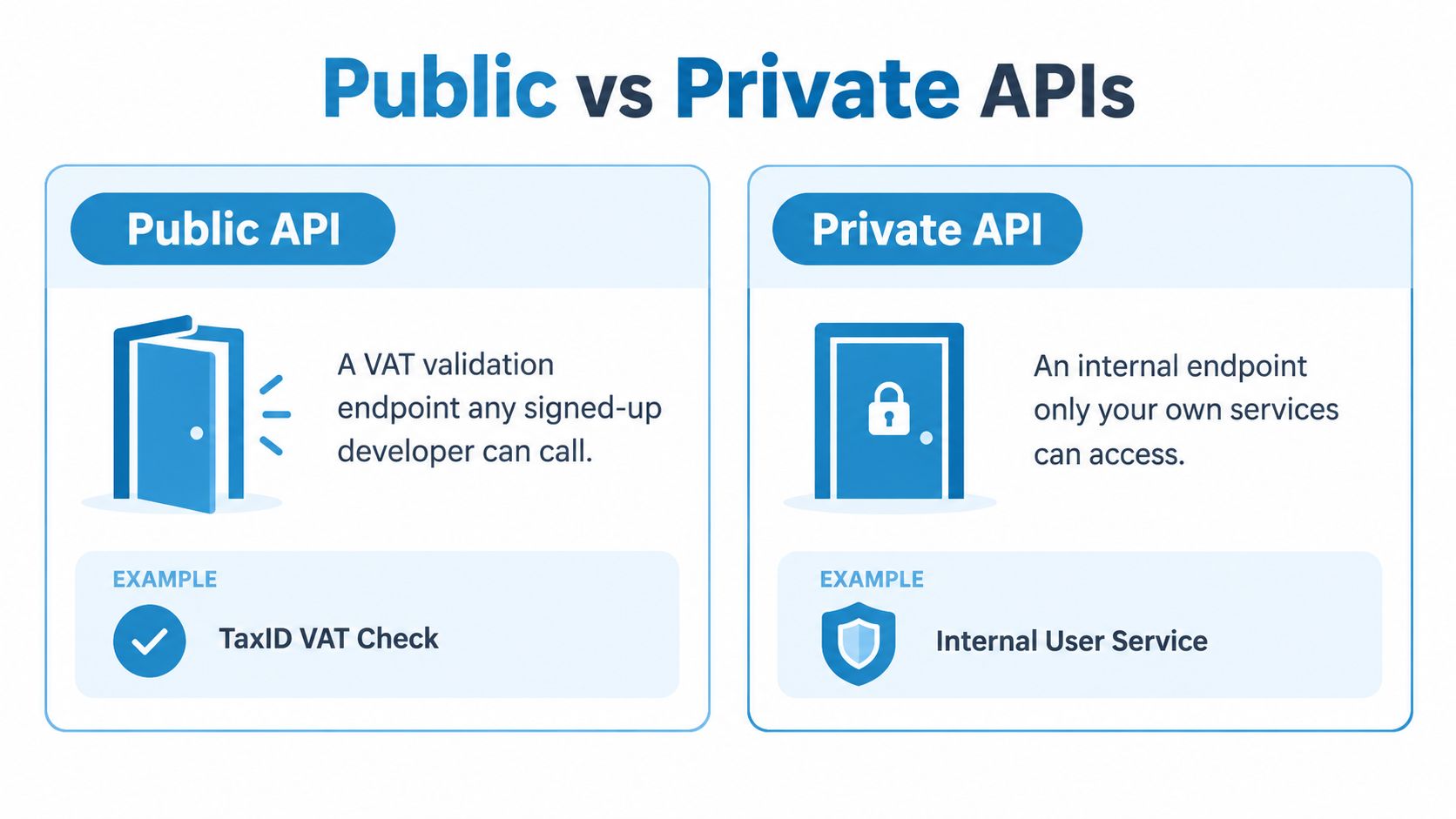
Public and private describe access governance
The public/private label tells you who is allowed to discover and call the endpoint. It doesn't tell you whether the endpoint is well secured.
A public API should normally apply authentication, scoped authorization, tenant isolation, request validation, quotas, and abuse monitoring. A private API may use mutual TLS, workload identity, network policy, and service-to-service authorization. Both still need endpoint-level authorization because network placement doesn't prove that a caller should access a particular resource.
NIST's cloud-native guidance supports this layered approach, including identity-based segmentation, rate limiting, timeouts, circuit breakers, and input and output validation for APIs that aren't necessarily internet-facing (NIST API security guidance).
Partner APIs occupy the middle
Many teams force partner integrations into the public or private category. That's a mistake. A partner API is externally reachable but restricted to named organizations, contractual clients, or approved applications.
A logistics carrier integration is a typical example. You may need internet connectivity because the partner operates outside your network, but you don't want anonymous self-service access. Partner credentials, allowlists where appropriate, contractual quotas, and a dedicated support process fit better than either a fully open developer API or an internal-only endpoint.
For teams assessing an exposed interface, a practical API penetration testing guide from ThreatExploit AI can help identify authorization, input-handling, and abuse paths before customers depend on the endpoint.
Side-by-Side Criteria That Drive the Decision
The public API vs private API choice becomes easier when you compare the operating criteria instead of arguing about labels.
| Criterion | Public API | Private API |
|---|---|---|
| Security model | External identity, scoped access, tenant isolation, abuse monitoring | Workload identity, service authorization, network controls, internal monitoring |
| Rate limiting | Required per client, tenant, credential, or plan | Still needed to prevent overload and cascading failure |
| Versioning | Stable contract, explicit compatibility and deprecation policy | Coordinated releases may work, but undocumented coupling creates risk |
| SLAs | External consumers expect published reliability and support expectations | Internal teams need dependency objectives and clear ownership |
| Discoverability | Documentation and onboarding are intentionally accessible | Registry, catalog, and internal documentation should control discovery |
| Monetization | Can support subscriptions, quotas, usage billing, or partner pricing | Usually supports internal efficiency rather than direct revenue |
| Governance | Product owner, audit trail, lifecycle policy, abuse response | Inventory, ownership, least privilege, and retirement discipline |
Security model
Public clients are outside your operational boundary. You can't assume their network, deployment process, or retry behavior. Give each consumer an identity, restrict its scopes, isolate tenants, validate payloads, and record authorization decisions.
Private callers are more predictable, but they can still be compromised or overprivileged. A service account that can read every tenant's billing data turns one credential leak into a broad incident. The practical implication is simple: private reduces the audience, not the need for authorization.
Rate limiting
Public endpoints need quotas because an unknown client can generate accidental or deliberate load. Apply limits by customer, credential, tenant, and sometimes operation. Return machine-readable responses so clients can back off rather than retry blindly.
Private services also need limits. A failed dependency can cause retries across multiple internal services, creating a cascade. Timeouts, circuit breakers, bounded concurrency, and queue controls protect the rest of the platform.
Versioning
External clients upgrade on their own schedule. A public API needs additive change where possible, explicit versions when behavior changes, and a deprecation process that gives consumers time to migrate.
Internal teams can coordinate deployments more closely, but shared ownership often makes “we'll update everything together” unreliable. Register internal APIs, assign owners, and document compatibility assumptions.
For response behavior, define status codes and error bodies consistently. A focused reference on REST API response code best practices is useful when you're turning internal errors into a contract external developers can consume.
SLAs and support
A public API needs a stated reliability target, status communication, and a support path. You don't need an elaborate enterprise SLA on day one, but you do need to tell customers what the endpoint does during dependency failure.
Private services still need operational objectives. An internal checkout dependency can block revenue just as quickly as a public outage can frustrate customers.
Discoverability, monetization, and governance
Public documentation makes discovery intentional. It can attract integrations and create a distribution channel, but it also advertises an attack surface and creates support demand.
Monetization is possible when external usage maps to customer value. You might charge for validation volume, include calls in a subscription, or reserve higher quotas for paid plans. Private APIs usually monetize indirectly by reducing duplicated engineering work.
For a plain-language overview of API call patterns relevant to founders, see this guide to API call types for founders. The central governance question remains ownership: who maintains the contract, reviews access, monitors use, and retires the endpoint?
Why Private Does Not Automatically Mean Safer
“Internal” is a routing decision, not a security control.
Salt Security reported that 95% of respondents had experienced security problems in production APIs, while 23% had experienced an API-related breach. The same report said API volume had increased by 167% year over year, while only 7.5% of organizations had dedicated API testing and threat-modeling programs (Salt Security's API security report). Those figures describe production API exposure broadly, and they reinforce a point many teams miss: internal systems can fail through the same authorization, validation, and secrets mistakes as public systems.
A separate 2025 API security dataset recorded 639 API-related CVEs in Q2, up 9.8% from 582 in Q1 (2025 API threat statistics report). The lesson isn't that every private endpoint has internet-level exposure. The lesson is that “private” doesn't remove the need to discover, test, patch, and monitor the interface.
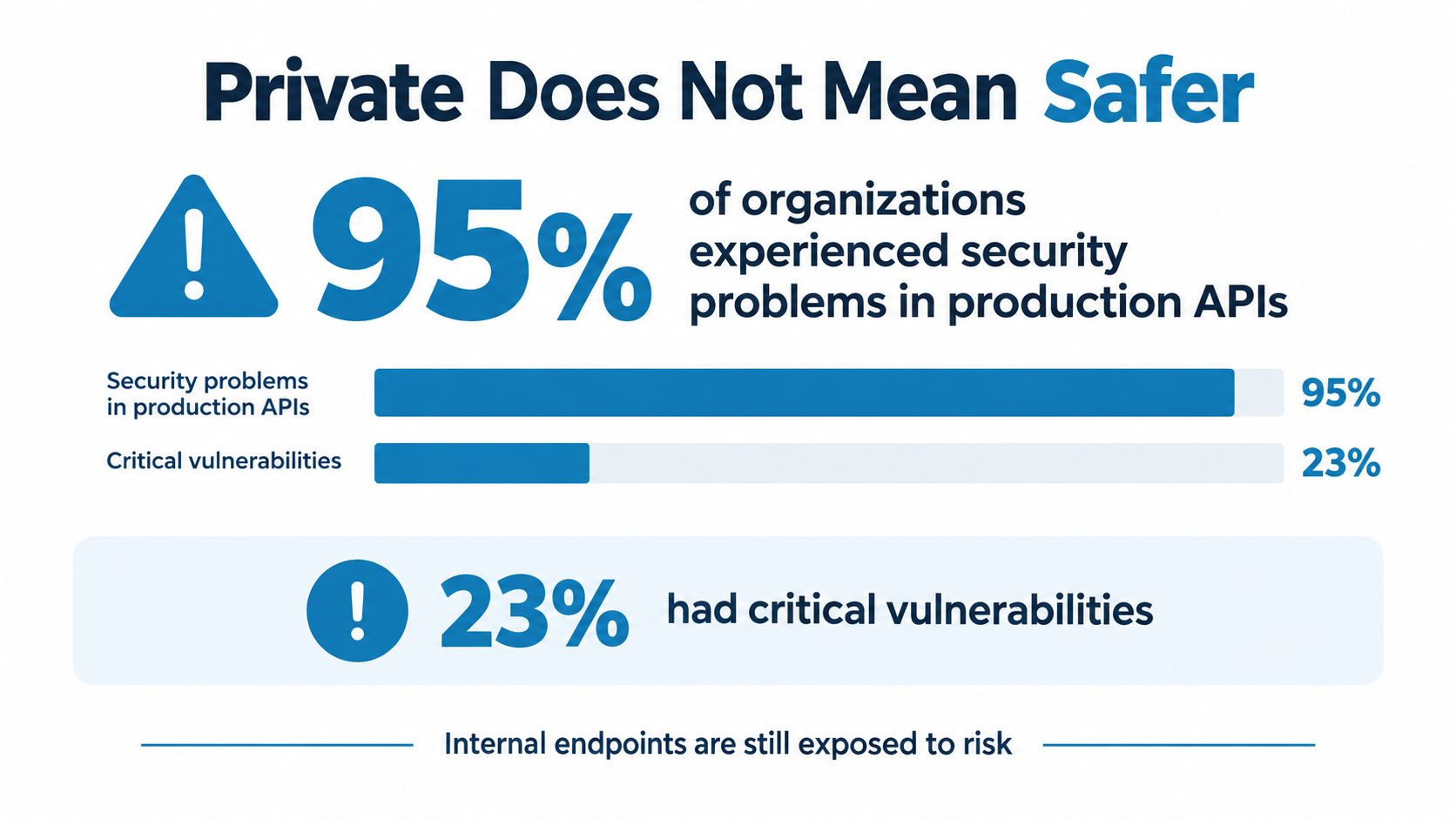
Common private API failure patterns
- Overprivileged service credentials: One internal service receives broad read and write permissions because narrower scopes take more work.
- Shadow endpoints: A temporary administrative route remains deployed after the original owner moves teams.
- Hardcoded secrets: Integration credentials enter source code, build logs, or deployment configuration and remain valid longer than intended.
- Legacy exposure: A route described as internal still has a public path, permissive gateway rule, or forgotten cloud URL.
- Missing tenant checks: An internal service trusts the caller and returns records without verifying that the requested resource belongs to the caller's tenant.
These failures are especially serious in billing and KYC workflows. Internal services may process tax identifiers, company records, payment state, invoice data, or compliance decisions. If one credential can query every customer or alter financial state, network restriction only limits the first step of the attack.
Security principle: Treat every endpoint as a governed product. The audience changes the controls you emphasize, not whether controls are required.
Use layered protection: workload identity, mutual TLS where appropriate, endpoint authorization, least-privilege scopes, input validation, encryption in transit, secret rotation, audit logs, anomaly detection, rate controls, and a maintained inventory. A separate safety overview for campaign tools is a useful reminder that operational safeguards should be explicit rather than assumed.
Discoverability, Identity, and the Real Decision Lens
The strongest decision lens isn't “public or private.” Ask four sharper questions:
- Who can discover the endpoint?
- What identity does it trust?
- What data or actions does it expose?
- How does the system continuously verify access?
Those questions reveal whether an endpoint is an internal utility, a partner product, or a public distribution channel.

A public API can create strategic value because outside developers build distribution around it. A 2023 study in Management Science found that firms adopting public APIs had 38.7% additional growth over 16 years compared with similar firms that didn't adopt public APIs. The study also found that public APIs expanded the network of connected applications, while public API adoption remained concentrated at approximately 3.5% of firms in the Compustat services-sector sample and about 3% of firms in transportation and public utilities by the end of the study period (the Management Science API study).
That evidence supports a strategic conclusion: public exposure can function as distribution infrastructure, not merely as a technical access setting. It also carries exposure risk. The same study found significantly increased hacking risk after firms opened a public API, so the growth opportunity must be paired with deliberate controls.
Private API use serves a different purpose. The study measured private APIs in roughly 0.7% of firm-quarters in its sample and found no direct market-value effect from private API use. That doesn't make private APIs unimportant. It means their payoff is usually operational, such as modularity, reuse, and internal integration, rather than external network growth.
For a SaaS billing or KYC system, the decision follows the data and identity. A narrow validation result for an external customer may fit a public facade. An administrative endpoint that changes billing state belongs behind controlled access. Product documentation, such as the TaxID API documentation, should describe the external contract without exposing internal implementation details.
A useful visual explanation of how teams can reason about these boundaries appears below.
Choosing the Right Path for Common SaaS Scenarios
Use the audience and failure impact to choose the path. Don't expose an entire internal service just because one capability has external value.
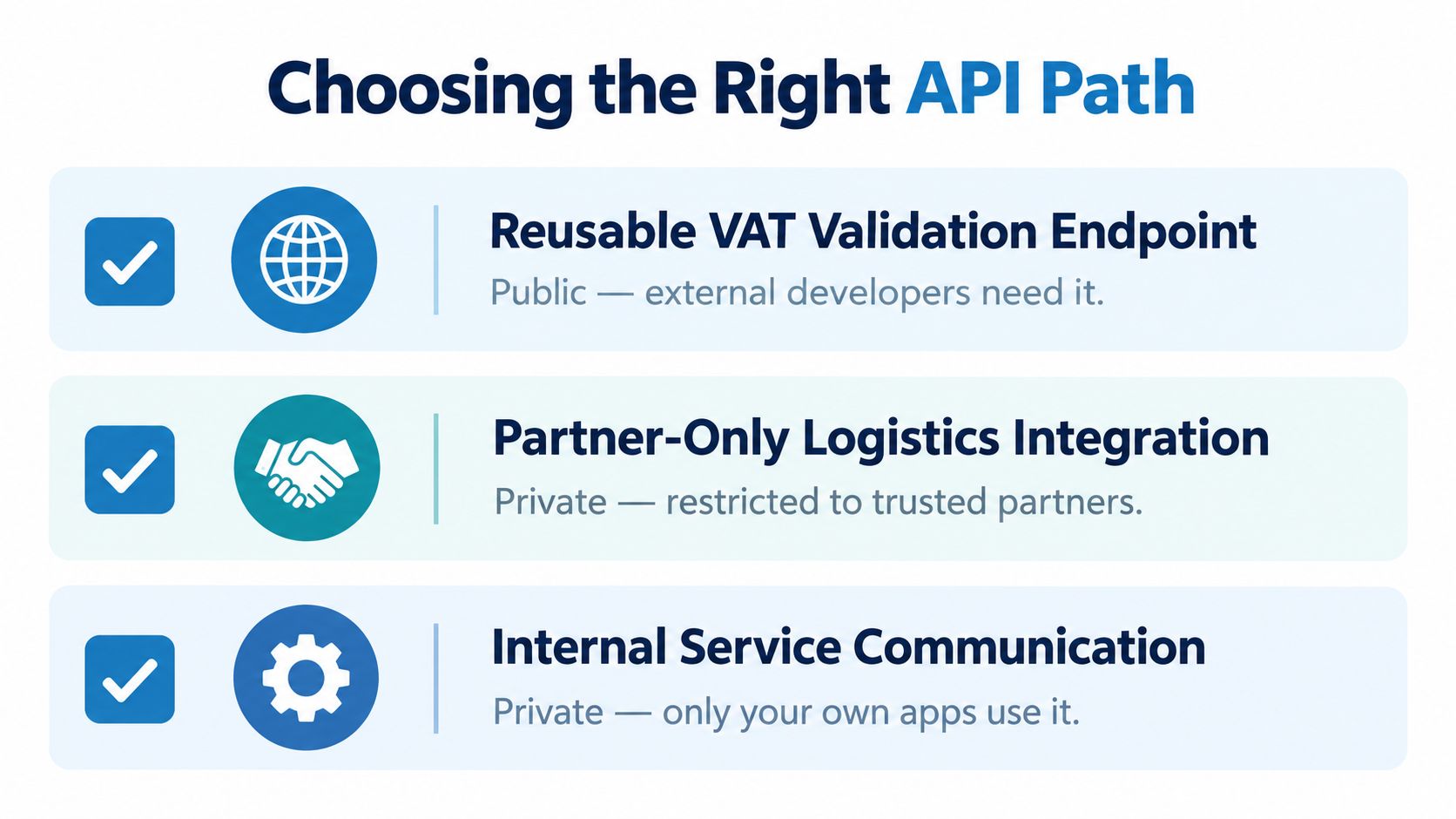
Reusable VAT or company validation
Choose public when external developers need repeatable access to a narrow validation capability. The trigger is clear: customers want to call the service from their own checkout, invoicing, or onboarding application without coordinating deployment with your team.
Minimum controls include:
- Scoped credentials: Give each customer a revocable identity with only the permissions it needs.
- Tenant isolation: Never let one customer's credential retrieve another customer's data.
- Schema validation: Reject malformed tax IDs and unsupported requests before expensive upstream work.
- Quotas and abuse detection: Protect the service and any authoritative dependency from uncontrolled traffic.
- Stable errors: Return machine-readable codes for invalid input, unavailable dependencies, and authorization failures.
- Dependency resilience: Cache safe repeat lookups and use explicit timeouts and circuit breaking around fragile upstream systems.
A wrapper around a government or tax validation service belongs in the public or partner column when customers depend on it, even if the upstream provider is unreliable. Your customers need your contract to remain predictable when the dependency is not.
Partner-only logistics integration
Choose partner when one or more named carriers, marketplaces, or suppliers need access, but anonymous developer discovery adds no value. The partner relationship should determine onboarding, credentials, quotas, support, and data-sharing boundaries.
Use separate identities per partner. Log every request against the partner and tenant. Keep administrative functions private, and expose only the operations required for shipment creation, tracking, or status updates.
Internal microservices
Choose private when only your own applications need the interface. A service-to-service endpoint inside a VPC or service mesh can avoid unnecessary public exposure, but don't skip identity and authorization.
Keep a registry of private APIs, name an owner, define request and response schemas, and monitor latency, errors, retries, and dependency health. Private services still need timeouts and circuit breakers because internal failures can propagate quickly through checkout and billing.
Embedded billing inside a fintech product
Choose partner or public based on the commercial contract. If a small set of named fintech customers embeds the capability, issue partner credentials and tailor limits and support to each relationship. If many independent developers should integrate through self-service onboarding, build a public facade.
Keep payment administration, account mutation, and compliance operations private. Expose only the narrow business action the integration needs, with explicit authorization for each tenant and resource.
A Hybrid Governance Pattern You Can Ship Monday
The strongest design for most SaaS teams is hybrid. Keep core services private, then expose a narrow public or partner facade that translates external requests into controlled internal operations.
The facade should own the external contract. Internal services shouldn't leak database models, administrative fields, retry assumptions, or upstream error text. The boundary should validate requests, authorize the caller, apply quotas, normalize errors, and emit audit events before invoking private services.
Define the public contract
A credible external facade needs:
- Stable schemas: Add fields without breaking existing clients, and avoid exposing internal object names.
- Machine-readable errors: Return consistent codes, status meanings, and remediation guidance.
- Useful documentation: Show authentication, request examples, response shapes, limits, and failure behavior.
- Versioning policy: State how incompatible changes are introduced and how old versions are retired.
- Observability: Attribute requests to customers, tenants, credentials, endpoints, latency bands, and outcomes.
- Deprecation process: Announce changes, measure remaining usage, provide migration guidance, and remove old behavior deliberately.
Performance deserves its own benchmark. Public routes often pass through internet transit, DNS, TLS termination, gateways, WAF rules, authentication, quotas, and geographic routing. Private routes may avoid some boundaries, but neither category guarantees better latency. Measure p50, p95, and p99 latency for cache hits and misses, throughput, errors, connection setup, and timeout behavior. IBM describes API management as a way to enforce performance benchmarks and track usage across public, private, and partner APIs (IBM's API management overview).
Grade an endpoint before promoting it
Ask:
- Does an external consumer need this exact capability?
- Can we issue a distinct identity and enforce narrow permissions?
- Is the returned data appropriate for that audience?
- Can we support the contract through dependency outages?
- Do we have an owner for documentation, monitoring, and deprecation?
- Would a smaller facade expose the value with less risk?
If the answers are mostly no, keep the endpoint private. If the value is real but the full service is too broad, create a purpose-built facade. Public API vs private API isn't a permanent classification. It's a governance decision you can revisit as the product, audience, and operational maturity change.
If your SaaS needs dependable VAT and company-number validation without exposing internal billing services, TaxID provides a REST API that returns structured validation results and machine-readable errors for billing, checkout, and KYC workflows. Review the integration model, decide whether you need a public or partner-facing facade, and test the endpoint in your next architecture sprint.