A billing integration can look healthy while making the wrong decision. The API returns HTTP 200, but the JSON body says "success": false; the client treats the request as successful, applies a tax exemption, and moves on. Or a validation service is temporarily unavailable, but its response looks just like an invalid tax identifier, so a legitimate customer gets blocked. These aren't JSON syntax problems. They're contract problems.
A reliable REST API JSON response format coordinates the HTTP status, media type, body shape, pagination rules, and error details. Clients need to understand both what the server returned and how to act on it, without guessing from prose or depending on undocumented quirks. That matters in checkout, billing, and compliance flows, where a response can drive a consequential decision.
Table of Contents
- Introduction to REST API JSON Response Formats
- HTTP Status Codes as Part of the Response Contract
- Envelope vs. Bare Object Responses
- Pagination Response Formats
- Error Response Formats with Machine-Readable Codes
- Content Negotiation and Media Types
- Example Schemas and JSON Snippets
- Quick Reference and Cross-Reference Guide
Introduction to REST API JSON Response Formats
JSON started with roots in JavaScript object notation, but it grew into a language-neutral data-interchange format. It became an ECMA standard in 2013 and was formalized internationally through ISO/IEC 21778 and the Internet Engineering Task Force's RFC 8259 in 2017. That standardization matters in practice: a JavaScript checkout, a Python billing service, a Java backend, or a client written in PHP, Ruby, Go, or C# can all parse the same predictable syntax without knowing how the server is implemented (JSON's standardization history).
The trouble usually starts after a client parses the JSON. One endpoint returns a resource directly, another wraps it in data, and a third adds a success flag that contradicts the HTTP status. An error might be returned as HTTP 200 with a sentence in a message field. The client then has to infer whether to retry, request credentials, correct input, or stop.
A response contract is bigger than its body. The status code, headers, schema, and documented client behavior need to agree.
That's why a sound response design makes several connected decisions. The HTTP status communicates the operation's outcome. Content-Type tells the client how to process the representation. The JSON schema determines where resource data and metadata live. Pagination defines how clients move through changing collections. Error fields distinguish, for example, a correctable validation problem from a temporary dependency failure.
These decisions are especially visible in integrations that run automatically. A checkout flow must decide whether a submitted identifier is invalid or whether validation is temporarily unavailable. A billing job needs to know whether a list response has another page and whether retrying a request could return duplicate records. Teams building these workflows can use this guide to integrating with a REST API as a practical starting point.
A good contract doesn't require one universal JSON schema. It requires consistent, documented choices. The sections below focus on the choices that most often affect real clients: status semantics, envelopes, pagination, error formats, media types, and complete response examples.
HTTP Status Codes as Part of the Response Contract
The status code is not decoration above the JSON. It's a direct signal to the client about the outcome of the HTTP operation, and it should match the body. A client should be able to tell whether a request succeeded, failed because of its input, or hit a temporary service problem before it reads a human-readable explanation.
Common outcomes include 200 OK for a successful operation that returns a representation, 201 Created when the operation creates a resource, and 204 No Content when the operation succeeds without a body. For failures, 400 indicates a malformed request, 401 missing or invalid authentication, 403 insufficient permission, and 404 a missing resource. 415 signals an unsupported media type; 429 indicates rate limiting; 500 means an unexpected server failure; and 503 indicates temporary unavailability. OWASP's REST security guidance documents these standardized outcomes and their meanings (OWASP REST Security Cheat Sheet).
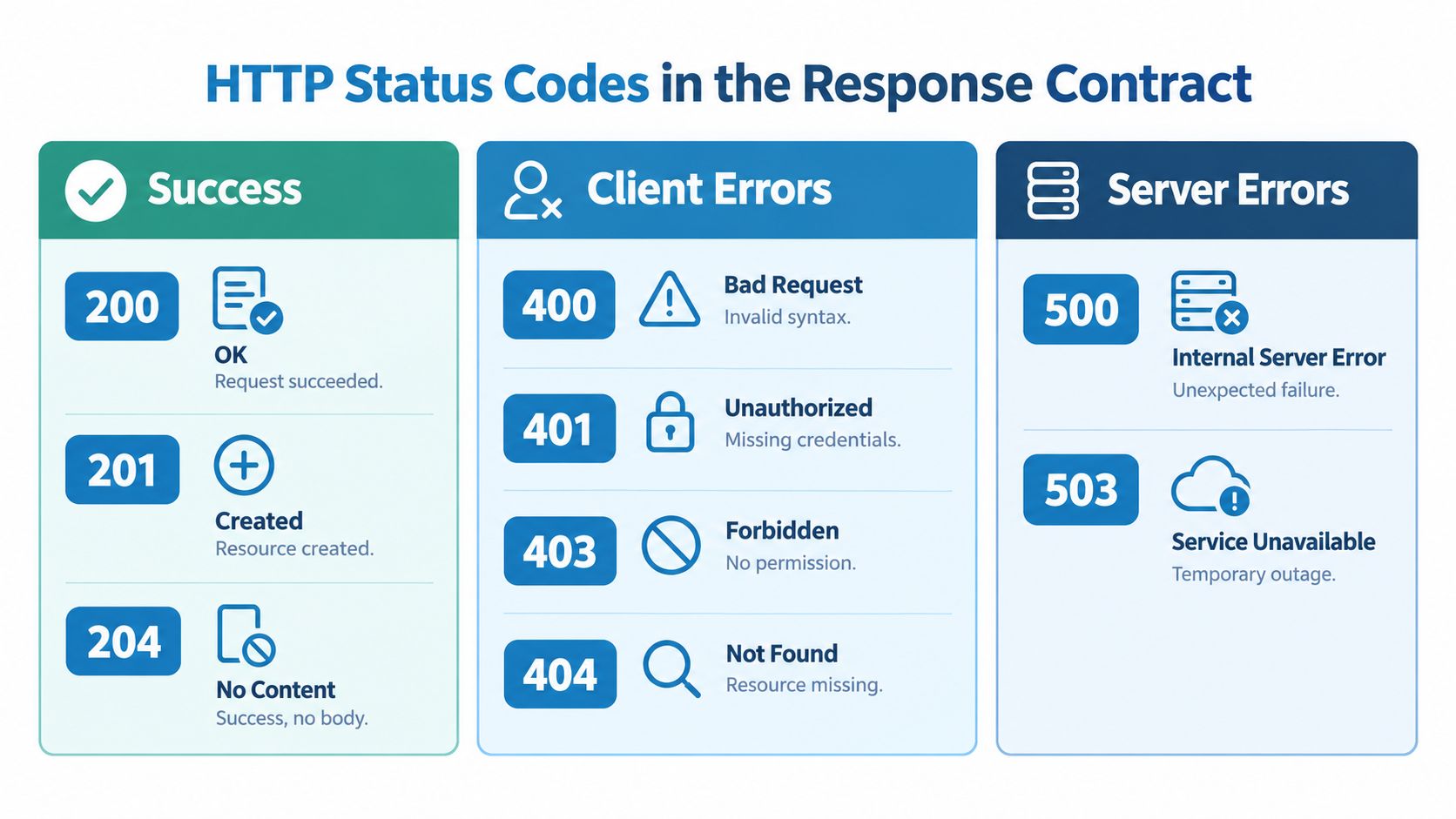
Let the outcome guide the client
A useful contract lets software choose an action without parsing the explanation:
- For
401, the client can request credentials or refresh its authentication. - For
429, the client can slow down instead of repeatedly sending requests at the same pace. - For
503, the client can apply its documented retry or fallback behavior. - For
400, the client can show a correctable input problem rather than treating it as a service outage.
The JSON body adds context, such as a stable error code or field-level validation details. It doesn't replace the status. A client can make a sensible first decision from the status, then use the body to explain or refine that decision.
Returning HTTP 200 for every outcome and putting success or failure only in an application-level field is a poor trade-off. It forces every client to implement custom interpretation, and intermediaries or monitoring tools may treat a failed operation as successful. In billing or compliance flows, that mismatch can contribute to duplicate requests, incorrect tax handling, or failures that go unnoticed.
Practical rule: Choose the status for the actual HTTP outcome, then make the JSON body explain it. Don't make the client reverse-engineer the result from a message.
Teams comparing code meanings across services can also consult the RealtyAPI.io HTTP status guide. For a deeper treatment of code selection and API behavior, see these REST API response code best practices.
Envelope vs. Bare Object Responses
Consider a client that requests a company record. The API can return the resource directly:
{
  "id": "co_123",
  "name": "Example Company",
  "country": "DE"
}
Or it can place the resource inside a response envelope:
{
  "data": {
    "id": "co_123",
    "name": "Example Company",
    "country": "DE"
  },
  "request_id": "req_abc"
}
Neither shape is automatically more RESTful or more reliable. The better choice depends on what the endpoint needs to communicate and whether the API can apply the same convention consistently.

When a bare object fits
A bare object keeps the resource at the top level. That's easy to read and works well when a simple endpoint returns one resource and has no body metadata to carry. It also avoids an extra layer of nesting, which can make small responses easier to consume.
The trade-off is flexibility. If you later need to add body-level metadata, a pagination object, or a request identifier, you'll need to decide whether to add top-level fields beside the resource or change the response shape. That change can surprise clients that assume every top-level property belongs to the resource.
When an envelope pays for itself
An envelope gives the API a dedicated place for resource data and response metadata. A stable shape such as { "data": {...}, "request_id": "..." } can make list, detail, and paginated responses easier to distinguish. For collections, it can hold data alongside meta without mixing pagination state into individual records.
The cost is ceremony. Wrapping every tiny response may add little value when the resource already contains everything the client needs. An envelope also doesn't fix an inconsistent contract by itself. If one endpoint uses data, another uses result, and a third nests metadata differently, clients still have to handle separate patterns.
A middle ground is to keep a bare resource in the body and put tracing information in an HTTP header. That can be a good fit when request metadata shouldn't alter the resource representation. Whichever design you choose, define it in the API documentation and avoid shifting between styles without a compatibility plan.
Pagination Response Formats
A pagination response needs to tell clients more than which slice they received. It should make clear how the client continues, how it knows the collection is exhausted, and what happens if the underlying records change while it is fetching pages.
Offset pagination uses a position, often represented by page and limit or by offset and limit. It's straightforward for stable administrative lists and interfaces where people expect numbered pages. But if records are inserted or deleted between requests, later offsets can point to a shifted set of items. A client might see a duplicate or miss an item while moving through the collection.
Cursor pagination returns an opaque token that identifies where to continue. It's generally safer for frequently changing feeds because new records don't shift the client's position in the same way. Recent guidance distinguishes these use cases and recommends testing concurrent page requests to check that data doesn't shift between pages (JSON best practices for pagination).
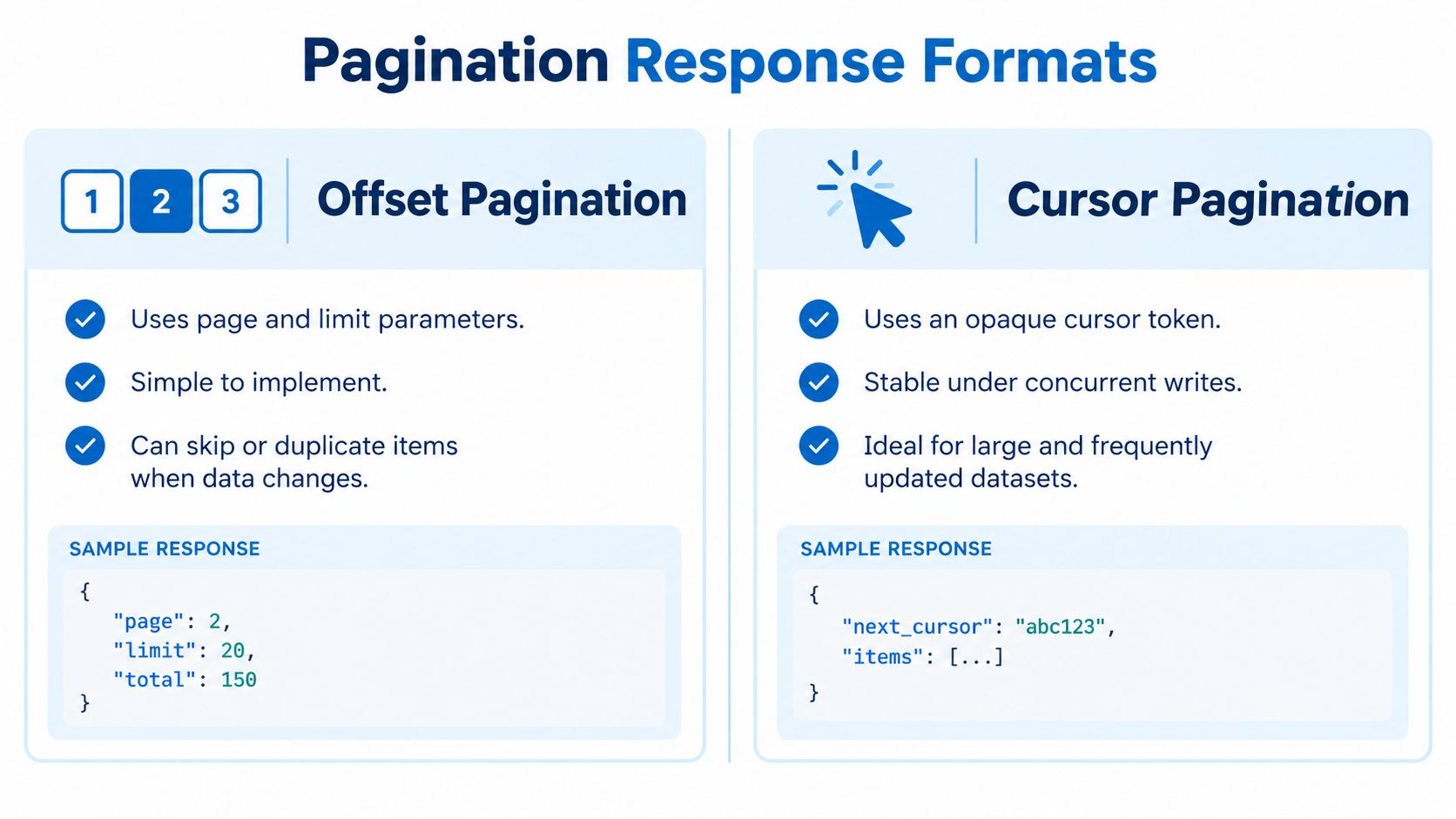
Define the consistency rules
A response can use either style and still leave clients confused if it doesn't document the operational behavior. Specify whether the cursor is opaque, whether results are snapshot-consistent, and what the client should do if a cursor expires. Define how clients detect exhaustion, such as an explicit has_more field or the absence of a next cursor.
Be deliberate about total. An exact count may be expensive to compute, stale by the time the client uses it, or misleading for a distributed collection. If the count is estimated or omitted, say so in the API documentation rather than letting clients assume it's exact.
For a changing billing or validation list, a cursor response might look like this:
{
  "data": [
    { "id": "item_123", "status": "validated" }
  ],
  "meta": {
    "has_more": true,
    "next_cursor": "opaque-token"
  }
}
The body gives the client a next step without claiming a precise total. It still needs documented ordering and replay behavior, especially if a client may retry a page request after a network failure. Without those rules, pagination can create gaps or duplicates even when the JSON itself is valid.
Error Response Formats with Machine-Readable Codes
An error message may be readable and still be unusable for automation. If a client has to inspect text to distinguish invalid input from an authorization problem or an upstream outage, small wording changes can break its behavior. A stronger contract separates the HTTP outcome from stable, machine-readable identifiers and instance-specific context.
RFC 9457 defines a JSON problem-details format for HTTP API errors and assigns it the application/problem+json media type. Its core members are type, a URI identifying the problem class; title, a stable short summary; status, the HTTP status; detail, context about the specific occurrence; and optional instance, which identifies that occurrence. Extensions can carry domain-specific fields such as code, field, or retry_after (RFC 9457 Problem Details for HTTP APIs).
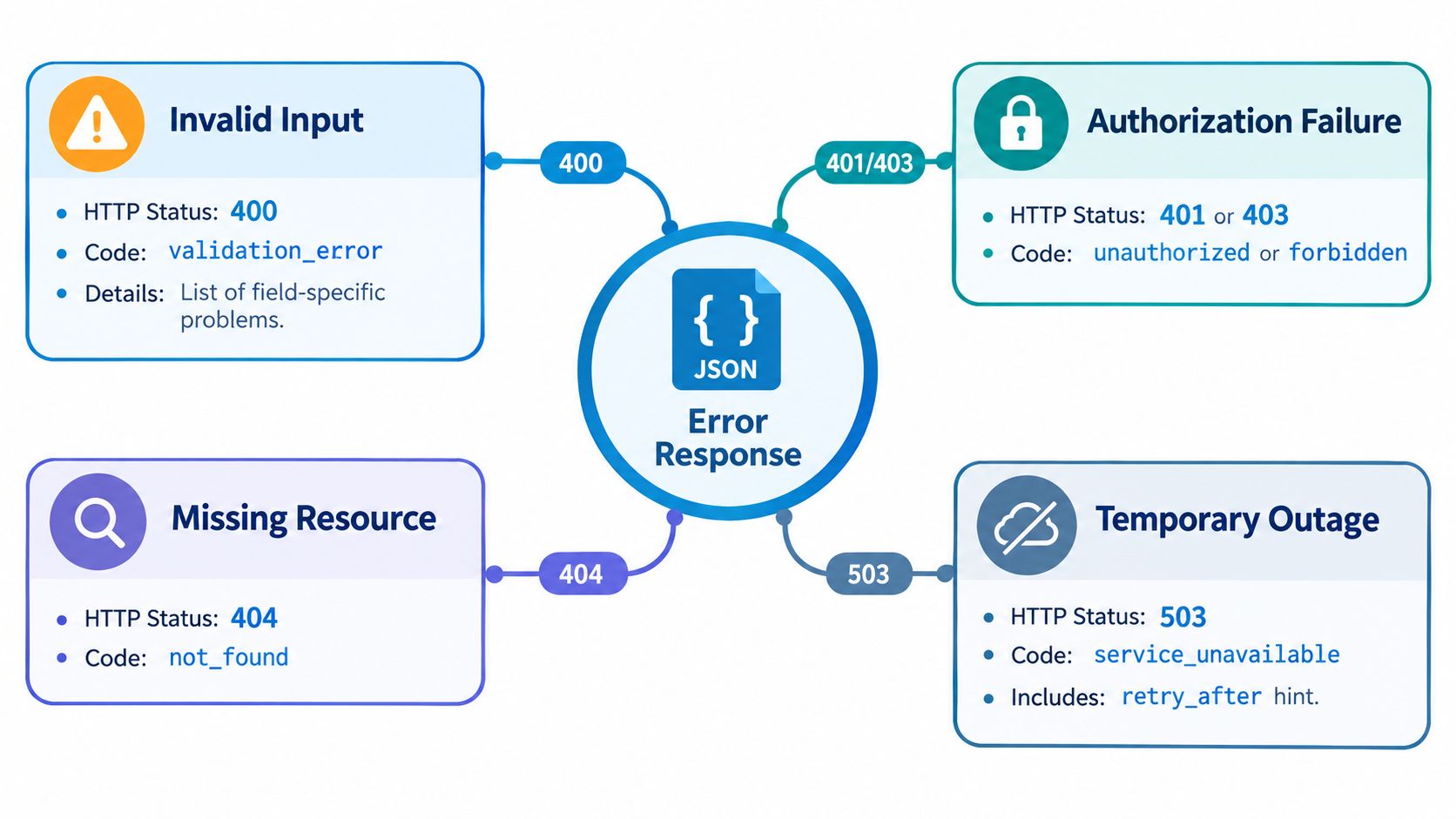
A validation endpoint might return:
HTTP/1.1 422 Unprocessable Entity
Content-Type: application/problem+json
{
  "type": "https://api.example.com/problems/vat-invalid",
  "title": "Validation failed",
  "status": 422,
  "code": "vat_invalid",
  "detail": "The supplied identifier failed country-specific validation",
  "request_id": "req_123"
}
The actual HTTP status and the body's status must agree. The code should remain stable enough for programmatic branching, while detail can explain the specific failure in human-readable terms. Don't put secrets, internal stack traces, or upstream service diagnostics in client-facing detail.
Make retryability a documented decision
A domain code can distinguish errors that share a broad category. For example, vat_invalid can indicate input the customer can correct, while service_unavailable can indicate a temporary dependency failure. A client shouldn't reject a legitimate customer because an authority is briefly unreachable; it may need to defer validation or use a defined fallback instead.
Conversely, a retry shouldn't be the default response to permanent input errors. Document which failures are retryable, what conditions should trigger a retry, and whether an extension such as retry_after provides timing guidance. RFC 9457 gives a standard structure, but it doesn't define those domain-specific behaviors for your product. Teams still need a reliability model and client guidance that match their workflow.
A useful way to review an error contract is to ask whether the client can identify the cause, choose an action, and report the incident without interpreting brittle prose. If it can't, the schema needs clearer codes or more precise documentation.
Content Negotiation and Media Types
A JSON body doesn't fully identify its own representation. The response headers tell the client how the server intends that body to be processed. In particular, RFC 9110 defines Content-Type as the header that indicates the media type and processing format of the enclosed representation (RFC 9110).
For a regular JSON response, declare a JSON media type, commonly application/json; charset=utf-8. For an RFC 9457 problem document, use application/problem+json. That distinction helps clients handle errors as a standard problem representation rather than assuming every JSON body follows the success schema.
Coordinate Accept and Content-Type
The Accept request header expresses which media types a client can process. The response's Content-Type declares what the server returned. Clients should send an Accept value that matches the formats they support, and the API should document whether it honors negotiation or always returns JSON.
Media type isn't a substitute for the status code. An error response can have an appropriate error status and an application/problem+json body. A successful response can return application/json. Clients should use the status to understand the operation's outcome and the content type to interpret the representation.
One important exception is a successful response with no body. RFC 9110 says 204 No Content responses must not include content; the same no-content rule applies to 1xx and 304 responses. Don't attach an empty JSON object to a 204 and expect it to mean the same thing as a JSON representation.
Make the contract executable
OpenAPI descriptions should document each response with its status, media type, and schema. Map object properties, array item schemas, and constraints such as minimums and maximums to the relevant media type. Include error responses and empty-body cases, not only the happy path.
A stable schema should also define predictable property types and nullability. If a field can be null, clients shouldn't have to infer that from occasional production responses. Clear declarations give generated SDKs, validation, mocks, and contract tests a shared basis for checking behavior. The goal isn't to make every response elaborate. It's to make the response predictable enough that clients can parse it without guessing.
Example Schemas and JSON Snippets
These examples show how the status, media type, and body fit together. They're illustrative schemas, not universal requirements: an API should document the choices it makes and apply them consistently.
For a retrieval that returns a representation, an enveloped success response might be:
HTTP/1.1 200 OK
Content-Type: application/json; charset=utf-8
{
  "data": {
    "id": "company_123",
    "name": "Example Company",
    "country": "DE"
  },
  "request_id": "req_abc"
}
The resource is separated from request metadata, so the client can treat data as the returned object. A simple endpoint could instead return the company object directly, as shown in the envelope comparison above.
For a list that uses cursors:
HTTP/1.1 200 OK
Content-Type: application/json; charset=utf-8
{
  "data": [
    { "id": "record_123", "status": "validated" }
  ],
  "meta": {
    "has_more": true,
    "next_cursor": "opaque-token"
  }
}
The client uses the cursor according to the ordering, expiration, and replay rules documented by the API. It shouldn't assume an exact total unless the contract promises one.
Match the body to the operation
For a successful operation that creates a resource, return 201 Created with a representation if the client needs the created object. For a successful operation with no response body, use 204 No Content and omit the body. The status should describe the outcome; don't use an empty object to obscure whether the operation returned a representation.
For a failed validation, a problem-details response can be:
HTTP/1.1 422 Unprocessable Entity
Content-Type: application/problem+json
{
  "type": "https://api.example.com/problems/vat-invalid",
  "title": "Validation failed",
  "status": 422,
  "code": "vat_invalid",
  "detail": "The supplied identifier failed country-specific validation",
  "request_id": "req_123"
}
A practical API design reference can help teams compare naming, body, and documentation conventions; BroLabel's page on conventions for APIs is one such resource. For a domain-specific response example, see the VAT validation response guide.
| Scenario | Status | Body style | Key fields |
|---|---|---|---|
| Retrieve a resource | 200 |
Bare object or envelope | Resource properties, optional request metadata |
| Create a resource | 201 |
Resource representation | Created resource data |
| Return no representation | 204 |
No body | None |
| Continue a changing list | 200 |
Envelope with pagination metadata | data, has_more, next_cursor |
| Report a validation error | 422 |
Problem details | type, title, status, stable code, useful detail |
| Report a temporary outage | 503 |
Problem details | Stable error code and documented retry guidance |
Quick Reference and Cross-Reference Guide
Use this checklist when reviewing a response contract or designing a new endpoint:
- Match status to outcome. Use the code clients need to make a first decision, then use the body to explain the result. The status taxonomy discussion above covers the common success and failure cases.
- Declare the representation. Set
Content-Typeto match the response body, and document how clients can request supported formats throughAccept. - Choose a body shape deliberately. Return a bare object when the resource is the complete representation; use an envelope when metadata or collection state needs a stable home. The trade-offs are covered in the envelope comparison.
- Document pagination behavior. State the ordering, continuation, exhaustion, consistency, and expiration rules. The pagination guidance explains why fields alone aren't a complete contract.
- Use structured errors. Keep problem details, application codes, and the HTTP status aligned. The error-format guidance covers classification and retry behavior.
- Keep schemas stable. Document property types, nullability, error shapes, and empty-body responses so clients don't need to infer them.
Check client behavior, not just examples
A sample response is only useful if it matches what the service sends. Test successful retrievals, creation, empty-body success, invalid input, authorization failures, missing resources, rate limiting, and temporary dependency outages. For each case, verify the HTTP status, media type, body schema, and the action a client should take.
Common contract failures are easy to recognize once you look at all the layers together:
- HTTP 200 for an application-level failure. Fix the status and use a structured error format.
- Human-readable text as the only error identifier. Add a stable machine-readable code.
- Pagination metadata with no consistency rules. Document continuation and concurrent-update behavior.
- A body attached to
204. Return no content, as required by HTTP semantics. - Examples that disagree with the live API. Keep documentation, schemas, and tests aligned.
For checkout and invoicing integrations, test the distinction between invalid tax data and a temporary validation outage before putting an API response in charge of an exemption decision. TaxID provides a REST API that validates VAT and company identification numbers and returns structured JSON with machine-readable error codes. Visit TaxID to review its API documentation and see whether its response contract fits your billing or validation workflow.