You're in the checkout flow, a customer has typed a VAT number, and the screen is waiting while your app asks VIES whether that business is registered. The request comes back as a SOAP error, then a timeout, then another response your parser can't trust. At that point, the core question isn't “Is the number valid?” It's “What should billing do when the registry, the network, or the response format gets in the way?”
That's why a VAT validation service is more than a lookup widget. It sits between your app and a patchwork of national tax registries, turns a fragile remote check into structured data, and gives checkout, invoicing, and finance systems something they can use. If you're picking a VAT API for a B2B stack, you're really choosing how your system behaves when reality is messy.
Table of Contents
- Why your checkout stalled on a SOAP error
- What a VAT validation service actually does
- The compliance and fraud stakes behind every lookup
- Inside a VAT validation request, step by step
- Build vs buy for VAT validation in a small SaaS stack
- What to evaluate in a VAT validation service
- How TaxID fits this checklist
- Storing validation evidence so an audit cannot surprise you
Why your checkout stalled on a SOAP error
The failure usually shows up at the worst possible time. A buyer is ready to pay, the VAT field looks correct, and the call that should have confirmed the number either times out, returns XML your client doesn't like, or disappears into a retry loop that nobody designed for business hours. That's not a tax problem first, it's an integration problem first.
The trap is assuming validation is a single yes or no question. In practice, your checkout depends on a remote registry, transport reliability, parser behavior, and your own fallback logic, all before anyone even decides whether reverse charge applies. If the registry is slow, your app still needs a sane state.
Practical rule: treat VAT validation like any other external dependency that can fail, not like a local form field check.
That's also why people reach for a dedicated wrapper instead of calling the EU service directly. The wrapper can hide SOAP, normalize errors, and keep your billing logic from hard-coding one-off country behavior. If you've already hit that wall, the pattern in this VIES service unavailable guide will feel familiar.
The mental shift matters. A VAT check is part tax compliance, part distributed systems hygiene, and part evidence collection. Once you see it that way, the rest of the design choices start making sense.
What a VAT validation service actually does
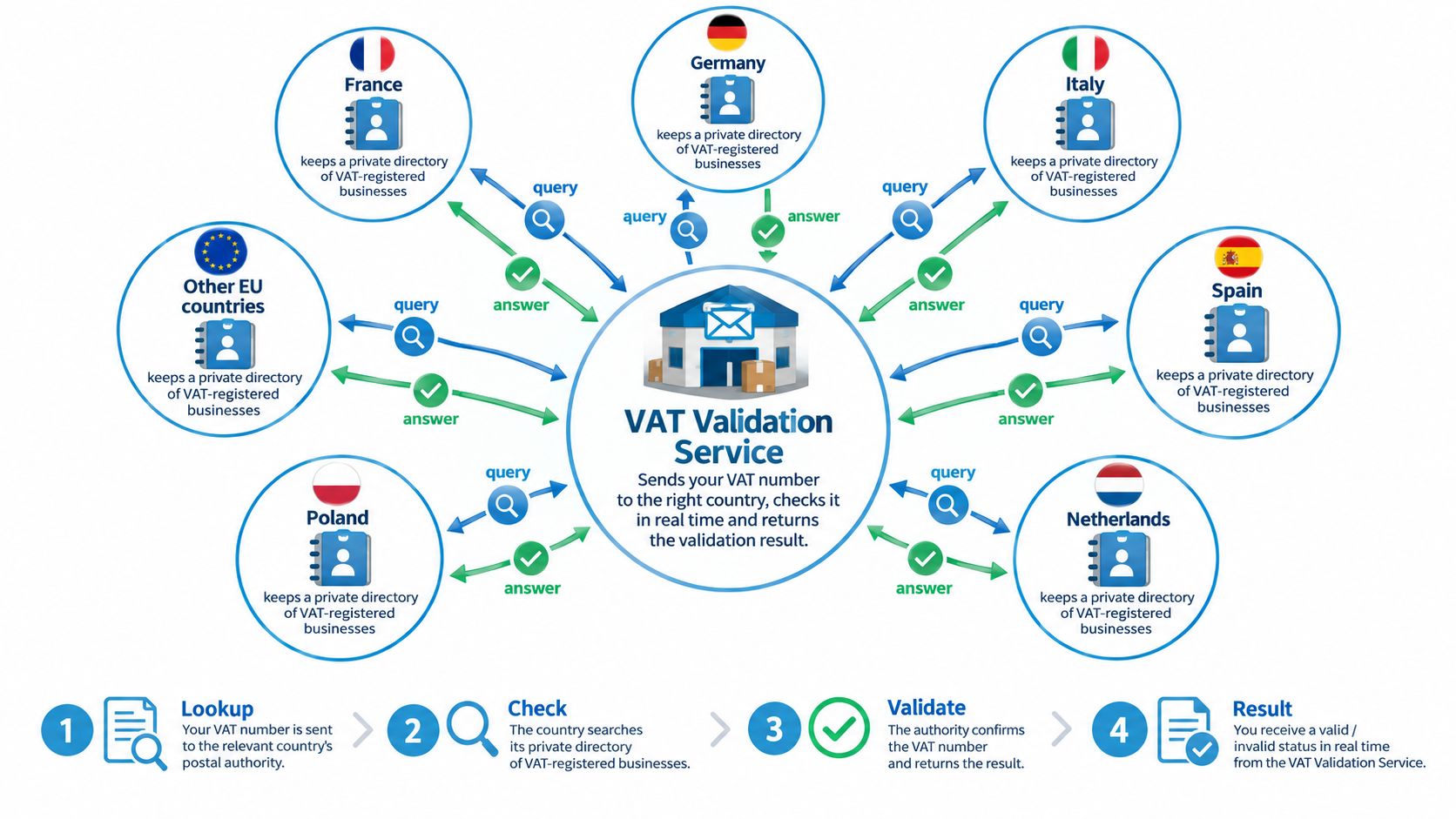
Think of each EU country as its own postal authority with a private address book of VAT-registered businesses. Your app doesn't get to browse those books directly. It asks a shared exchange, and that exchange relays the question to the right authority, then hands back what it was able to confirm.
The moving parts
At the input level, a service usually takes a country code and a VAT identifier. Before it ever talks to a registry, it should check that the pair makes sense syntactically. That local check is cheap, fast, and useful because a malformed identifier should fail immediately rather than consuming upstream capacity.
The output is where teams get sloppy. There are at least three materially different outcomes, valid, invalid, and technically unavailable. A valid result means the remote registry accepted the number and, where available, returned identity fields. An invalid result means the authority rejected the number. A technically unavailable result means the system could not establish validity either way.
The distinction sounds subtle until your billing code has to choose a path. If you collapse “unavailable” into “invalid,” you'll charge VAT in situations where you should have retried. If you collapse “unavailable” into “valid,” you'll grant reverse charge on a number you never confirmed.
A good service also returns structured fields, not just a blob of text. That usually means the normalized VAT number, the query country, a timestamp, the returned company name and address when available, and a stable response code your app can branch on. If you want a broader comparison point for how business identifiers are handled across systems, the startup guide to EIN and DUNS is a useful adjacent read.
VIES has been around since 1992, with an open interface for automated verification becoming available in 2005 (EU legal background). That history explains the shape of the problem. The tax rule is modern commerce, but the infrastructure still behaves like a federation of national systems that happen to cooperate.
The compliance and fraud stakes behind every lookup
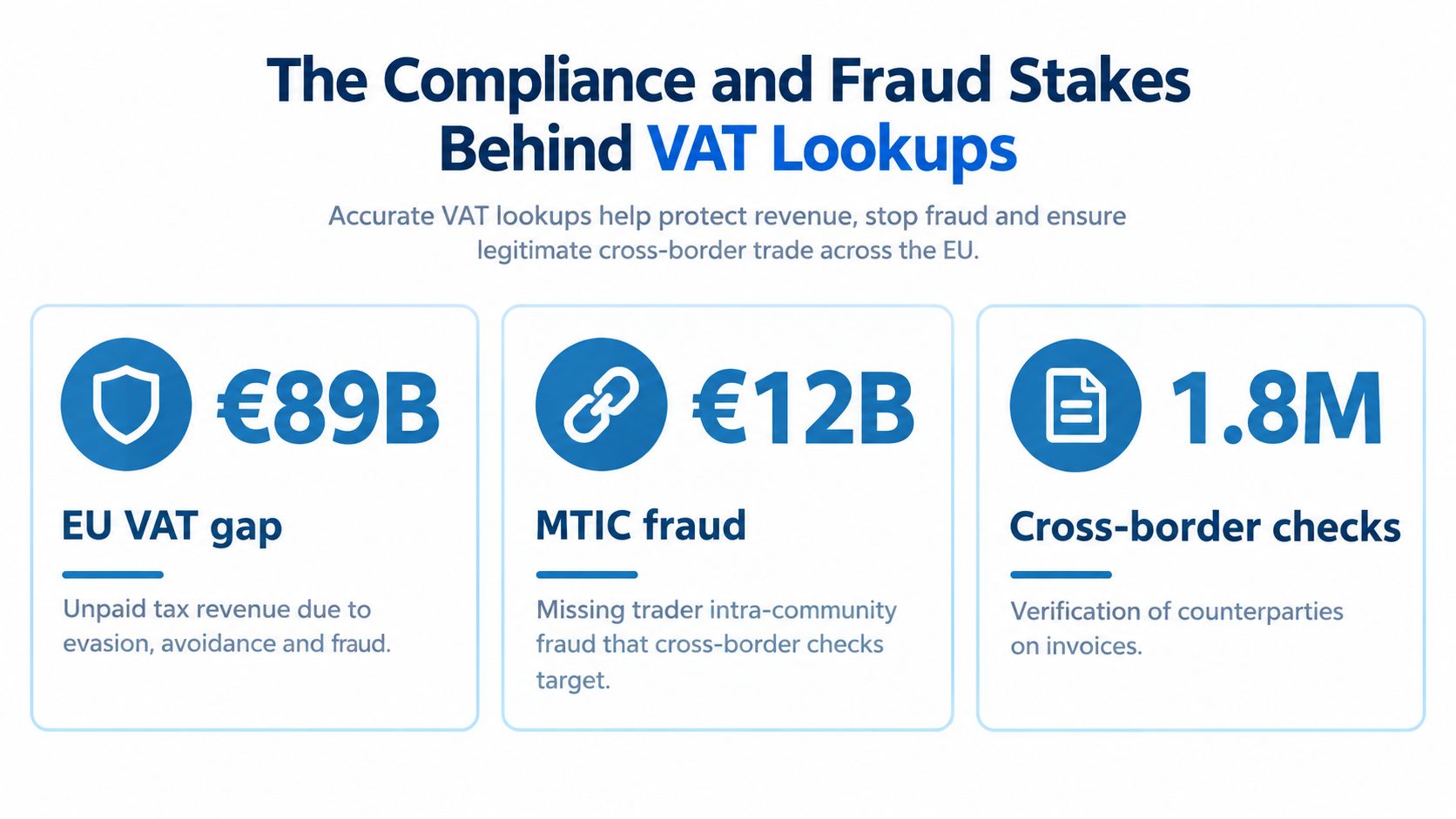
VAT validation exists because cross-border tax risk is real, not because teams enjoy extra form fields. The European Commission estimated the EU VAT compliance gap at EUR 89 billion in 2022, equal to 7.0% of total VAT liability, and it also estimated Missing Trader Intra-Community fraud at between EUR 12.5 billion and EUR 32.8 billion annually during 2010 to 2023 (European Commission figures). A lookup isn't solving all of that, but it is one control that helps document who claimed B2B status and whether that claim held up at the time of invoice.
Why finance and product teams both care
Finance teams care because they need defensible records. Product teams care because the checkout experience can't turn every edge case into a manual workflow. When a buyer claims to be VAT-registered, the system has to decide whether to treat that claim as support for reverse charge or as a signal to charge VAT.
That's why reverse charge is a downstream consumer of validation, not the entire point of it. A valid response helps establish the buyer's tax status for cross-border B2B treatment, but it doesn't decide the whole tax outcome by itself. Customer location, transaction type, and place-of-supply rules still matter.
A validation call is a control, not a conclusion.
The same logic applies to marketplaces and supplier onboarding. A supplier VAT check is often there to reduce fraud exposure and keep invoice handling clean, while a buyer-side check is there to support tax treatment at checkout. The workflow changes, but the risk model is the same.
Inside a VAT validation request, step by step
A clean implementation starts with local checks. Verify the country code and VAT number pattern first, because there is no reason to send obvious junk to a registry that may already be slow or unavailable. That local gate gives your app deterministic errors for simple mistakes instead of pushing every failure upstream.
After syntax passes, the request goes to VIES, which forwards the lookup to the relevant Member State's VAT registry. The result depends on the national system behind that country code, so a lookup can behave differently by country, or fail cleanly when a registry is having trouble. A positive response may include the business name and address when the authority exposes those fields (service behavior and evidence handling).
What the response should drive
A useful API returns more than “valid” or “invalid.” It should also tell you when a registry is down, when the response is partial, and when the system could not make a definite call. An app that can retry safely avoids making the wrong tax decision by default.
Persist the outcome with the timestamp, country code, normalized VAT number, returned identity fields, and a correlation ID. That record becomes your evidence trail later, especially when invoicing needs to show why reverse charge was applied. EU invoicing rules require the customer's VAT identification number when the customer is liable for tax and the words “reverse charge” on reverse-charge invoices (reverse-charge invoice wording requirements).
A practical response vocabulary looks like this:
- vat_invalid for a genuine invalid number
- service_unavailable for a registry or transport failure
- country_format_mismatch for a malformed pair that never should have been queried
Those codes let checkout, invoicing, and compliance systems act without parsing provider text. If you want a deeper integration pattern, the REST API integration guide is a practical companion.
Build vs buy for VAT validation in a small SaaS stack
Building this yourself sounds simple until you list the actual work. You need country-specific format checks, SOAP handling, retries, a cache with expiry rules, a stable error vocabulary, and logic for when a national registry is slow or offline. You also need to keep your implementation aligned with changing registry behavior over time.
Buying a service shifts that operational burden to someone else. You still own the tax decision in your app, but you don't have to maintain the plumbing that gets you a reliable answer. The tradeoff isn't philosophical, it's about where your team wants to carry complexity.
What in-house ownership really includes
An internal build means someone has to own the edge cases when a registry times out, when cached data gets stale, or when the response is technically successful but operationally useless. It also means your team has to decide how long to keep successful validations, how to classify failures, and when to re-check a record outside the checkout path.
That's the hidden cost. The first version is usually fine. The maintenance burden is what grows.
If you're a founder or small team trying to move fast, the bottleneck is often staffing, not code. A hire developers from latam resource can help if you're building in-house and need a team that can own the wrapper, but the same question still remains, do you want to own the failure modes too?
The better framing is this. If your business wants VAT validation as a small internal utility, keep the scope narrow and be honest about the maintenance surface. If your business needs it in checkout, invoicing, and supplier workflows, the wrapper becomes infrastructure, not a side task.
What to evaluate in a VAT validation service
A checkout that stalls on a VIES lookup usually points to a service that treats VAT validation like a simple yes-or-no check. In practice, it behaves more like a distributed system with uneven country coverage, intermittent outages, and responses that are useful only if you can trust their context. Coverage is still the first question, but it is only one part of the decision. A service should support all 27 EU member states through VIES and also cover the extra countries your customers ask about, because many SaaS teams do not operate in a purely EU-only world. For a walkthrough of the API surface itself, see this VAT number validation API guide.
The next question is how it handles the messy parts. A production-grade service should reject malformed country and number combinations before it makes a remote call, cache successful responses for a bounded period such as 24 hours, and separate invalid, timeout, unavailable, and rate-limit cases so downstream systems can choose between retry, manual review, and charging VAT. That kind of error split matters because a temporary registry failure is not the same thing as a bad VAT number. EU Commission VIES consultation statistics make the scale of that upstream dependency clear.
Buyer checklist
- Format handling: Does it validate country-specific structure before making remote calls?
- Failure modes: Does it separate invalid, unavailable, timeout, and rate-limit cases?
- Caching behavior: Is the TTL explicit, and does the response carry the original validation timestamp?
- Response shape: Are name, address, status, and error codes returned in machine-readable fields?
- Checkout performance: Is the cached path fast enough that billing does not feel laggy?
- Docs and SDKs: Can a single developer wire it up without a support ticket?
One thing to keep in mind is that VIES reliability is not uniform. Country registries can respond differently, and a result that looks clean at the API level may still leave you without enough evidence for billing or audit work. A good service should make that uncertainty visible instead of hiding it behind a single success state.
Country workflow differences worth checking
| country group | what changes in practice | notes |
|---|---|---|
| EU member states | VIES coverage and registry behavior vary by country | plan for timeouts and retries |
| UK | separate post-Brexit workflow | often handled outside VIES |
| Switzerland | outside VIES, but often needed in SaaS billing | useful for cross-border invoicing |
| Norway | outside VIES, but often needed in SaaS billing | common in regional B2B workflows |
| Australia | outside VIES, but often needed in SaaS billing | broader billing coverage may require it |
The point of the checklist is simple. A service should help you make a defensible decision with enough context for checkout, invoicing, and evidence storage, not hand you a bare yes or no.
How TaxID fits this checklist
TaxID fits this checklist because it is built for the same operational reality. It exposes one REST endpoint for all 27 EU member states via VIES, plus the UK, Switzerland, Norway, and Australia, so a team does not need to stitch together separate registries to cover common B2B billing cases. The API returns validation status, company name, and address in structured JSON.
Reliability starts before the remote request leaves your stack. TaxID performs country-specific format checks locally, then uses Redis-backed caching with a 24-hour window for successful lookups. That keeps repeated validations predictable at checkout, where even a short pause can feel like the page is hanging.
What the integration looks like in practice
The response shape is meant for downstream systems, not just someone reading logs. Machine-readable error codes like vat_invalid and service_unavailable let checkout, invoicing, or finance decide whether to retry, flag the record for review, or charge VAT. That is much easier to automate than parsing provider text.
The useful part is that a small team can treat validation like a normal dependency, not a separate resilience project. The free tier includes 100 monthly validations with no credit card, which lowers the bar for indie teams and early SaaS products that need to ship, test, and learn.
Use the API result as a state input, not a final tax verdict. Billing still has to apply customer location and transaction rules before deciding whether reverse charge is appropriate.
A simple rule of thumb helps here. If you need a VAT validation layer that behaves like infrastructure, TaxID is built for that job. If you only need a one-off manual lookup, the extra structure is probably more than you need.
Storing validation evidence so an audit cannot surprise you
A valid response is the start of a record, not the end of one. The European Commission says VIES validation confirms a customer's VAT identification for intra-Community transactions, and traders can keep proof of the check for tax authorities (Commission service guidance). That makes your evidence model part of compliance, not just engineering hygiene.
The useful record is plain enough: request timestamp, country code, normalized VAT number, returned company name and address if available, response code, correlation ID, and the invoice or checkout session the result supported. If you cache a response, store the validation timestamp with it so no one mistakes an old hit for a fresh government confirmation.
Why logs need to outlive the request
A validation API can help you make the checkout decision in the moment, but audits arrive later. By the time finance opens the file, the original session context may already be gone unless you saved it deliberately. Immutable logs and evidence schemas solve that gap.
Ambiguity matters too. A response that says “valid” but leaves out identity fields is not the same as a response that returns name and address. The tax treatment may still work, but the audit trail is weaker, so your storage should preserve what the authority returned, not only your app's interpretation.
ViDA raises the stakes further. The EU adopted VAT in the Digital Age in March 2025, and the rollout is meant to progress over the following years as cross-border B2B reporting changes take shape (ViDA adoption and rollout timeline). Even if your workflow works today, evidence discipline will matter more, not less.
If you want a VAT validation layer that gives you structured responses, caching, and clearer failure handling without tying your team to SOAP quirks, take a look at TaxID. It is built for B2B billing, checkout, and invoice workflows where the validation result has to be usable, not just technically returned.